26 April, 2013

Gun Machine is Good Medicine


Gun Machine, like most of Warren Ellis' work is about shoving interesting people into a situation that is both familiar and chock full of  big ideas that one would never think to associate with something as pat and done as a murder mystery. Law and Order this is not.


With Ellis it's always been less about the results than it seems to be about this passage of time between the covers. There are exceptions to that, but you look at Planetary or Crecy and you see that the grand story takes a backseat to the plot. The moment is more important than the sum total. He is less interested in presenting the why of an interplanetary spaceship hidden underneath the pavement of New York City than he in presenting what that would do to a guy. The depths of his work come out of passing through the world and not out of some traditional conclusion. He rarely ever bothers with telling you that this all means something, instead he lets you sort it out from the puzzle pieces he left behind.

Gun Machine is very much in that style. It seems to be about what these characters are presently dealing with rather than how all of the pieces come together. It is about gears, not the machine. This approach to a procedural prevents the story and all of its threads getting in the way of its main characters. You see this the various history lessons it presents (that seem to have only a tangential baring on the plot) and you see it in how they go about solving the crime. There aren't any hard revelations, there is just the continuation of these characters putting work into this horrific murder contraption that spans New York City. Rather, there's just people dealing with their moment to moment problems. Sometimes those moments involve horrible, roccoco murders.

And you see this in the fact that the serial killer of the story doesn't even have a name (and it even says in the book that it doesn't seem to matter). It isn't about who he is or why he's doing it, the story is about what he is doing and how to stop him.

Another one of Ellis' strengths are his characters. While all great stories tend to have really memorable characters, there is just something special about characters like Spider Jerusalem or Jakita Wagner or just about anyone from Agents of HATE. He writes vulgar, violent characters that are fun to listen to and who you want to hang out with, even if they are utter maniacs and Gun Machine has all of that in spades, even if they aren't as cranked as high as the kind of characters that populate his comic book work (or even Crooked Little Vein, from what I remember).

Ellis' John Tallow, like James Bond, seems to have a name that is designed to be forgotten. He's a terminally uninteresting person and has spent much of his life working at that.

Ellis doesn't seem to be too interested in Tallow's life. That might be because he doesn't have one. The lifeless detective is a blanched human being just short of being a cipher. But being a cipher at least shows the hand of the author, however lazy, Tallow is just, well, he's just a nobody. He's a cop that, like so many people seems to be in the place he is because life carried him along like a piece of driftwood.
Another character that Tallow reminds me of is another sluggish, troubled detective, which is Jo Nesbo's Harry Hole
In that way he is different from the long tradition of troubled detectives. Tallow might not be as complex as a Harry Hole (by the very nature of Hole being featured in nearly 10 novels), but he also cannot be accused of being cliched, except by the laziest and, I'm sure, simple of critics. It certainly is brave to write a main character with no distinguishing personality and it's certaintly a sign of skill if the author can get away with it like Ellis does.

And I want to see the further adventures of John Tallow. Though, there is another difference, which is that Nesbo avoids giving his audience hard and definite ends to al of his book's crises because he has a series to continue and Hole has a life to live beyon this one book. Ellis, on the other hand, just doesn't seem that interested.

What Tallow and this world exists as is perfectly fine. Yet, I want to see more of the batshit insane CSU personnel and I want to see Ellis contrive a way to make Tallow into some kind of a human being, which is something that Tallow seems desperate to try and avoid.

In a way it doesn't matter as this book is all about present action. Seeing Tallow in the future where the past begins to creep into his life would be interesting to see, I also just want more lines like “I am a Crime Scene Unit detective for the New York City Police Department, you heinous fucking mongoloid and there is nothing I cannot do.” If that means that some of the quality of the story is going to suffer, then I guess I'll just have to be okay with that.
On the downside, too much of the story relies on coincidences that a first year screenwriting student would be forced to hack out.Then again it's these coincidences that keep the book from getting bogged down. They're depressingly convienient plot devices. While the plot and the characters are what stand out in this book, they also stand out because they have to do most of the heavy lifting. In many ways the story is an excuse to get their people into rooms with each other and to explain weird things about New York's crypto-geography and that's all well and good, but I don't know that's what the novels were built for.

I still wonder if the novel is Ellis' artform. I do not that even if it isn't one of his mastered mediums, he can still crank out a worthwhile novel that still has all of the massive ideas and creative cursing that you come to expect from the man who dreamed up Spider Jerusalem. Though, creative cursing isn't exactly what one goes to books for (or even comic books for that matter). Ellis is lacking something in this book. As much fun as it is and as many wonderful ideas are on display, none of it adds up to something more significant than just a kooky murder mystery. I guess I'm okay with that.


I just re-read Ennis' Global Frequency, which was recently re-printed in a single trade in its entirety. It's a fantastic comic book and a perfect example of what the medium can do. As a book it moves like a hyper-manic love child of Mission: Impossible and The Twilight Zone. This book introduces these amazing ideas and then casts them off as soon as the story moves along. It isn't in love with its own cleverness, just in telling the story. Besides being a good yarn, it also might make one wonder why the fuck the X-Men need 27 issues and four cross-over books to tell the same kind of story (but with less thrills, emotions, and cost).

I mention this book in the same breath as Gun Machine because, while they are completely different kind of books, they share the same DNA. They are both stories about ideas and these ideas, in turn, help move the plot. The only real difference is that Global Frequency doesn't ever feel like a character has shown up simply to let you know about something rad. There simply isn't enough space for that sort of thing.

Global Frequency reads like a form of Ellis' style and interests that has been boiled down to a crystal form that is either perfectly suited as a weapon or a high-quality narcotic. It takes all of the dark corners that Ellis' stories exists in and only shows us them in these fast-paced forms that are already half-way finished by the time we get to them.

They are almost all tinged with Ellis' unshakable sense of hope, as well. He isn't an optimist, not exactly, but he is a guy that seems to believe that if the right people are there they can outsmart, outfight, outkill, and outlive the worst that the universe has to offer.

While it is also infected with Ellis' hyper-competent, benevolent dictator/Nietzchian superman character that he loves so dearly (ie: Men and women so intensley skilled that you deserve to be murdered by a robot for even bothering to ask who they are and why they are yelling so loud. See: Spider Jersualem, Elijah Snow, and Miranda Zero and maybe the bad guy in Gun Machine if he wasn't, you know, a baddie). As a comic book archetype, there are worse people to spend time with. At least they help stop cyborgs or solve mysteries about angels or gouge out each others' eyeballs.

Reading these two books in such close proximity, though, reminds me why I like Ellis so much and why he is so well regarded in the comics community (or at least why he should be). This trade also serves as is another piece proving that Ellis is not only one of the great storytellers living, but he is also one of our great idea men.


(And not to end this on a love in Wolfskin and Black Summer are both swollen dog corpses that were drowned in a shit-bog. Avoid these comics at all cost. One is lifeless to the point of being offensive and the other is incoherent dreck only serves to remind one that there are stories that exist that have beheadings for a reason.)

21 April, 2013

So, This is On TV


There's a scene in this movie where a Holocaust survivor is singled out by the Muslim terrorists, along with all of the other Jewish passengers.

Now keep in mind this is all scored to an overbearing 1980's synth soundtrack and was immediately preceded by Chuck Norris being re-recruited by the Delta Force to a score that would have seem not out of place in Team America: World Police. It's completely ridiculous and it'd be offensive if it wasn't clear that their intentions were sincere and, oh and if it hadn't actually happened in real life.

And. . . I think it got to me, even though I was laughing at a bad child actor shout "Please don't take my daddy," somehow through all of the bad music and character actors, I still got a little tingle. I guess that's a sign that this movie might just work.

Now Lee Marvin is suiting up to take back a plane chock full of hostages. Let's hope he gets out of this okay. Oh, hey, Robert Vaughn is in this movie.


That's never a bad thing.

13 April, 2013

Adventures of Imperial Glory!

A Quick Thought About the Lives of a Bengal Lancer--


This movie isn't a great one. The Lives of a Bengal Lancer in terms of Imperial Adventure moves falls below GungaDin, but above The Northwest Frontier (and probably well above Carryon Up the Khyber if the You Tube clips are accurate). There are certain kind of movies that I am drawn to though, and regardless of the quality I have to watch them. I've been over this before, but besides the obvious choice of WWII movies, movies about Imperial adventure are high on the list. It's a problem I have.

Outside of my own ridiculous solipism, movies like The Lives of a Bengal Lancer meet a larger need. They're the grease that keeps movie studios going between bouts of costumed affair dramas and biopics about dead jerks. Like the Western or the War movie or the screwball comedy, it meets a certain need, it stars a certain kind of actor, and it gets in and out without you having to think too hard. It's old fashioned film making and for better or worse it represents the kind of movie they don't make anymore.
And considering that it comes on a dual-disc with the movie Beau Geste,, I think that means that this isn't the most popular Gary Cooper film of all time. . . except maybe with Adolf Hitler, apparently (then again A Matter of Life and Death comes similar packaging and that movie is just about perfect). This movie is no A Matter of Life and Death, though, what it is is the perfect B-picture. It meets every need that it is expected to meet and it does it without you really ever having to pause and be embarrassed by the fact that this movie has a dramatic use of brown face.

(To be fair the brown face scenes are awesome. Hear that, liberal elite? Awesome. Also: It is totally grounded in historical fact. Chew on that, hippies.)

What I like is its expedience in storytelling. It's the kind of thing movies like it (or their distant relatives) should take note on. There are no B-plots that don't get resolved or flow into the main story. There aren't any ruminations on what this all means or the impact of their mission unless it directly

This film has no fat. A butcher would be proud.

It seems that movies forgot what they were. Nowadays everything is getting longer and longer. I suppose it is as a response to television and video games being what they are (3d is also a symptom of this fear). They want cinema to be more cinematic and one thing TV can't do is make something that's three hours long.

Looking at this movie (and many more like it), I think that they're missing the point. You don't need a one-hundred forty minute running time to make a movie cinematic. Since the birth of cinema they've made good films that are good partially because they're short and to the point. Making them longer, to me, is an attempt to treat the wrong symptoms.

There's also the old adage of quality over quantity, but I'm being a hypocrite here, so let's just move quietly along, shall we?

Another reason this movie benefits from its percieved brevity is that we don't get much of a chance to mull on the fact that this movie tacitly supports the subjugation of about a fifth of the world's population. That tends to put the damper on enjoyment, as a rule. Its storyline is also about as pat as a movie like this can get. There's no surprises, there's no real insight, it's just a story that follows three men (a jaded veteran, a cocky upstart, and an unproven rookie) as they take on an Afghan warlord (I should make a list of that stock character's apperances. . .) and then the movie ends as soon as they've accomplished that.

It's a frolic. There's no substance, there's no real philosophy, there's just men doing their jobs and then a big bad guy with an accent dies at the end. In between there's some horse riding, aome costumes, a some outdoors, a dragon lady, and dialogue that ranges from glib irony to cloying sincerity. In short: It's an old fashioned adventure film. What more could a man want?

06 April, 2013

The Post-Apocalyptic Sci-Fi Comic You Didn't Know You Wanted


East of West is the craziest comic I've read since. . . well, the last time I read a Hickman comic.

East of West feels like a blend between a high-concept indy comic that you saw at a convention (and would likely never read) and the most low-brow, straight forward pulp to fall out of Image's ass in the mid-90's. Due to what alchemy, I do not know, the results are something rather amazing. Violent, oblique, and ambitious, and amazing.

Did I say it was amazing?

East of West tells the story of. . . I don't know what. There's a supernatural trio of murder machines (with a missing sibling) that exist in an alternate future where the United States was segmented into seven different nation and a nuclear war went down in the middle of the 21st century. Then there is a prophetic Mao Ze Dung and the president gets his head blown off. It's pretty good.

At the very least it's a fine first issue and considering how much of this world has yet to be revealed, I think this might end up being a very fine trade indeed.

My interest flagged slightly when the exact identity of the Four is revealed, which takes the mysterious power of these characters and then anchors them to one of the more well-worn pieces of Biblical mythology. It doesn't ruin anything, it just seems to present an answer where I didn't need or want one. Ideally, as the story unfolds, the intent and origin of the Four will reveal itself as something slightly different than that great Biblical quartet.

I know I throw the word “crazy” out quite a lot. Too much, probably. That's the trouble with not having an editor currently and that's the trouble of having the same thought over and over again. East of West is demonstrably a crazy book.

I know I've said it about Nowhere Men and I know I've said it about Prophet (hey, both are Image books, strange. . . ). It's true with this book too.

Ignoring psychiatric diagnoses for a moment, let me ask you a question: Is there anyone in comics doing as much varied and exciting work as Bryan Hickman is right now?
Between The Manhattan Projects, Secret, The Red Wing, his Fantastic Four run, and this I'm hard pressed to think of someone doing as many out-there projects as he is-- and that's without including his mainstream comic book work. At the risk of naming the Great Bearded One and bringing up all that name connotes, Hickman's current position in the industry reminds me of Alan Moore.

Time will tell if Hickman is also a bitter, old crank. We already know that he's a wizard, but that could mean anything.

You should read the first issue. It doesn't matter if you like science fiction or westerns or. . . whatever genre this actually is you need to buy it.

Another congenital defect of my writing is my repetition of the phrase “This is what comic books should be.” In this case it's still true. This is what a comic book should be. It's what the market needs more of.

At the very least I know it's what I need more of.

03 April, 2013

You Had Me at "A"


Man. I really need to rewatch Winter's Bone. And No Country For Old Men. And do some laundry. And stop drinking.

Man, I really want to see whatever the hell this movie is.

01 April, 2013

FUCK THIS MOVIE PART XXIV

Careful. This is important.


See that trailer? Congratulations, you saw the only good parts of The Raid: Redemption. What follows between the split second cuts is a moldering heap of nonsense, bad CGI blood, and follie work thrown into a blender,spat into, and then hard-boiled. Somehow the featureless, grey mush that pours out is considered a film by some. These people are art-criminals.

At some point I stopped watching the movie as it was intended and instead began to watch it in fast forward. After about five minutes of that (I don't think I missed much), I grew weary of that, too, and quit the entire project all together.

Don't watch this movie. Not drunk. Not high. Not with friends. Not ever. Roger Ebert was right. Everyone else is wrong. It's a nonsense movie. It's the kind of martial arts movie snobs mean when they say, “Oh, isn't that a martial arts movie?”

There's nothing interesting or redeemable at all about this film and I say that as a fan of violence. The plot is non-existent. The main character is a non-entity. The bad guys are just various tank top wearing goons that might have accidentally fallen out of a closeted bisexual's fever dream (nothing but long hair and a lack of sweat despite all his exertions). The main villain himself an out of shape man in a tank top. Even the set itself is a boring, nondescript place that makes you wonder if The Wire ever happened. Or if set design ever happened. Or if reality actually exists in a form that can be observed by any of the production crew at any point in their lives.

Hold on, I'm keeping back the vomit here.

Okay. Let's carry on.

If someone gets their throat slit it should mean something either because it's a horrible thing to happen to a person or because it is the culimination of a lot of other bad things. In this, like everything else in the movie, it's just a thing that happens. Regarding the violence, though, it's my love of violence in film that makes me loath this film just so much, because I've seen this damn thing done right.

That isn't awesome. That's grotesque in a way that is almost autistic in its misunderstanding of how violence works. Violence isn't awesome because it's on screen. Children get this. Why this director thinks that the popping of arteries devoid of context or meaning or emotion is awesome makes me think that he should be put in a home in the country and held down with a series of wet medical-grade blankets.

Then maybe someone should read a story to him, because there's a chance he's never actually encountered one in his entire life. (He is Welsh and they are a people in need of many things. And if this movie is any indication, literacy might have been one boon too many).

If you want a good movie about clearing a tower of criminals watch Die Hard. Or Dredd 3d.  If you're keen for trash, then go check out Fast Five, at least. And if you want an insane martial arts movie watch Ong Bak 2 (a film that involve pirates, child/alligator fights, ninjas, and Babar: King of the Elephants all within the first fifteen minutes), which, for its many flaws, does include things like people and set design in its overall aesthetic. If you want an Indonesian movie then check out Marentau, which isn't even very good either, but at least it has a heart. And a story. And, like things that exist in a place somewhere adjacent to the planet earth. Then it ends.

Fuck. Fuck.

Fuck this movie.

The only redemption to be found is watching a better movie afterwards. In my case it was The Lives of a Bengal Lancer. With you it could almost be anything.

22 March, 2013

Liam Neeson: Wolf Puncher is an excellent film

Before I get back to my usual ridiculous self, I'd like to be dreary for a moment here and talk about The Grey.


As you will recall, The Grey is the movie where we were all led to believe that Liam Neeson gets in a donnybrook with wolves and, while it is that, it's also an incredible film that is about much more than the trailer advertises. As it turns out, it's a harrowing, horrific tale about the pain of living and the meaninglessness of our our existence. Also, yes, there is some wolf-based terror somewhere in the middle there.

What's more is that if I made movies, The Grey is the kind of movie I'd like to make.

Despite my love of slick, big films (my movie collection is mostly science fiction, war, and samurai movies of all types), I do love naturalism (Now, I don't say "realism," that's a whole other bag of marbles). There's something about filming a movie in a down to earth fashion that appeals directly to my artistic sensibilities. I remember Jay from Red Letter Media said that about a movie that he enjoyed and I know exactly what he meant.

That particular feeling is rare. It's also very specific. As great as Pulp Fiction might be or Inception or Kung Fu Hustle, I don't know, When Harry Met Sally, they aren't the kinds of movies I would have liked to have made. They certainly aren't movies I could have made. I think we can all agree on that.

The following are movies I would have liked to have made:
La Haine.
Battle of Algiers.
Clerks.

I can't say that The Grey is as good as any of these films, but it strikes a lot of chords that are just very particular to my taste. Therese films have the look of somebody just picking up a camera and filming whatever it is they see. There's nothing showy about it, it's just a well told story. I love that. That's what I would want to do in a movie. And it isn't just the handheld or the simple shooting style (in some cases, maybe not so much with La Haine), it's that the actual craft only exists to serve the film.

It's thrilling and, what's more, is it's emotionally effecting. It manages to bring up movies like Alive without distancing you from the moment. It doesn't come off as the movie telling you a joke, it comes off as a group of men lost in the woods talking to each other. It's natural and being lost in the woods is naturally terrifying. You don't need to do a whole lot else with that except not fumble the ball.

 In a way the movie is one of the strongest arguments I've ever seen for nihilism on film. Even Gaspar Noe has more hope hidden away in his films than this one.

Not only do you have a main character explicitly stating that he doesn't believe in God or the afterlife, but you have another character making the argument that there isn't anything else in this universe besides the life you have and that's one of the core arguments for nihilism as I understand it.

But to say that the movie is "atheistic" or nihilistic, to me, is taking the simplist interpretation of the film. While I don't think it's a hidden argument for embracing Christ as your savior, there is much more to be said about this film's theological outlook than "Your god will not save you." It's arguments like that that make teenagers on the internet so very boring and makes them the exact opposite of well done wolf movies.

Also, I appreciate the only use of the old chestnut "I'll believe in you if you just help me in this one thing" as something that actually works in this film. As cliched of a prayer as it is, it works, because this guy doesn't need a parking ticket to go away, this motherfucker is goddamn desperate.

There's another chestnut which is, "God works in mysterious ways." Cold comfort to a dying man in the wood.

But all good art allows for differing interpretations.I don't need to prove that, though, because, once again, the movie has done the work for me: It's named "The Grey."

I was going to go on about its implicit connection to  An Occurance at Owl Creek Bridge* (to paraphrase Kurt Vonnegut, if you don't know what that is and you can read Engish, you're a twerp), as well as the theology of a movie where all of the characters have names of the Apostles (down to there being more than one John) and the general theology of your prayers not being answered, but all of that bores me. This movie is on Instant Watch as we speak.

All I want is for people to go see it. It's less than 90 minutes and it's the pinacle of what a genre movie should be.

If you just want to watch a movie where men struggle against the elements, then you'll find a very good movie in The Grey. If you want a little bit more, you'll probably find that too. So go watch it, already.

*I just had a recovered memory: There was an adaptation of this short story on Alfred Hitchcock Presents. My dad watched it and explained to me how amazing this was. It was a dick move, but I think I had to break it to him that it was one of the most famous short stories in American literature. I am a bad son.


13 March, 2013

Chasing the Dragon

 
Upon trying to chase the reaction to my entry on Young Adult, I decided to watch a movie on KCET's Classic Cool Theater called Go For Broke and crack wise like a shit bird until I got bored.

PBS' Classic Cool Theater is a program basically designed to prevent the senile from getting riled up by tricking them into thinking that it's still 1951. It comes complete with a newsreel and a vintage cartoon, which means that my dad isn't the only person in the world who misses those things. Go For Broke, the program's feature for the week, is a propaganda film in favor of Japanese-American soldiers in WWII, this whole movie feels like it's a cunt hair away from a character going "Me so solly!" which would be way out of line as that is a Chinese stereotype. It's a strange watch.

What follows are the reactions I had between the point where I started the movie and the point where I gave up because I wanted to play the Leviathan DLC in Mass Effect 3--

 There is a character with a ukelele. Apparently the 1940's had insufferable hipster, douchebags of all creeds and colors, too.

 And apparently their commanding officer is an Aryan superman. Not sure if this is supposed to be ironic. Right now he's arguing with a doughy guy about how he doesn't trust the Japanese-American recruits. Want to bet if he changes his stance on them by the end or not? Alright-- Double or nothing, do you think one of them has to jump on a grenade for him before he sees the light?

Van Johnson is a dead ringer for a guy who would rape Captain America just for sport.

He doesn't trust the Japanese. I haven't heard the word "nip" get thrown out yet. Considering how often McHale's Navy seemed to use the word, I think it might mean I'm not paying attention.

Huh. Apparently a big chunk of the cast were actually in the 442nd. Daniel Inouye is strangely absent. Must have been busy.

Hmmm.

Anyways, off the top of my head there is Audie Murphy in To Hell and Back, as well as the guys who raised the flag on top of Mount Suribachi in The Sands of Iwo Jima. Nowadays I think that's sort of standard operating procedure (just about every action movie nowadays, it seems, comes with the approval and resources of some aspect of the DoD), but I can't think of the last where soldiers were included in a film and they weren't serving a purpose that other than an elevated stuntman.

Blacked out there a bit. Apparently the US Army has decided to flank the Italian Army by way of invading southern California.

Alright. Action. Rad. Some Germans are gonna get shot and that's almost never a bad thing in a WWII movie.

I can't tell if the German is firing a semi-automatic weapon or not. I'll put this on my giant, useless list of firearm errors that you'll find my suicide note sitting on top of.
This movie seems about as harmless as every other WWII movie before 'Nam. It needs, like, Jack Palance or maybe the guy who got killed in the Twilight Zone movie from Combat in it to round out the cast, though.

Alright, the grenades went off a little bit too soon, but that was still a well put together piece of action. It actually looked like people might have been fighting in a war and not on a set somewhere in the foothills of Sunland.

Two of the soldiers are going to check a room in the bunker they just took. . . And a pot belly pig comes running out. I think that just about represents the tone and stakes of the picture overall.

. . . I just now realized that this is a movie made in 1951 wherein a bunch of Asians killing a bunch of other white people. Chew on that one, Quentin.

I can't help but think about Broken Blossoms. Now there's a movie that doesn't quite get why people keep calling it racist. It's like if a Ricky Gervais character went back in time and decided to that making movies was his calling.

Then again at least Go for Broke has the common decency to try and hunt down people of Japanese descent to be in this movie-- and people who were veterans of the regiment in question, no less. Even Memoirs of a Geisha with all of its budget and prestige didn't manage that.

Speaking of Griffith, as much as there has been said about him over the years, I'll add this: I think he is most guilty of one of the white man's great follies, which is that he doesn't understand why the racist things he is going are racist.

Other items in this category include: "What do you mean I can't say that? Rappers say it all the time!" or "I've got plenty of black friends" and "Why are they so angry all the time?"

For further information on this subject consult your local dad!

Now I'm actually wondering what the appeal of this movie is, because it carries none of the shame of DW Griffith's more odious works have. It clearly wasn't built with the intention of detached, ironic jerks like myself watching it (even if I was watching it on Classic Cool Theater which makes me think that even they are saying "Hey, isn't this a bit neat?"). It's trying to say something, which is that at a certain point and time a bunch of Americans with every reason in the world to give up rose to the occasion. That's why I was watching it in the first place. There's a reason nobody equivocates about the 442nd's legacy and it's not because they don't want to seem racist.

I guess it's this combination of seeing a movie with sincere intentions, progressive intentions, too, and still have it be mired in tropes of the time. There are little bursts of things in this movie that you usually follow up with the thought of "Boy, that's a bit racist, isn't it?" yet it's about how great these men were and how important they were to the United States.

It doesn't hurt the movies seems to be no better or worse made than a good chunk of the WWII movies I've seen from the era, either. It's just that this one happens to be about the Japanese can be Americans too and that must have been something of a bolt from the blue in 1951.

(It should also be noted that Classic Cool Theater also just had an episode featuring a movie called Blood on the Sun, which definitely puts Go for Broke into relief. . . it also makes me assume that any movie featuring not white people on this particular program might not be safe. That might have been presumptuous.)


(The introduction to this scene is embarrassingly bad, but good, goddamn this is a rad judo fight.)

The legacy of the 442nd is one to be proud of, but maybe this movie is better at pointing in the right direction than being something to be proud of in and of itself.

Alright. I'm bored. I'm going to go watch a better movie about WWII, one where the only time I think about race is because someone gave a dog an unfortunate name.

(Go For Broke is also copy right free, so you can watch it all right here freely and legally.)

11 March, 2013

My Folks' Reaction to Disctrict 9

Mom--

"This is almost as bad as the last movie on." (The last movie being Adios Sabata, which, yeah, is pretty darn bad.)

"Is this supposed to be funny?"

Dad--

"Is this a documentary?"

"How long did they have before they're supposed to be evicted?" (My dad trying to parse out the politics of the eviction of illegal aliens before he finds out that the "illegal aliens" are actually space aliens.)

My Friend Joe--

"So dope." (Upon me asking him "how dope was this movie?"

He's right, you know? It is the dopest.

24 February, 2013

The Casino Royale Prequel and Other Bondian Revelations


WHERE'S MY GRITTY AUSTIN POWERS RE-BOOT?

For all of the talk about reboots and reinventions and everything else that James Bond has gone through over the past ten years or so, I think it's

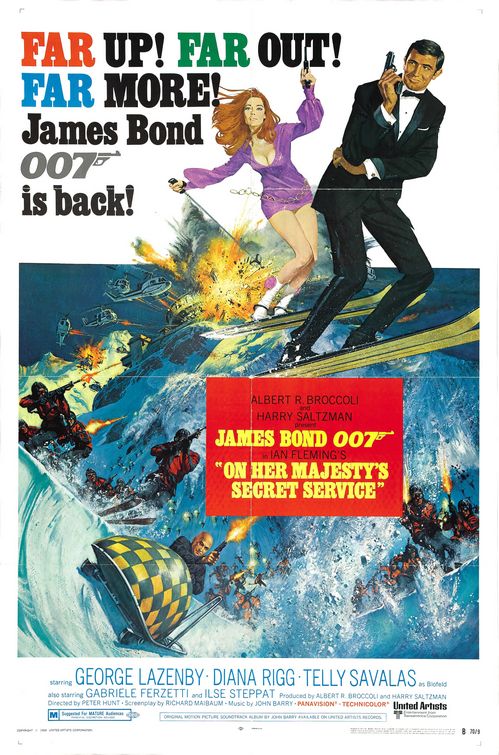
Casino Royale isn't an aberration of the franchise, it's a reintroduction of a tone and style that has been there for almost forty years. And that movie is, of course, On Her Majesty’s Secret Service, that's right, the one with George Lazenby.


Let me get the obvious similarities out of the way--

First of all, James Bond whips the shit out of everybody he meets in this movie. Just socking guys in the teeth from beginning to end and often with no real reason. People are just there for him to work his judo out on. Sure he looks scared as hell when he's going it, but he's not the one with an Italian loafer broken off in their ass.

Secondly, there are no gadgets from Q. There isn’t even a mission from M for that matter, now that I think about it. The more important fact is that James Bond is left to his wit and his acumen with brute force to save the day. There’s no exploding car keys or watch lasers, just lots of fisticuffs. . . and maybe one electronic safe cracker, but that’s just the one thing, I mean, come on now!

Thirdly, this movie revolves around James Bond being vulnerable. He’s scared and, what is even more crucial, is he is capable of loss. Unlike a Connery or a Brosnan, this Bond’s arc revolves around losing and gaining something, which is the same arc that Bond follows in Casino Royale.

This isn’t so much of a secret long uncovered as proof that the James Bond we’re living with now is almost as old as the one we started with.


INTERNATIONAL ASSHOLE OF MYSTERY

Another point that I’ve come to agree with and, this is only after re-watching the Connery films and watching the Dalton movies for the first time, is that James Bond is something of a dick. I’m willing to come to terms with this.

What kind of an asshole goes to foreign countries with the express purposes of creating paperwork for the local police? Do you pay taxes there? Do you know these people? Why are you drunk driving? Why is there a flaming Alfa-Romero in St. Peter’s Basilica?

Then there’s the fact that he just plows through women in this movie like nothing else. The whole movie kind of hinges on the fact that he’s courting this Countess, meanwhile he just bangs a bunch of chicks at Bloefeld’s mountain compound. Like, consecutively. At first it’s kind of funny then you just realize that behind all the pirate shirts and kilts that he might just be a skeezball.

He also hits Diana Rigg in the face at least twice.

But to quote this song, he's suave, it's okay.


SWEET RACK, BRO

With other Bond movies I always felt that the sexist attitudes, if they were sexist, were always in fun or they were knowingly ridiculous or they fell into the generic trappings of the spy movie and were therefore mostly exempt from criticism in the same way that complaining about the physics in a science fiction movie are slightly beside the point. It doesn’t mean all is forgiven or that you can’t say something meaningful, but people should be aware that when you harp on about how James Bond is a sexist, misogynist dinosaur and you aren’t Judi Dench you are likely a tedious person.

It’s just it’s a spy movie from the 1960’s, not a treatise on suffrage by Susan Sontag.

And with all of that said: OHMSS has one of the best examples I have ever seen in the Male Gaze. It’s kind of incredible on an academic level and it’s even more incredible that, at one point, a series of people making a film thought that this was a totally cool thing to do. It’s flabbergasting just how perfect it is.

I don’t truck much with the Male Gaze and, if it does exist I don’t have a huge problem with it. Men like looking at a nice ass. A nice ass is a nice thing to look at. Women will tell you the same thing. We can debate about possession and objectification and the dominant patriarchy, but the reality is nobody wants to watch a movie about Eleanor Roosevelt’s ass for two hours no matter how well it’s told. Sometimes people want to see Marilyn Monroe. In fact, science has proven that people always want to see Marilyn Monroe. To me, as interesting and as relevant as the Male Gaze can be as an argument, it strikes me as sour grapes about 90% of the time. Incredibly boring sour grapes. I mean, shit, we have to use that college degree for something, don’t we? (Unlike me.) 

All that said, this movie pretty much has the perfect example of what the Male Gaze is. There is a scene where James Bond is gambling (one more tally on the James Bond is a Dick scoreboard) and a woman walks into frame. Or part of her does. Her head is blocked by a lamp and the only thing we can see is a very fine dress displaying the fact that Emma Peel has a far nicer rack than you might have previously imagined.

Seriously. It’s a nice, nice rack.

I SPY SOME NIPPLES

This Bond movie has not one, not two, but three nipples in it. That’s higher than most Bond movies.

At one point James Bond not only reads a Playboy, but he also performs the ultimate middle schooler move by tearing out the center fold.

It’s kind of hilarious.

Also, as a testament to how things have moved on, can you imagine Daniel Craig picking up a Playboy in a contemporary Bond movie?

BACK TO THE BEGINNING OF THE END OF THE BEGINNING BUT NOT BATMAN

Swinging back to my vague premise: I believe that OHMSS is a hard precedent to Casino Royale. Not to say that it’s the gritty, post-Bourne work that Royale is, but they share more DNA than any other movies in the series do. It proves that Bond was never truly re-booted, because he's still the same basic guy that he was in 1969.

More importantly, OHMSS is a pretty darn good movie. It wouldn't be worth talking about if it wasn't.

In that way it’s the missing link between James Bond talking about listening to the Beatles on headphones and James Bond cussing at waiters for dillydallying about his order. Most thankfully this story is free of the self-parodic elements and arch-silliness of the Roger Moore films (which, again thankfully, disappear with Timothy Dalton’s movies). It’s still a Bond movie, though, and it still comes with the basic trappings of the series for better or for worse, yet it manages to be emotional in a way that doesn’t take away from the fun of the ski chases and bikini babes.

What else could you want out of a Bond movie?

13 February, 2013

A Boring Review for a Pretty Decent Comic


Lobster Johnson: The Burning Hand

Good to see Mr. Johnson getting cover work.

Hellboy trades are one of those things I wait around for on bated breath. I love Hellboy and have for quite some time and Mike Mignola is quietly one of my favorite names in comic books. The world that Hellboy exists in means a lot to me and every time a new, proper Hellboy trade comes out, I am excited. That even extends to side stories, stories like Lobster Johnson: The Burning Hand.

In this particular case, I was especially excited because Tonci Zonjic, a man as talented as his name is unpronouncable, would be performing art duties alongside John Arcudi's writing. What's more is that the last Lobster trade was something of a disappointment, so this could only

My longing for another Lobster Johnson trade comes from that fact that it was drawn by Tonci Zonjic and increased by the fact that the first trade could only be improved upon.

The Burning Hand exists as its own story and the story that is there is fairly solid. Does it have glow in the dark Indian Italian mobsters? Yes. Does it have a hobo spy ring? Yes. Does it have a dragon lady and a guy who "isn’t" Peter Lorre? You bet. The problem is that it uses the characters, the setting, and the crazy throwaway madness to no real end. It just is. While it is told fairly well, it still isn't Hellboy. Hell, it isn't BPRD.

John Arcudi is skilled at a great many things as a writer. As a nerd and as a fan of what amounts to be pulp garbage, I appreciate that Arcudi is best when he's in a position to throw his idea bucket at the story at hand. What I mean is that all of the zombies, werejaguars, and Fu Manchus all exist to accentuate a more important story. In the same way that Cuba's revolutionary problems aren't what the Godfather series is about, the Nazi clone robots are not what BPRD is about. The story is never just the monsters, it's what these monsters mean to the world and the people in it.
See? Now there's a title!

The problems with the Lobster Johnson series is that it is only ever about the Nazi robot elephant in the room, which I guess is sustaining enough of an idea for 100 pages or so. The book is defined by its disposable thrills and those pointless moments are kind of amazing in their own way. They show you a wider, weirder world that would maybe work better as an ongoing story or maybe one that didn't require you to fill in the gaps with various other series.

The more I think about it, the more I realize that Hellboy, as a series, isn't something that is as self contained as I think it is. Huh. That'll bug me.

Anyways.

 My favorite weird moment is when Lobster Johnson and his team are lured into the mansion of what they believe to be a mob boss’ hideout. In reality, it’s a lair given over to the cannibals that run New York City’s underground and it is a trap. Because of course it is.

Because it’s a pulp book and it stars a guy with two pistols. It isn’t be the solid world building of BPRD or the far-out mythology of Hellboy. It is, however, fun. Saying it is “insubstantial” is almost inherent to the premise. It’s almost a compliment. People don't want to read baggy pulp stories, that's how you get bad Quentin Tarantino movies. This genre was built to move and Lobster Johnson moves.

While it's in the same universe, you buy Hellboy for the mythology and for BPRD you buy it for this cast of characters dealing with the end of the world and in this case you buy it for the mobster cannibal houses.

The art from Tonci Zonjic is the best part of this comic. Zonjic brings something special to the work in the same way that Duncan Fegredo and Guy Davis bring something special to their work, so does Mr. Zonjic. I'd like to think that he gets it.

What are you doing? Buy this book already.
It somehow just fits better into the overall look and feel of  the Hellboy universe. Feel is a word that I have to put in itallics, because there's no real qualifying it. Some artists just feel wrong. I never liked anyone drawing Hellboy until Douglas Fegredo, because he seemed to get it somehow. While Lobster Johnson isn't a proper Hellboy book, he performs the magic that Fegredo has done in the past, which is he makes the content seem both beautiful and somehow perfectly natural in the the supernatural world that Mike Mignola has created.

In the end isn't that all you need? The book is called Lobster Johnson. There are better pulp books and there are worse pulp books and there are very few that involve the Hellboy name, so as flawed or as underwhelming as it is, it does deliver on the title. It is about a character named Lobster Johnson and he does some Lobster-Johnson-ass-shit in between the cover and the back.

At least it doesn't completely drop the ball like The Iron Prometheus, as well. That felt like it someone had forgot that it was a four issue mini-series at the last moment and had to cram in an ending (one which you only get if you read BPRD which, last I checked, is not how Hellboy works. That is how bad X-Men work). If I'm angry at The Burning Hand, it's because I'm projecting all of my frustrations on it from the last book in the series.

In the end, though, this this stuff is fun. And that is kind of all it is. It isn't brilliant, it doesn't transcend anything and it doesn't really need to. I expect more from the talent involved and from the franchise involved and, yet, this book is about a guy with two pistols and his crew of New York stereotypes shooting people and saving the day. If that's the worst thing that can be said about this book then I think we could use a lot more terrible comic books like this.