Showing posts with label The Internet. Show all posts

29 May, 2019

Too Much, Too Late, Too Loud (A Kind of Review)

Some Thoughts on ASSASSINATION NATION (2018)
Written and Directed by Sam Levinson
Cinematography by Marcell Rév
Score by Ian Hultquist
Staring Abra, Odessa Young, Suki Waterhouse, and Hari Nef 

Assassination Nation is a film that wants to be Persona meets Sasori meets The Conversation. What is more is that it thinks it's all of these movies. If that sounds either intriguing or a mess to you, the answer is: Yes, yes it is.

Assassination Nation is a style in search of a story. It's a bold, strange movie that wants to tackle a hundred subjects at once and also wants to be 1980's trash horror movie-- and it wants you to take it seriously. Very seriously. It's admirable for its ambition, it is also maddening because none of it works as well as it needs to.

The gravest sin of Assassination Nation commits, style-wise is how over-written it is. I complained a week* or so ago about The Mule and how the big beats of that movie sound like a formula from Final Draft than they sound like people. Assassination Nation has a different, but related problem. The Mule is trying to write plot into peoples' mouths. This movie is trying to write agenda into peoples' mouths. It wants to shout what the point of all of this is and, oh, man, haven't I got you thinking now?

And I'm sitting there watching it, thinking, no, man, you don't. I'm here for the Female Prisoner #701 homage and you have vastly overestimated how much I care what you have to say, bro. And then it just keeps on going about What It All Means and how Current Events are Effecting The Youth. Perhaps if you don't have Twitter this might have some novelty. As a film it feels like a panicked treatise on everything that is wrong with the internet but also a letter on Sam Levinson's keyboard was broken.
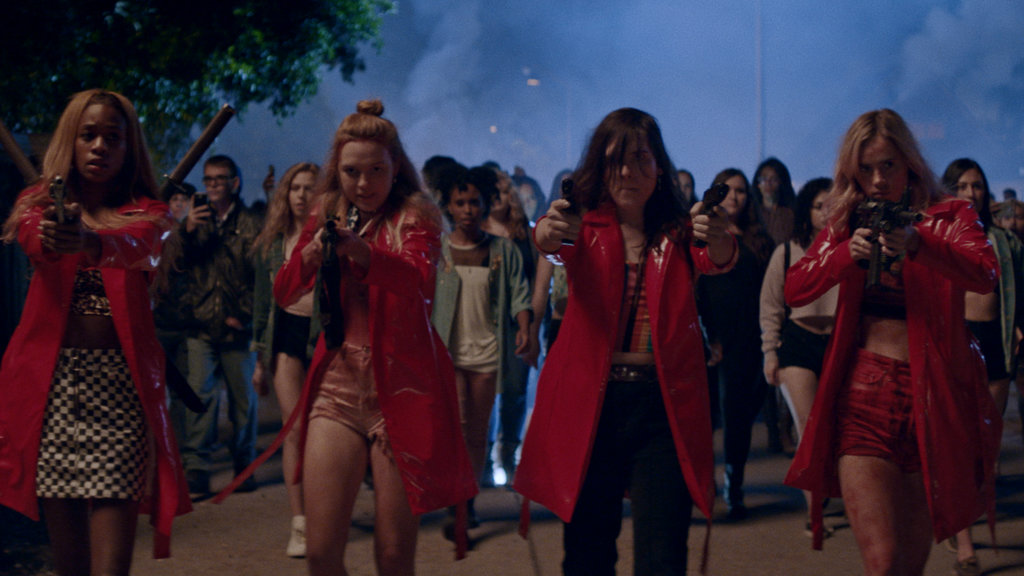

The movie pulses with this sort of energy. There is nothing in this film that is at half-dosage. The acting, the direction, the lighting, the set design, the everything, is going as loud and as extreme as it possibly can. Even the quite moments in this film are a panoply of Final Cut editing tools and film school excess. This has some appeal, because at no point does the movie ever become boring. It’s a rocket exploding on the landing pad. Beautiful and loud and probably not what the builders intended.

And on the other hand, the value of Assassination Nation is that it's a sleazy exploitation movie (or a simulacrum of one, a trust fund baby wearing a Sex Pistol t-shirt), is that it's dealing with the regressive nature of the internet and the toxic personalities that it fosters. We're now living in a post-#MeToo world where the president of the United States, a game show host, won an election by convincing your brain-worm infested mee-maw that El Salvadorians were going to break into her house and make her a drug mule. It's wild out there and beyond The Purge and Riverdale there aren't a whole lot of piece of media that are dealing with this issue directly. That itself is a problem, because it also seems like most of the popular media dealing with these stories also seem to be dumber than shit (but I stand to be corrected).

If there is one redeeming quality in the movie, it's that it takes a very dim view of the internet as it stands. As much as we all love videos of capybaras in hot springs, it's also where budding young psychopaths are radicalized into the next school shooter. The internet is an untended garden and Sam Levinson seems to understand this. The internet in Assassination Nation, as in real life, is a platform in which the worst aspects of human nature are allowed to roam freely.

With that said, taking a stand against nihilism is hardly a brave or interesting point of view. Maybe it's a necessary one, but it doesn't feel like something you can hang a movie on-- or at least it's not something you can hang on this movie.

I mean, for a movie with as many Sarah-Connor-in-T2-ass sounding monologues as this movie has, it sure doesn't seem to actually say very much. Now Sarah Connor, there was a woman who had a problem with technology and could tell you what the solution was.

Assassination Nation is never quite lands. It's a film that has a lot going on, but none of it means much of anything. It's a movie that wraps itself around an issue, but ultimately has very little to say about the issue other than it exists (Hey, were you aware that the interent is a cess-pool? Me too!). It's a confused film that isn't entertaining enough to get away with it. It doesn’t seem so much ambitious as it does pretentious. Like the best internet videos, the most spectacular fails are the ones where they really go for it and I can't say that the cast and crew of this movie weren't going for it.

If only for that, Assassination Nation is a film worth watching. Maybe.
  
OTHER THOUGHTS:
  • A better version of this "Too much, too now" type of film from 2018 is Sorry to Bother You-- which also happens to be my favorite movie from that year. It's a hell of a ride and, unlike Assassination Nation, all of its extraneous details and asides feel like part of a greater tapestry than stuff Boots Riley wrote into the movie.
  • Notably, it objectifies male bodies in a way that I don’t know that I’ve ever seen before in film. Good for them.
  • This film stars a trans woman (Hari Nef) and it never goes out of its way to stress that she is trans. She's just one of the girls and that's that. Which is cool and more movies should follow this one's example when it comes to that sort of a thing. Where it gets really cool is that, as much rampant attempted murder as this film features, at no point does feel the need to us the t-word or misgender her-- because this film might be packed with jock douchebags and general-issue psychopaths, but they're not monsters. It's admirable that even a movie that seeks to shock knows that there's a line where it stops being fun.
  • This film is directed by Sam Levinson, the son of Barry Levinson, so fuck this guy.
  • I can't help but feel-- and I know this is fucked up to say-- that Assassination Nation is the type of movie that Max Landis thinks he's making.
  • I was just thinking about Sasori: Female Prisoner #701 and, seriously, just watch that instead and then maybe wash it down with a re-watch of Hackers. Because Sasori and Hackers are ill as fuck. 
  • For that matter, also go read Assassin Nation. It's a beaut of a comic. In stores now!
No, seriously, go watch Female Prisoner #701

FOOTNOTES:
* Okay, this took me, like, four months to put out for some reason. Not sure how. Not sure why. But, hey, here we are.

James Kislingbury is a writer, podcaster, and hasn't had any internet death threats lately. Must be losing his touch. You can listen to him here and here. You can shovel piles of lucre at him here and here.

17 November, 2010

This is What I Get


Here's the results of me trying to figure out if someone has ever used a certain phrase before. Apparently they have. And it's in Kim Possible fan fic.

No, no, dear reader, your patronage is more than enough thanks.

05 August, 2010

Cinecult: Film Noir!? I Hardly Know Her!


Film noir is probably something most of us here love, but I'm also willing to bet that it's something most of us are in the dark about (rim shot). It's a far larger and wider genre than people like Frank Miller present it to be. It's been around since the 1930's and it's as storied and respectable as any other genre, even though most of its source material can safely be considered pulp garbage (but what can't be, these days?).

With that said, I'm going to shoot my mouth off about it. Let's take a journey through film lore, shall we?

Film noir was created out of a few factors in the late 1930's. In general there was a malaise in the American public (and ditto abroad). It hadn't quite recovered from the Great Depression and Hitler's maneuvers half way across the world wasn't making anyone feel any better about their lot in life. Many of the movies were direct adaptations from the hard-boiled novels of the era. Authors like James M. Cain, Dashiell Hammett (who wrote about the east coast), and Raymond Chandler (who wrote about the west coast). Even writers of proper literature like William Faulkner and Ernest Hemingway could be folded into the heritage of film noir.

Photobucket

Another influence was the surge of German and European film makers fleeing Europe due to the specter of Nazi Germany. As a result, many talented film makers like Fritz Lang, who were a part of German expressionism took what they knew and moved it to Hollywood. While for many, their best work was behind them, the abstract, moody, and stylized lighting of the movement helped steer the genre into what it would become.

During the brief era that film noir were popular and numerous they weren't actually called anything more than B-movies or crime movies or distractions from the various horrors occurring in Europe and in the Pacific. It wasn't until WWII ended that the French discovered a whole crop of gritty, American crime dramas that weren't available for almost five years. It was then that a whole new audience began to notice the similarities of all of these American crime movies-- both good and bad.

So, French critics dubbed the movement "film noir," meaning "black film," which probably came from a combination of the low lighting prevalent in the movies (because why build a set when you could light it dramatically?), as well as the dark themes.

(By the way, if you ever want to be a know-it-all, if someone calls a book "noir" correct them by saying "Uh, actually, it's only noir if it's a film. Duh." Also, you'll get double points for pronouncing it as "new-ah.")

Putting a name on it, probably also helped hasten its end. Howard Hawks and Jules Dassin and all of the great directors never sought to make a movement or a genre or anything besides an interesting film. Once something like that becomes self aware, it's only so long before it starts to get too ornate or rigid for its own good and someone starts to parody it. Things can only become so baroque before they start too become gaudy and ridiculous.

The same thing happened to Spaghetti Westerns. Leone, more or less, started the movement copying and exaggerating the tropes of American Western directors like John Ford. In less than ten years the sub-genre was kaput, a victim of its own success, and by its end, even Leone himself was making parody movies

Film noir, as a movement started with Howard Hawkes' adaptation of The Maltese Falcon in 1941 and it ended with Orson Welles' Mexican border crime film Touch of Evil in 1958.

While the movement and its influences lasted well past the date of 1958, the golden age ended with Welles' butchered opus.

The classics of the era are numerous, but a brief list would include:

Photobucket
The Maltese Falcon.

Photobucket
Casablanca, a rare classic that is better than everyone says it is. The movie features one of the best screenplays of all time, as well as an incredible cast of characters, ranging from Syndey Greenstreet to Peter Lorre and, of course, Humphrey Bogart and Ingrid Bergman.

Photobucket
Touch of Evil, directed and starring Fat Orson Welles, along with Charlton Heston as the single most unbelievable Mexican in film history, it isn't a perfect movie, but it has more than a few moments that make it the last gasp of a great era-- including one of the longest and most impressive single-take crane shots in film history.

Photobucket
Double Indemnity had its screenplay written by Chandler (based off of a Cain novel) and was directed (and written) by one of the great directors of all time, Billy Wilder.

Then there's the French copycats and prototypes, which are equally numerous:

Photobucket
Elevator to the Gallows is an interesting movie, because it's both directly influenced by American film and by ugly pieces of French history like the Indochina War. What makes it stand out is its rather avant garde soundtrack by Miles Davis, who, as I recall, recorded the whole thing in one day. It's also a movie that shows that the French hate police officers.

Photobucket
Les Diaboliques, which was later remade in the 1990's. The film is directed by Henri-Georges Clouzot, who is one of the great French directors that didn't make it to the New Wave.

When William Friedkin met Clouzot in the 70's, he told him that he'd be remaking his movie The Wages of Fear. Clouzot then said to him, "Well, it won't be as good."

Photobucket
Le Samourai. I've spoken about this movie a lot. In fact, it's been the subject of no less than three identical sig/avatar combos on this forum. It's the epitomy of cool. It's not a fast moving film, but Jean-Pierre Melville proves that he's a methodical director and that Alain Delon is more than just an obscure punchline in the first season of the British version of The Office (it's the episode where the guy throws the shoe on the roof). Also: Le Samourai was a heavy influence on John Woe-- The Killer is more or less the same exact plot.

Photobucket
Rififi, directed by American Jules Dassin, it's regarded as one of the greatest heist movies and French crime films of all time. It was later heavily borrowed from by Jean-Pierre Melville in his own fantastic movie, Le Cercle De Rouge (see image below).

Photobucket

There could be a whole other thread about the atavistic works and films that made film noir what it is, but if you boiled down the genre, what you would find are a few, basic tropes-- especially in the movies-- that define what film noir is.

Photobucket
There's the reluctant hero (or the plain anti-hero). In Westerns people like Gary Cooper and John Wayne did what was right and punished the bad guys. In film noir, more often than not, the protagonist would get his head kicked in by the sheriff. He doesn't want trouble and he doesn't care about it, it just finds him.

The doppleganger (which is much harder to express in a single still image so I'm going to skip it), but usually the guy is either framing the main character or being chased by him. This character more or less underpines the idea that being a hero isn't all that different from being a scumbag on the street.

And, of course, there's the femme fatale.
Photobucket
The femme fatale kind of gets a bad rap. While she is bound to the Production Code's rule that a sexy woman is evil, they're interesting because, often they're what starts the plot in most of these movies. It isn't Philip Marlowe that goes out looking for trouble, but rather, some crazy dame that-- somehow, every time-- gets him mixed up in everything. They aren't exactly paragons for the feminist movement, but having a women this powerful and this sexual in a genre as murky as film noir was an important part of

Some people like to drop film noir as an idea that went and died and are clever for bringing back, but film noir has always been with us. It's too good of an idea to be left by the wayside and, unlike the western, its nowhere near as costly or complicated to replicate.

In the 1974 Roman Polanski directed Chinatown, a tribute to the classic American detective movie. It was written by Robert Towne,.

Even though the movie didn't intend to bring anything back in and of itself, it did signal a new wave of films inspired by film noir.

Neo-noir, much like the creation of the modern action movie, established itself formally during the 80's. In many ways neo-noir shares a heritage with action movies (which didn't exist as we know them know until the 1980's).

America wanted (and needed) old fashioned films and something to rationalize the ugliness of the past twenty years. Action movies were the more direct way to deal with the failures of twenty years of bad government and in a way both the action movie and neo-noir were a way to deal with American losing its first war, the government transforming into a villain, having drugs run amok in the streets, JFK and MLK having their heads blown off. have feminism and civil rights and Indian rights and everything else turn the status quo on its head, not to mention Watergate, the fuel shortage, joblessness, and the general failure of the Great Society. Obviously the 60's and 70's were no picnic anywhere else in the world, but in America, I think the movies we got later were a symptom of this mass, disappointment with the world.

On the plus side, at least we didn't get another Shirley Temple.

So what movies count as neo-noir?

The original wave would include (but not be limited to):

Photobucket
Chinatown is as perfect as it is depressing. It might have been directed by a child raping, prison dodging goon, but the work itself is flawless. It's kind of ironic, now that I think about it.

Photobucket
Body Heat, which, like many movies on here, isn't great, but it's worth seeing if only for some crazy, hot, sweaty sex the likes of which is rare in American cinema. And as bonerlicious as it is, it's a rare movie (like Akira Kurosawa's Stray Dog) that makes you feel how muggy and unpleasant the weather in the movie is.

Photobucket
Blade Runner is a confluence of sci-fi and hard-boiled and the results aren't exactly perfect. It's one of my favorite movies of all time, but it's plagued with fiddling by the studio and didn't get a proper release until a few years ago in its full restored glory. Blade Runner mixes a lot of old LA noir tropes (like the Bradbury Building and the architecture of Frank Lloyd Wright) with the (then) fledgling come back of big special effects pictures.

Photobucket
No Country For Old Men. The movie was based on the novel by Cormac McCarthy and takes place on the Texas border in 1980. The movie mixes up a lot of ideas about Westerns along with the classic crime/thriller/chase movie. There's lots of things going on in this movie and it's one of the best to come out of the past ten years. The Coen Brothers directed the movie and one of the defining features of their work is that they always seem to be leaning heavily on past features (The Hudsucker Proxy was a throwback to the screwball comedy and O Brother Where Art Thou was based, in part, on Sullivan's Travels).

The Big Lebowski, The Man Who Wasn't There, and Blood Simple are also infused with film noir aesthetics and sensibilities, perhaps more apparently than the movie above.


The Killer Inside Me, which is also based off of a novel (have you seen a theme, yet?) by Jim Thompson which was written in 1952. While movie has received mixed reviews, mostly based off of its alleged misogyny, it's safe to say that with a subject matter like this, yeah, it's film noir.


And, of course, LA Confidential, which was based off of the novel by James Ellroy, a Los Angeles native and gifted crime writer. There's plenty of movies that attempt to copy that era of LA, but none have done it as well as this movie. It's impressive considering that most of the leads aren't from this country.

Genres are like anything else in art, they aren't rigidly defined and even though you can attach a definition and an understanding to them, there's so much bleed over and overlap that you can't ever fully get a grip on it. There's no real end to the Western, you see it in every TV show where someone has a revolver or wears a hat. The Simpsons still do musical numbers, even if it's probably much easier to wrangle a stray cell than a crappy dancer (Now that I think about it, Blazing Saddles was a Western and had a musical sequence). We still have "Women's Pictures" and melodramas, too (Tyler Perry is a fairly shitty replacement for , then again, most people are).

I'm tired now. Now you talk about film noir (feem newah).

Bonus!
Here's a great website for photos of film noir. It has a pretty appropriate title.

More of a Bonus! Here's a further link to shit I posted, but have no desire to reformat.