Showing posts with label Film Noir. Show all posts
Showing posts with label Film Noir. Show all posts
29 January, 2014

25 November, 2013
Child of Gluck: A mediocre review of a mediocre movie
 |
| Remember this poster? Well, this is at least better than The Savages. |
Cormac McCarthy stories are almost guaranteed to bum you out in some way. From main characters being brutally murdered to people losing their innocence, his stories don't tend to comfort. In his universe hope is something to be extinguished. This is no less true of The Counselor, crime film that has more in common with a Greek tragedy than it does with film noir. Of course, that's the shame of it. It isn't trashy enough for noir and it isn't finely tuned enough for tragedy.
I went into this with no little anticipation. McCarthy is my favorite author and Ridley Scott is high in the running for my favorite director (despite his recent run of middle of the road features). Toss in an excellent cast on top of that and you have every reason to believe that this is going to be one of the best movies of the year. How could it not? As it turns out this particular Cormac McCarthy story bummed me out in a new and terrible way.
Sorry. I was just sighing there. Give me a moment. Alright. Let's get to it.
 |
| "Congrats! We get paid for this no matter what our Fresh Rating is!" |
As much as The Counselor is a reflection on Classical tragedies or maybe the Drug Wars or maybe even the human soul. Or maybe it's just a bunch of assholes hoping that if they talk long enough they'll get to the point. In Blood Meridian this works. In No Country For Old Men this works. And even in Blade Runner you get the sense that somebody, somewhere, either on screen or off has something of note to say.
The film makers don't seem to know what the film is about, so how is the audience supposed to know? In opaque thrillers like The Spy Who Came in From the Cold and Tinker Tailor Soldier Spy, we're given insight into a world that is completely unknowable to us, yet retains a dramatic spark because somebody in the play does. We're invited to discover what is happening along with the characters. In this case I don't even think the characters know what they had for breakfast. But they sure as hell want you to think that they know.
Maybe the problem isn't that the characters don't know what is going on. It's not their fault that they have no clue what is going on, it's the film makers. They want to make this work of high tragedy with all of the markings of trash pulp and, in the end, it doesn't end up satisfying either genre. Then again, looking at the talent, maybe they did know and they went ahead with it anyways. Now that's a scary thought. . .
All of these concerns aside, the problem real problem of the film is that The Counselor, if it is about anything, it is a movie about furniture.
With every new scene we are treated to a new set, impeccibly shot and designed and with every scene we're treated to another piece of the Herman-Miller collection. Or a French press. Or a computer. Or a cool bar. Or something that you're paying attention to instead of the story. And, oh hey, is that a motorcycle? Cool.
And that isn't a metaphor for the vacuousness of these people's lives. It isn't some sign of their misgotten gains. It isn't a plot point. It isn't mis en scene, for God's sake. It's the movie. It's a series of chairs and tables occasionally broken up by some fool whining endlessly about whatever new nonsense has kinked up their life. And then it goes on for two hours like that and then it ends and you realize that Cameron Diaz must have photos of somebody somewhere.
The movie's fixation with mid-century modern, while laudable is a sign of the film failing on just about every other level. Furniture shouldn't be something I am staring at. Characters should be something I am staring at. Unless I'm autistic and, in that case, that's just how my brain works. In this case I'm just bored. And a little bit angry.
Blade Runner is a movie that I can watch endlessly and, even having seen it probably twenty times, is a movie that still yields little details hiding in the background. It's the perfect example of a world that is fully realized, a world that feeds into the story as the story feeds into it. There isn't a hard line where the plot starts and the set begins, it is all a part of a piece and, like I said with Gravity, that is an incredible sight to see. When it works it is amazing. When it doesn't, it's Avatar.
Ridley Scott, at his best, can design these worlds and make them real in a way that George Lucas once knew how to do and Stanley Kubrick went insane attempting. Even in his less successful films (Kingdom of Heaven leaps to mind), he creates a world with real weight and texture.
 |
| A vision of a much better movie. |
This isn't even Ridley Scott at his worst. I don't know what this is. It is polished mush. Not a turd, it isn't terrible. Despite how hilarious a scathing review can be, it isn't bad. It's worse than that. It's a shining, grey mess that the man who directed Black Hawk Down and Alien and Thelma and Louise should not be capable of creating.
After doing my time with The Counselor, I feel as though I've picked this movie clean of any hidden detail. And the details I've found are unremarkable in all aspects except for how unremarkable they are.
I have the Mark Kermode go-to line about a movie of this nature. That "There's a good 90 minute exploitation movie in there" and as much as I think there's truth in that line, I don't think there is in this case. There is something fundamentally wrong with this film and it cannot be solved by trimming it down. It was perhaps rotten at birth and should have been drowned at the earliest possibility. A lot of heartache and dollars could have been saved that way. Instead we have a fully grown monstrosity to deal with and we have to wonder to ourselves "How could this have gone so bad?"
The Counselor doesn't sadden me because it's awful or because of a widespread series of failures. It saddens me that the collective talents of Cormac McCarthy and Sir Ridley Scott and many others made a work of art that merits the phrase "It's alright."
Who saw that coming?
SIDE NOTES:
This was made for 25 million dollars? Alright. I am slightly more okay with this movie now. Slightly. Guardedly. Shamefully.
After walking out of this, I was left wanting a new, good McCarthy movie that I almost want to see Child of God. You hear that? Jesus Lord. The Counselor has wanted me to seek comfort in the arms of a necrophiliac tone poem adapted by a guy who could barely read a cue card at an awards show.
I'm still going to buy the screenplay. I have a collection to keep up. At the very least, it's always nice to have a cautionary tale that is concrete.
Maybe someone out there will pull a reverse No Country For Old Men and take an average movie and adapt it into a good book. SD Perry, you still working? I think we got a job for you.
I hate Salon, but this review is a delight.
THE AD ZONE:
I just had a comic printed! It's 40 page comic that features a new, 22-page story, along with a ten pager that came out last year in the Freshman Fifteen. It's cheap. It's easy. It's fun and it keep me from dialing that assisted suicide guy that I found on Tor for one more month. It's not on Graphically yet (the old one is), but, in the mean time, think about it, won't you?
I also do a podcast with my friend Cruz (and, formerly, my friend Joe). It's called White Guys, Square Glasses and it's a lot of fun. I think so, anyways. If you like laughter and ribaldry and dirtbags sounding off about movies and stuff, maybe give it a listen? Or at least subscribe to it on iTunes and never listen to it. Either way, we win.
25 October, 2013
Shotgun Blast of White Trash

Killer Joe is not so much a crime film as it is a kaleidoscope of scum. And not your average scum, either. The kinds of scum that walk the earth of Killer Joe need to be scrubbed from the earth with chemical fire. If there was ever a film that would make you want to take a shower, this is the one.
A more snide director would look down on the target family of the film and a more exploitative one would look up to them, but Freidkin is far more intruiged by looking at them dead in the eyes. It isn't that he avoids judging them, it's that there'd be no point to it. It'd be like explainingthe meter of a sonnet to a pig eating a boot. Morality and judgement would be wasted on this family, and for that they are sort of likable. Sort of. In the same way dive bar vomit might have a kind of charm. We like them enough to see what horrid shit-pile they'll roll into next.
I was talking to a friend of mind and she said that after a certain point, she just stopped watching Kiler Joe. This strikes me as a sane response to this movie. For the rest of us, the ones who want to see humanity at its Biblical worst, this movie is the movie for you. Just, you know, make sure you have a luffa handy.
 |
| A scene that does not stick out in Killer Joe. |
Not to get off topic here, but it kind of reminds of The Great Gatsby. Yes, that The Great Gatsby. Now stick with me here.
To me Tom was always the least terrible of any of the character (which in the context of The Great Gatsby means that he least resembled a weapon's grade goat asshole). Sure he drank, cheated, had strong feelings about the dominance of the white race, and hit his wife, but at least we knew where he stood. There was something honest about him. Myrtle is run over he's the only one who seems to feel bad about it outside of how this dead body was going to eat into this mid-morning squash session. He's capable of love, while everyone else, from Nick to Daisy to Gatsby himself are self-obsessed, vapid bores who think that not having a soul can be made up for by having a really great head of hair.
This is what makes Killer Joe a kind of hero of the film. He's the most insidious and violent, yet he's the only one with any measure of honesty or competence. Everyone else is exactly who they appear to be (with one, notable exception). You sort of root for him, as much as you can root for a murderous, border-line sex criminal. That, if anything, indicates just what a morally bankrupt film that Friedkin and Letts have constructed.
As disgusting as this movie is, in the end, it manically and brutally wraps everything up with such suddenness that you feel as though someone was fucking with you the entire time, and instead of it being a moment of annoyance, there's this sense of pleasure that you've been fucked with by somebody who is really, really good at it. Killer Joe feels like what would happen if the Jackass guys were really into committing crime. I don't know that there are many other experiences like that in film.
As it turns out that's a good thing.
30 June, 2012
Max Payne: The Post-Modern Shootmetheus

Max Payne 3 is a mighty fine video game. It's been a long damn while since the last installment of this series has come out
This entry really isn't going to be about that. It's really just going to be about things that it reminds me of. I'm going to glaze over things I learned in my film classes and I won't nearly have an appropriate amount of references. If that sounds fun, then let's go! Let's do it!
Lost in a Payne Hole--
This game triggered something deep inside of me. It is something that I can't even put exact words to. I can only ramble. . . but rambling has taken me this far, so I figure I'll just figure out where it wants to take me. With a lot of things ans with this game in particular, it's practically subconscious and I can testify to this because it has made me pine for Michael Mann films, which are films that I have complained about again and again ad nauseam. It's also made me think of a lot of other nonsense.
If that's what you want to read about, then come along! Seriously! Last warning!
What it's made me think about, though, are mostly subjects that are just on the periphery of the game. Everything from the storyline to the tone to the setting to the game play reminds of me a heap of movies an TV shows (and those things in turn remind me of other TV shows and movies). Most specifically Kane and Lynch 2: Dog Days (at least in some ways, but I'll get to that in a moment.).
The Max Payne series has always been over the top and self-aware. It's a hard-boiled game series that knows it's in a hard-boiled game series. Not only did the creators know that its audience had their heads chockful of Sin City and Pulp Fiction (not hard-boiled, but you know what I mean), but Max did too. Referencing past works is in the DNA of Max Payne. It's why he moves in slow motion and holds two pistols at once and talks in overwrought metaphors.
While the third installment has been made by a new team and it has stripped away its old comic book noir sensibilities, it's now published by Rockstar, a company that has never felt shame over wearing its influences on its sleeves. If anything, in this case, they want you to remember the things that inspired it.
This game picks off years after the last installment in the series came out and, predictably, the years of murder, mayhem, and drug abuse has not done Max any favors. He's a wash-out and a self-hating addict with a very narrow set of professional skills. In short Payne is exactly the sort of character that I love best.
(Why couldn't they just make that game?)
The Case of Lynch V. Payne--
What Max Payne 3 is what Kane and Lynch 2: Dog Days should have been. Where Kane and Lynch 2 is a monochromatic, senseless game with poor controls and almost no plot to speak of, Max Payne 3 has great art design, an entertaining combat system, and a plot that is about as edifying, but much better written (CONTRADICTION) it has greater depths than "LET'S GET THE FUCK OUTTA HERE!"
Despite being a man of no little education, I like Kane and Lynch 2. I know I'm alone on this and I know that I shouldn't. It's a complete mess. From top to bottom it is an unworthy game. Its a shooter where shooting barely works. It takes place in an exotic location that you can't see. Calling the main characters two-dimensional would be an insult to cardboard and worst yet its last boss is literally a dog.
Let me repeat: THE LAST BOSS IS A SINGLE (ONE) DOG.
Payne's boss is a much more impressive encounter, even though both of them take place on an airport. If I had to put my finger on what differentiates these games is that Max Payne 3 is Jack Bauer and Kane and Lynch 2 is just Jack Bauer torturing people.
 |
| Don't like these guys? Tough shit. |
I cannot think of a game as unapologetic and brutal as that game. One of its trailers revolves around the titular characters running naked from police attack dogs. One of the men is attacked and his partner picks up a plastic fast food tray and starts hitting the dog. Top that off with the "Bowling for Shangai" video, I realized that this is a game that I want to play (plus the demo wasn't terrible. It had potential and some of the guns had the kind of kick that guns in a gritty game like this should have. Unfortunately the finished game is not the demo).
Where it goes a bit pear-shaped is that it's entire aesthetic seems to have been crafted to have been off-putting. From the washed-out You Tube-esque digital grain to the nihilistic storyline and its scumbag main characters seems to have been crafted to get people to not want to play it. Well, IO Interactive succeeded. They wanted to make a game that is as unpleasant and mean as the world the titular wallows in and they hit the bullseye. Good for them, I guess. But maybe they should've wrapped a better game around that whole concept.
Max on Fire--
But general harshness isn't the main thing Max Payne 3 (or the games before it, really) shares with Dog Days.Max Payne 3's non-gameplay sequences is complete with digital distortion and neon blow-outs and every other kind of 21st century film making technique. It's a technique they both use in various ways and to various effects. It's not a direct stylistic aping and it might be that if they both weren't crime-centric third-person shooters I wouldn't have ever thought of it, but here we are.
The one piece of art that's most similar to the third Max Payne is the movie Man on Fire, which not only lends a big, bloody chunk of its plot, but also its frenetic on-screen aesthetics. It's worth noting that Man on Fire is also the only Tony Scott movie where Tony Scott's recent manic style isn't completely terrible.
But it isn't just the odd crime game or Tony Scott movie that's been doing this sort of thing, I've also seen it appear most recently in the second episode of the second season-- 'scuse me, guv, the second series-- of Sherlock. The You Tube era's version of distortion has supplanted my generation's TV snow. I doubt that kids today even know what the hell snow is (And I know they do not appreciate the pleasure of scrambled pornography. We lucky few). In that case I think that was specifically a decision to be clever, but it's Sherlock-- That whole show is a showcase for clever.
In most of these cases, they aren't They aren't statements, they just look cool.And art is in a position where instead of making things look better and have higher fidelity, we're trying to find ways to make things look wonky. In fact, new technology seems to exist specifically to make things look less like regular ol' reality.
Without getting into stuff like indy lo-fi bands or vinyl collecting, I think the best example-- and really the most fun example-- is the newest Star Trek movie.
To Boldly Mess Things Up For a Lot of Money Like Nobody Has Before--
 |
| Well, at least the trailer didn't have any Inception sounds. |
Fifty years ago a lens flare was considering a flaw in filming. A lens flare is a result of the light of the Sun (or a similarly bright projection like a lamp or a key light) hitting the back of the film stock and projecting back into the camera. Film isn't supposed to work that way and traditionally that was a fuck up. It meant that you filmed a scene poorly, after all, nobody wanted to watch a scene with Humphrey Bogart with these optical spirits dancing around the camera. In still photography that also meant that you would pray to whatever saint was relevant that you had images on your test strip to cover you.
It wasn't until Lawrence of Arabia came around that lens flare actually became an artistic technique. That film had long and important sequences about the Sun and about the heat of it and these flaws in the filming because the means to show the audience just how terrible this Arabian sun was-- After all, we'd never seen a sun so bad before that it distorted a camera, had we?
And that was then. Lawrence of Arabia is considered one of the best films of all time and with reason, so it's funny to see the reboot of Star Trek take that lesson and apply it, not as a reference to Lawrence of Arabia, but because lens flare means the future. It's made a full circle. It isn't an error, it isn't even really an artistic choice, it's ubiquitous.
(I guess it's also worth considering that color opens up the film to a lot more techniques like that, where as in black and white, which is binary by definition, it is a far more glaring flaw.)
There are plenty of other problems that come up with digital filming, but every single piece of lens flare that appears in JJ Abrams' Star Trek has been artificially placed there. What you have then is a film that has spent millions of dollars to artificially mar a film that would have been a disaster only a generation or so ago. What was once a flaw has turned into a stylistic choice and now has just become standard operating procedure. I wonder what David Lean would think.
 |
| Hey, Larry? That's a fire hazard, buddy. |
And to bring it back to video games this sort of absurdity is only heightened. Digital distortion is now just an aesthetic choice as much as anything. For whatever reason war games have globbed onto this style, as well, because nothing says visceral like static and buzzing noises (and a vaguely disguised Terminator theme, apparently).
(Ghost Recon: Future Soldier also has supertext and words projected onto the world in the same way that Splinter Cell: Conviction, but, again, where Max Payne uses it to get across the concept of grit, Ghost Recon does it because pop-up words means the future. So: More static to think about.)
And the list of games that use the same techniques as Max Payne 3 and Kane and Lynch 2 to get their tone across goes on and on.
Mass Effect 2 naturally had a false film grain effect on it, which naturally kicks it back to the kind of 70's and 80's science fiction films that it's a product of (Aliens, Silent Running, Outland, Enemy Mine). I guess that's another slight break between Alien and Prometheus, which is that one is super sharp and the other is a low-budget genre flick from the 1970's.
Resident Evil 5 allowed you to put multiple film grain effect over the game once you beat it (Since it's a horror game, I don't know why that isn't simply the default. I know it's an HD game, but come on, film grain is cool!). Silent Hill uses the same technique, as well, which is a case where I'd appreciate them taking it out, because, fuck, man, I couldn't even finish Silent Hill 2 I was so upset by it. Tone it down, Silent Hill 2, I just want to play you!
In science fiction seeing film grain makes you think of the future and in horror it's there to instill a sense of something being off (or, again, maybe you just want to reference Evil Dead 2 or something). With fake film grain you can have it all!

Then, there are video games that now have lens flare a la Star Trek and Lawrence of Arabia or whatever else, but, again, like there being no film to have grain there isn't any lens to have a flare. There isn't even a sun or light. It's all made up!
Putting Dog Days Down--
Alright. Back to Kane and Lynch 2-- Because I have to get this out somewhere--
 |
| "Here's looking at you, shitwad." |
I mean in in that it allows room for actual good guys and maybe lets some people to not be tortured to death. It's not much, but there is something more to this game than Dog Day's main statement on the human spirit than "We're all cocksucking scumbags or Chinese. Or dead." It's depressing.
Max Payne 3 has a discernible story arc as well as an incredible design, and what is more is that is plays like a good video game. There is something that is simple and appealing about diving at people whilst holding two guns that I just can't explain. It's just awesome. It doesn't work as well as it does in the first or second Max Payne, admittedly, but it is a much different kind of game.Thematically Max Payne 3 also works far better as a Michael Mann homage than does Dog Day's (the first game, Dead Men, has a whole level that apes the club scene in Collateral).
The visceral appeal of Mann's movies are that they revolve around men being experts at a sort of obscure art. Whether that be a behavioral psychologist, a thief, a frontiersman, another kind of thief, a cab driver, cops posing as thieves, or cops fighting thieves, he makes movies about men being men in very specific ways. I love that. And where this game goes its own way is that Max isn't a professional, he's a fuck up who has been cursed with having professional skills. His skill set is more a curse than a boon and you couldn't say that of somebody like Ali.
None of Mann's character's are cursed (except for in The Keep, but since when has The Keep ever counted for anything?). They execute until they cannot execute any more. Payne is a character who has to execute because he isn't much good at anything else, especially being alive. I like that. I like a down and out character and I especially like that being rammed into the digitally perfect styling of Michael Mann. As much as this game is indebted to Mann (in addition to Man on Fire and Elite Squad and, of course, John Woo) it is also shirking these associations and going its own way. It is being honest with its influences without being a copycat.
I also appreciate that Max Payne 3 had the good taste not to force America through another parkour sequence through a favela (see: The Incredible Hulk, Fast Five, and Modern Warfare 2). At least video games have made some progress with this thing.
To mangle a Joseph Campbell quote, he was once asked why what he studied and talked about mattered and he replied that it didn't matter. He then said that a dog is happy, but it doesn't know about anything that we care about or any of the things we study. But, he added, "It's a dog's life."
Which Brings Us To The End--
So, what's the fucking point? I don't know: If you're going to do something weird, make sure you do it well. I don't see a sense in mucking it up any further than that. I already used the term "post-modern" and that's unforgivable enough without me becoming an even bigger jerk.
I guess, in general, though, I like being reminded of good things. It's more than just that pleasure of recognizing something, which is the kind of thing that Dane Cook thrived off of, I just like seeing and knowing that the thing I like also likes other good things. Knowing that the Coen Brothers love Raymond Chandler makes me like them more and it makes me understand them more as artists. I also like seeing where something as simple and as generally invisible as intentionally grainy footage goes. That's fun to me. If it wasn't I wouldn't have become a media studies major.
Now, okay, I guess that's what makes me the jerk in this scenario
If you've got any input, please let me know. I won't assume that anyone will make it this far down this article, but it is always nice to hear from other people. That sort of thing keeps me sane. My friend Andy said some interesting things about my Prometheus post, so maybe I'll present my rebuttal when it comes out on DVD. I wish I had gotten back to him on that. Anyways, good on ya, I'm off to watch Body of Lies.
Anyways, apropos of very little, here's the best bit of dialogue in the movie Thief--
A FEW RANDOM OBSERVATIONS:
* I think it's pure laziness on the part of the Max Payne 3 writers that there's a gang called the Comando Sombra and nobody connects the dots and calls them "cocksuckers." Get it together, guys.
* While Kane and Lynch 2 is almost uniformly regarded as garbage by both the public and the critical community, the new Hitman looks pretty hot even with stupid shit like videos about killing battle nuns.
* I'll back away from falling any further down the reference hole, but you all should watch Elite Force: The Enemy Within, Mandala Bala, and Senna as soon as humanly possible. They are great, great films about Brazil for completely different reasons.
* Thinking about t now, I realize that Kane and Lynch 2 has one advantage over Max Payne's third outing which is that you can pick up gas canisters and fire extinguishers and chuck them as bombs. That's the kind of weaponization that I'd like to see more of in video games.
*Oh, you can also take human shields in Dog Days. I like that. You can't turn them into bombs though as in Gears of War 3, though.Two steps forward, one step back. . .
* Life imitates art. . . But in Spanish, not Portuguese.
* Here's a link to something better about this game.
* Also: This image kind of perfectly sums up the tone of Kane and Lynch 2.
* I love how many costume changes Max goes through in this game. His hair changes with just about every level, as does his clothing and his various wounds. It's great. It'sa big macho game of dress-up the psychopath. What's more is once you beat the game you can dress him up as Max from the first two games as well as the model from the ending, which includes Max in full-blown tourist wear right down to the flip flops.
* Not to bring up Prometheus again . . .again (again), but while looking for Lawrence of Arabia images, I remembered that movie was featured in Ridley Scott's sci-fi film after stumbling upon this blog.
* I could have totally used the term "mis en scene" to describe the various styles, tones, and aesthetics of these movies because, but I didn't. Because I care about you the reader.
* Also my next entry will be shorter and more coherent then this one so, as you may have guessed, it will be about Chinese history.
10 June, 2012
Let's Mutate Comic Books!
As much as it's nice to commercialize comic books (as, let's face the facts, they normally aren't),there is something obnoxious about some studio exec looking down a list and saying "Let's go adapt that" or, more and more likely as time goes on "Let's reboot that."
If you heard that Battleship was being turned into a movie ten years ago would you have done anything but laugh? At least it flopped, proving that while America is stupid enough to keep watching Pirates movies, at least they aren't going to fall for a movie adapted from a boring board game.
There's a line and I don't know who said it (so sorry, dude), which is that movies are no longer allowed to be good, they have to be awesome. Adapting comic books has a lot to do with this idea because most comic books are awesome. They're basically budget free blockbusters. They're stories where you can burn down Europe, go to space, have the devil fight an alien, and enlist a cast of thousands without any larger of a budget than a kitchen sink film. In a way they're basically free screenplay idea and, while I don't want to get into the pitfalls of that whole end of movies, it's something to consider. I don't want to be accused of just hyping comic books to be turned into movies because, as artifacts on their own, they do not have to be anything else than good stories. Comic books are great as comic books. They are not always good as films.
But, who the hell wants to fantasize about things that should not be? Let's leave that to the religious fanatics, shall we?
So, what should be made before we get our unwanted Defenders movie, here is what I would like to see if I have to see it--
100 Bullets

It's hard to think of a crime book that's as byzantine or involved as 100 Bullets and while cramming it all down into a two hour (or God-forbid three hour) film would almost certainly be a disaster there is something to be said about seeing the b-movie schlock premise of the book, which is that a man in a suit named Graves shows up with a gun with one-hundred untracable bullets and tells you that you to go wild, turned into an adventure on the big screen. The world is full of great characters and dialogue as well and while film is full of noir crime stories it would be fun to see old man Graves encouraging a righteous killing spree or two.
It's a smart enough B-movie premise to get people in the doors and with the right actors and behind-the-camera talent it could be a pretty successful film (then again, you could say that about most movies, couldn't you?). Just throw Bruce Willis at it. He's great at this sort of thing. He doesn't even need to try any more, either.
Ideal Directors: David Fincher, Nicholas Wending Refn, Michael Mann.
Elevator Pitch: It's the ultimate crime caper mixed with the ulimate vengeance tale. It's smart, it's funny, it's got sharp dialogue, and, better yet, none of that matters because all of the bad people die in terrible ways. It's everything a crime movie should be and what's that? Oh, yeah, sequels. Franchise.
(Apparently David Goyer might have beat me to the punch on this one. Or not, you know how these things work.)
The Damned

The Damned is one of the most refreshing books I've read in a long time.What sounds like a terrible idea in the abstract (in an alternate or after-life version of the 1920's the cities crime syndicates are all run by demons and curses are as deadly and as real as tommy gun bullets), but the idea comes to life because of the sharp dialogue and twisting plotting of Cullen Bunn and the sharp and expressive artwork of Brian Hurtt. It's everything a hard-boiled comic book should be with that little bit extra that should keep it from blending in with the rest of the uninspired genre dreck that plagues our shelves (though comic book noir, I feel, doesn't really fit on that list, does it?).
It's a wonderful comic book. It's funny, it's gory, it's creepy, and it's an original idea that executes as well as you could ever hope.
There's also a second volume of The Damned, but my shop is always sold out of it. I guess I could have them order it in for me. . . Hmmm.
Ideal Directors: Guillermo Del Toro, Rupert Wyatt, Tim Burton.
Elevator Pitch: Monster meet mobsters.
Desolation Jones

Desolation Jones is what happens when you film a remake of The Long Goodbye if the cast of characters consisted entirely of citizens of the Island of Misfit Superspies. . . which is literally what the book is. In Warren Ellis and JH Williams III's arc we're introduced to insomniac ex-spy Jones (the sole survivor of the mad science project) who is exiled to Los Angeles, which acts as an Elba Island for unusual spooks such as himself. From there Jones is hired by a retired (and probably insane) army officer to recover his private stash of porn staring Adolf Hitler. From there it gets weird.
It was a great book when I read it the first time and it was great when I read it again recently. Besides the wonderful art and layouts of Williams, Ellis has managed to create a world of spies and intrigue that doesn't feel at all rehashed or cornball. The world has a ton of potential and, unfortunately, this one trade is all we're ever going to have.The second arc was never completed, so, if there is any chance at a continuation it'd be on film. While most of the titles here I would rather see instead of Avengers 3 or Superman: King of All Monsters, in this case I'd like to see it simply to keep this weird little fucker of a story alive.
Read it if you can, because apparently no one else did (Hey, I detect another theme in this article!)
Ideal Directors: Joe Carnahan, Steven Soderburgh, Ken Loach.
Elevator Pitch: It's the Maltese Falcon if it cut open and wore the skin of In Like Flynn. It's the kind of movie Red grew up watching and decided to become a spy because of. Also: Stolen Hitler porn. Let's pull this trigger, shall we?
Hellblazer

As much as I loath relaunches and the very idea of a reboot Hellblazer is a book that deserves proper treatment in the eyes of the public.Whether you know it or not Hellblazer is one of the longest running books on the market which is incredible when you consider that it's about a Cockney wizard in modern times. He's one of the great icons of comic book history and considering that even Swamp Thing got a movie it does feel a bit odd that old Johnny Boy has been left out in the cold (then again so has most of DC's TV and film projects).
Of course Hellblazer was already adapted in what amounts to a not very good movie.What movie was that? Constantine, which, while not terrible didn't set the world on fire.
First of all they can't even pronounce the character's name right (even though how "Constantine" is supposed to be pronounced is stupid. . . ).
Secondly making John Constantine an American is incredibly bizarre. It isn't as though Americans won't watch a piece of media if it has English accents. Stupid people think that. Studio executives think that. As a result we're expected to believe that, but it simply isn't true. Guy Ritchie made his career selling accented shlock to the American people and Harry Potter is the highest grossing franchise of all time. People are ready for white folk with accents. To remove that is absurd at best and immensely and impenetrably retarded at worst.
He's Cockney. He speaks in that language and he's a part of that world. As bad as mid 2000's Guy Richie is he would have been much more at home than the guy they got. Toss in Eddie Marsan and Ray Winstone and you might have yourself an actual picture. Or at least the color of one. Making Constantine American is like making Sherlock Holmes into an American. Or Colonel Blimp for that matter. It might not be a terrible idea, though the odds are: It is probably a terrible idea. The reboot would need John Constantine to be American. Like he is fuckin' supposed to be.
Lastly Neil Gaiman was right: The movie would have been better if he had a tan trench coat. Nobody knows why, it just would have been better.
And, let me play the Internet's Advocate briefly and air out the idea that Benedict Cumberbatch play the titular detective. Hey, it worked before!
Ideal Directors: Matthew Vaughn, David Yates, Alejandro Jodorowsky.
Elevator Pitch: If Humphrey Bogart went to Hell and had an accent, he'd be the Hellblazer. Now give him all your money, would you? There's no better property in the DC canon to reboot than this bad boy.
Sgt. Rock
 For whatever reason DC relaunched this book during its "New 52" and decided that there was a market for garbage.
It also added superhero elements to the book, which isn't inherently a terrible idea (Punisher used to and still does fight superhumans and that seems to work just fine), but my thought is: If you're going to relaunch a character and have him fight supervillains why would you choose Sgt. Rock? A character famous for fighting in WWII exclusively? And don't we have Stormwatch for that? Also the book was called Men of War. I mean, did they even try?
After the failure of Men of War (just hire Garth Ennis, will you? Or Greg Rucka? Or Chuck Dixon? What's wrong with you idiots?) they started up GI Combat, which is the most comic booky of comic book ideas: soldiers fighting dinosaurs. Only Darwyn Cooke has ever made a worth a damn story about dinosaurs fighting GIs and that only lasted about a dozen pages. It's a terrible idea. There's nothing wrong with straight WWII stories. There's never been anything wrong with that. If you have to change the premise of something good either you have a brilliant concept or you're an idiot who doesn't know a good thing when he sees it. You can only round the wheel so much and that's Sgt. Rock if there ever was an idea.
It's simple, clean, Nazi killing fun. While that's not a great pitch to anyone outside of myself-- fuck you, this is my blog, damnit!
Ideal Directors: John Woo. No other names. Just John Woo.
Elevator Pitch: Quentin Tarantino proved that people still love a good WWII yarn and there's a million different ways to tell them. In short: Sgt. Rock kills Nazis. Let's let him. Also, fuck all of the DC 52 military relaunches. The fuck are they doing over there?
The Winter Men

The Winter Men is one of my favorite comic books of all time. Every aspect (but its tragic release schedule, which I'll get to in a bit here) is nailed perfectly by the writing and by the art.
The Winter Men takes place in a world where super heroes and super science once ran rampant, but has since fallen to the wayside, forgotten and abandoned like so many once mighty creations of the Soviet world. The main story isn't so much about those great colossi as they exist to set up the background of the world. They were then, the corruption and intrigue of post-Soviet Russia is now. From the accents to the background artwork The Winter Men feels like an incredibly well thought out and fleshed out world that we're only getting to see a sliver of one panel at a time.
Then there's John Paul Leon's artwork-- which I realize would not make it to the big screen-- which works excellently with the writing. He gives it just enough detail to flesh out this world and to feed back into teh realism of it and yet he can also draw robotic supermen and atomic children without it feeling silly. It's not so much of a strange book, it's a unique one. It's exactly the kind of weird jewel that I follow comic books for.
Maybe, at least it'll get people to buy more of these books. And if the creators get a nice piece of the pie, well, that'd be dandy. Overall, though-- and this is the fan in me speaking-- is that a movie could conceivably deliver a final and finished ending to a story that truly deserves it.
Ideal Directors: Duncan Jones, Martin Campbell,Werner Herzog.
Elevator Pitch: Fuck you, this book is a wonder. Give me the money I need to make glory. Fuck all the bodies who will not wish this so!
Honorable Mentions:
Bone
The One Trick Rip-Off
Onwards Towards Our Glorious Deaths
The Other Side
Queen and Country
Scalped
The Sixth Gun
Alright. That's enough of that. I'm going to go watch Prometheus now and then wonder later unironically why nobody seems to do anything original any more.
If you heard that Battleship was being turned into a movie ten years ago would you have done anything but laugh? At least it flopped, proving that while America is stupid enough to keep watching Pirates movies, at least they aren't going to fall for a movie adapted from a boring board game.
There's a line and I don't know who said it (so sorry, dude), which is that movies are no longer allowed to be good, they have to be awesome. Adapting comic books has a lot to do with this idea because most comic books are awesome. They're basically budget free blockbusters. They're stories where you can burn down Europe, go to space, have the devil fight an alien, and enlist a cast of thousands without any larger of a budget than a kitchen sink film. In a way they're basically free screenplay idea and, while I don't want to get into the pitfalls of that whole end of movies, it's something to consider. I don't want to be accused of just hyping comic books to be turned into movies because, as artifacts on their own, they do not have to be anything else than good stories. Comic books are great as comic books. They are not always good as films.
But, who the hell wants to fantasize about things that should not be? Let's leave that to the religious fanatics, shall we?
So, what should be made before we get our unwanted Defenders movie, here is what I would like to see if I have to see it--
100 Bullets

It's hard to think of a crime book that's as byzantine or involved as 100 Bullets and while cramming it all down into a two hour (or God-forbid three hour) film would almost certainly be a disaster there is something to be said about seeing the b-movie schlock premise of the book, which is that a man in a suit named Graves shows up with a gun with one-hundred untracable bullets and tells you that you to go wild, turned into an adventure on the big screen. The world is full of great characters and dialogue as well and while film is full of noir crime stories it would be fun to see old man Graves encouraging a righteous killing spree or two.
It's a smart enough B-movie premise to get people in the doors and with the right actors and behind-the-camera talent it could be a pretty successful film (then again, you could say that about most movies, couldn't you?). Just throw Bruce Willis at it. He's great at this sort of thing. He doesn't even need to try any more, either.
Ideal Directors: David Fincher, Nicholas Wending Refn, Michael Mann.
Elevator Pitch: It's the ultimate crime caper mixed with the ulimate vengeance tale. It's smart, it's funny, it's got sharp dialogue, and, better yet, none of that matters because all of the bad people die in terrible ways. It's everything a crime movie should be and what's that? Oh, yeah, sequels. Franchise.
(Apparently David Goyer might have beat me to the punch on this one. Or not, you know how these things work.)
The Damned

The Damned is one of the most refreshing books I've read in a long time.What sounds like a terrible idea in the abstract (in an alternate or after-life version of the 1920's the cities crime syndicates are all run by demons and curses are as deadly and as real as tommy gun bullets), but the idea comes to life because of the sharp dialogue and twisting plotting of Cullen Bunn and the sharp and expressive artwork of Brian Hurtt. It's everything a hard-boiled comic book should be with that little bit extra that should keep it from blending in with the rest of the uninspired genre dreck that plagues our shelves (though comic book noir, I feel, doesn't really fit on that list, does it?).
It's a wonderful comic book. It's funny, it's gory, it's creepy, and it's an original idea that executes as well as you could ever hope.
There's also a second volume of The Damned, but my shop is always sold out of it. I guess I could have them order it in for me. . . Hmmm.
Ideal Directors: Guillermo Del Toro, Rupert Wyatt, Tim Burton.
Elevator Pitch: Monster meet mobsters.
Desolation Jones

Desolation Jones is what happens when you film a remake of The Long Goodbye if the cast of characters consisted entirely of citizens of the Island of Misfit Superspies. . . which is literally what the book is. In Warren Ellis and JH Williams III's arc we're introduced to insomniac ex-spy Jones (the sole survivor of the mad science project) who is exiled to Los Angeles, which acts as an Elba Island for unusual spooks such as himself. From there Jones is hired by a retired (and probably insane) army officer to recover his private stash of porn staring Adolf Hitler. From there it gets weird.
It was a great book when I read it the first time and it was great when I read it again recently. Besides the wonderful art and layouts of Williams, Ellis has managed to create a world of spies and intrigue that doesn't feel at all rehashed or cornball. The world has a ton of potential and, unfortunately, this one trade is all we're ever going to have.The second arc was never completed, so, if there is any chance at a continuation it'd be on film. While most of the titles here I would rather see instead of Avengers 3 or Superman: King of All Monsters, in this case I'd like to see it simply to keep this weird little fucker of a story alive.
Read it if you can, because apparently no one else did (Hey, I detect another theme in this article!)
Ideal Directors: Joe Carnahan, Steven Soderburgh, Ken Loach.
Elevator Pitch: It's the Maltese Falcon if it cut open and wore the skin of In Like Flynn. It's the kind of movie Red grew up watching and decided to become a spy because of. Also: Stolen Hitler porn. Let's pull this trigger, shall we?
Hellblazer

As much as I loath relaunches and the very idea of a reboot Hellblazer is a book that deserves proper treatment in the eyes of the public.Whether you know it or not Hellblazer is one of the longest running books on the market which is incredible when you consider that it's about a Cockney wizard in modern times. He's one of the great icons of comic book history and considering that even Swamp Thing got a movie it does feel a bit odd that old Johnny Boy has been left out in the cold (then again so has most of DC's TV and film projects).
Of course Hellblazer was already adapted in what amounts to a not very good movie.What movie was that? Constantine, which, while not terrible didn't set the world on fire.
First of all they can't even pronounce the character's name right (even though how "Constantine" is supposed to be pronounced is stupid. . . ).
Secondly making John Constantine an American is incredibly bizarre. It isn't as though Americans won't watch a piece of media if it has English accents. Stupid people think that. Studio executives think that. As a result we're expected to believe that, but it simply isn't true. Guy Ritchie made his career selling accented shlock to the American people and Harry Potter is the highest grossing franchise of all time. People are ready for white folk with accents. To remove that is absurd at best and immensely and impenetrably retarded at worst.
He's Cockney. He speaks in that language and he's a part of that world. As bad as mid 2000's Guy Richie is he would have been much more at home than the guy they got. Toss in Eddie Marsan and Ray Winstone and you might have yourself an actual picture. Or at least the color of one. Making Constantine American is like making Sherlock Holmes into an American. Or Colonel Blimp for that matter. It might not be a terrible idea, though the odds are: It is probably a terrible idea. The reboot would need John Constantine to be American. Like he is fuckin' supposed to be.
Lastly Neil Gaiman was right: The movie would have been better if he had a tan trench coat. Nobody knows why, it just would have been better.
And, let me play the Internet's Advocate briefly and air out the idea that Benedict Cumberbatch play the titular detective. Hey, it worked before!
Ideal Directors: Matthew Vaughn, David Yates, Alejandro Jodorowsky.
Elevator Pitch: If Humphrey Bogart went to Hell and had an accent, he'd be the Hellblazer. Now give him all your money, would you? There's no better property in the DC canon to reboot than this bad boy.
Sgt. Rock
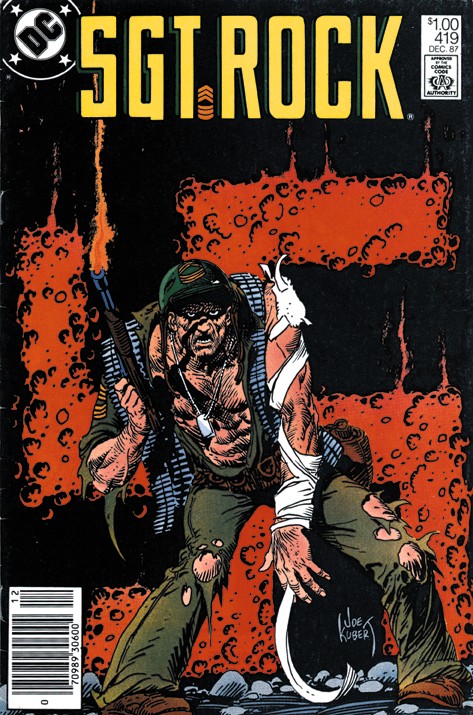
It also added superhero elements to the book, which isn't inherently a terrible idea (Punisher used to and still does fight superhumans and that seems to work just fine), but my thought is: If you're going to relaunch a character and have him fight supervillains why would you choose Sgt. Rock? A character famous for fighting in WWII exclusively? And don't we have Stormwatch for that? Also the book was called Men of War. I mean, did they even try?
After the failure of Men of War (just hire Garth Ennis, will you? Or Greg Rucka? Or Chuck Dixon? What's wrong with you idiots?) they started up GI Combat, which is the most comic booky of comic book ideas: soldiers fighting dinosaurs. Only Darwyn Cooke has ever made a worth a damn story about dinosaurs fighting GIs and that only lasted about a dozen pages. It's a terrible idea. There's nothing wrong with straight WWII stories. There's never been anything wrong with that. If you have to change the premise of something good either you have a brilliant concept or you're an idiot who doesn't know a good thing when he sees it. You can only round the wheel so much and that's Sgt. Rock if there ever was an idea.
It's simple, clean, Nazi killing fun. While that's not a great pitch to anyone outside of myself-- fuck you, this is my blog, damnit!
Ideal Directors: John Woo. No other names. Just John Woo.
Elevator Pitch: Quentin Tarantino proved that people still love a good WWII yarn and there's a million different ways to tell them. In short: Sgt. Rock kills Nazis. Let's let him. Also, fuck all of the DC 52 military relaunches. The fuck are they doing over there?
The Winter Men

The Winter Men is one of my favorite comic books of all time. Every aspect (but its tragic release schedule, which I'll get to in a bit here) is nailed perfectly by the writing and by the art.
The Winter Men takes place in a world where super heroes and super science once ran rampant, but has since fallen to the wayside, forgotten and abandoned like so many once mighty creations of the Soviet world. The main story isn't so much about those great colossi as they exist to set up the background of the world. They were then, the corruption and intrigue of post-Soviet Russia is now. From the accents to the background artwork The Winter Men feels like an incredibly well thought out and fleshed out world that we're only getting to see a sliver of one panel at a time.
Then there's John Paul Leon's artwork-- which I realize would not make it to the big screen-- which works excellently with the writing. He gives it just enough detail to flesh out this world and to feed back into teh realism of it and yet he can also draw robotic supermen and atomic children without it feeling silly. It's not so much of a strange book, it's a unique one. It's exactly the kind of weird jewel that I follow comic books for.
Maybe, at least it'll get people to buy more of these books. And if the creators get a nice piece of the pie, well, that'd be dandy. Overall, though-- and this is the fan in me speaking-- is that a movie could conceivably deliver a final and finished ending to a story that truly deserves it.
Ideal Directors: Duncan Jones, Martin Campbell,Werner Herzog.
Elevator Pitch: Fuck you, this book is a wonder. Give me the money I need to make glory. Fuck all the bodies who will not wish this so!
Honorable Mentions:
Bone
The One Trick Rip-Off
Onwards Towards Our Glorious Deaths
The Other Side
Queen and Country
Scalped
The Sixth Gun
Alright. That's enough of that. I'm going to go watch Prometheus now and then wonder later unironically why nobody seems to do anything original any more.
12 January, 2011
Vertical Blinds in Cinema

There's more than likely quite a number of well written and poignant essays on Double Indemnity, so I'll be brief (that's usually the conceit I use to be lazy).
Lately I've been on a noir/crime/thriller/whatever kick, so I've been trying to plow through as many classics as I can (I just broke the pattern by renting Kiki's Delivery Service, a Japanese cartoon about a witch who delivers mail). For whatever reason I thought this was a Hitchcock movie, when I found out that it wasn't, I wasn't disappointed though, since it's directed by Billy Wilder, co-written by Raymond Chandler, and is based off of the James M. Cain novel. That's a pretty lofty pedigree.
Luckily the movie is exactly as good as the credits would lead you to believe. The dialogue is top notch (if a bit cute, but it's film noir, so lay off), it's well acted, and beautifully shot (there's at least two or three really good scenes with venetian blinds in them, as you can see above). I don't have a whole lot else to say about the movie-- I mean, I could waste your time on it-- but it's Double Indemnity. It's one of the all-time, great pieces of film noir, if not one of the all-time, great pieces of cinema.
While it isn't my favorite Billy Wilder movie (which is Sunset Blvd, naturally), it's still awesome from beginning to end. I feel like a bit of a heel that I knew so little about it until last week.
02 January, 2011
Another Thin Man
Alright, I'm going to try to switch up my blog for this year. I've been meaning to do so for a while, but this whole brand fresh 2011 thing gives me an excuse to clean the slate. So, I'm going to try to write a paragraph or two about every movie I see-- assuming I don't have to cancel my Netflix again (which is highly likely, so if laziness doesn't hit me first, expect this whole endeavor to drop off by maybe June).
I've written about the original Thin Man movie here and on my portfolio blog (normally this is where I'd link my review of the original film, but apparently it's locked away on Issu dot com somewhere, so fuck it, just imagine brilliant writing and call it a day), so I won't bore you
It isn't as good as the original film, not by a long shot. Maybe that's because I'm a far more jaded person or maybe it's because the originality of the first has worn off, but it's still worth seeing, if only for the inevitable dinner scene-cum-baby party-cum-mystery solution scene, which I'd say is rather unique for a piece of film.
Besides the idiosyncratic bits of the movie, it's full of the normal repartee and drunkeness that you would expect from a William Powell noir/comedy.
I was going to rewatch Collateral again and watch the new Sherlock Holmes movie today, but certain things like frostbite and vodka got in my way. Fuck it. There's always tomorrow, isn't there?
SIDE BAR: I would wreck Myrna Loy with the force of a thousand suns, I tell you what. It's one thing to be full of spunk or attitude or pip or whatever your dead grandpa calls being a handful, but it's a whole 'nother thing to be an intelligent woman. Is she as good of a detective as Nick? Fuck no, but that's like saying Ilsa wasn't as good of a secret agent as Rick-- it just ain't fair. What she is, though, is an intelligent, ambitious woman that isn't hampered by things like babies, domesticity, or her station in 1930's America. She's a goddamn pip and that's why we love her. While writing a feminist essay on The Thin Man series would be a fruitless, joyless endeavor, there is something to be said about how beautiful that woman looks in a movie full of pretty women.
I've written about the original Thin Man movie here and on my portfolio blog (normally this is where I'd link my review of the original film, but apparently it's locked away on Issu dot com somewhere, so fuck it, just imagine brilliant writing and call it a day), so I won't bore you
It isn't as good as the original film, not by a long shot. Maybe that's because I'm a far more jaded person or maybe it's because the originality of the first has worn off, but it's still worth seeing, if only for the inevitable dinner scene-cum-baby party-cum-mystery solution scene, which I'd say is rather unique for a piece of film.
Besides the idiosyncratic bits of the movie, it's full of the normal repartee and drunkeness that you would expect from a William Powell noir/comedy.
I was going to rewatch Collateral again and watch the new Sherlock Holmes movie today, but certain things like frostbite and vodka got in my way. Fuck it. There's always tomorrow, isn't there?
SIDE BAR: I would wreck Myrna Loy with the force of a thousand suns, I tell you what. It's one thing to be full of spunk or attitude or pip or whatever your dead grandpa calls being a handful, but it's a whole 'nother thing to be an intelligent woman. Is she as good of a detective as Nick? Fuck no, but that's like saying Ilsa wasn't as good of a secret agent as Rick-- it just ain't fair. What she is, though, is an intelligent, ambitious woman that isn't hampered by things like babies, domesticity, or her station in 1930's America. She's a goddamn pip and that's why we love her. While writing a feminist essay on The Thin Man series would be a fruitless, joyless endeavor, there is something to be said about how beautiful that woman looks in a movie full of pretty women.
05 August, 2010
Cinecult: Film Noir!? I Hardly Know Her!
Film noir is probably something most of us here love, but I'm also willing to bet that it's something most of us are in the dark about (rim shot). It's a far larger and wider genre than people like Frank Miller present it to be. It's been around since the 1930's and it's as storied and respectable as any other genre, even though most of its source material can safely be considered pulp garbage (but what can't be, these days?).
With that said, I'm going to shoot my mouth off about it. Let's take a journey through film lore, shall we?
Film noir was created out of a few factors in the late 1930's. In general there was a malaise in the American public (and ditto abroad). It hadn't quite recovered from the Great Depression and Hitler's maneuvers half way across the world wasn't making anyone feel any better about their lot in life. Many of the movies were direct adaptations from the hard-boiled novels of the era. Authors like James M. Cain, Dashiell Hammett (who wrote about the east coast), and Raymond Chandler (who wrote about the west coast). Even writers of proper literature like William Faulkner and Ernest Hemingway could be folded into the heritage of film noir.

Another influence was the surge of German and European film makers fleeing Europe due to the specter of Nazi Germany. As a result, many talented film makers like Fritz Lang, who were a part of German expressionism took what they knew and moved it to Hollywood. While for many, their best work was behind them, the abstract, moody, and stylized lighting of the movement helped steer the genre into what it would become.
During the brief era that film noir were popular and numerous they weren't actually called anything more than B-movies or crime movies or distractions from the various horrors occurring in Europe and in the Pacific. It wasn't until WWII ended that the French discovered a whole crop of gritty, American crime dramas that weren't available for almost five years. It was then that a whole new audience began to notice the similarities of all of these American crime movies-- both good and bad.
So, French critics dubbed the movement "film noir," meaning "black film," which probably came from a combination of the low lighting prevalent in the movies (because why build a set when you could light it dramatically?), as well as the dark themes.
(By the way, if you ever want to be a know-it-all, if someone calls a book "noir" correct them by saying "Uh, actually, it's only noir if it's a film. Duh." Also, you'll get double points for pronouncing it as "new-ah.")
Putting a name on it, probably also helped hasten its end. Howard Hawks and Jules Dassin and all of the great directors never sought to make a movement or a genre or anything besides an interesting film. Once something like that becomes self aware, it's only so long before it starts to get too ornate or rigid for its own good and someone starts to parody it. Things can only become so baroque before they start too become gaudy and ridiculous.
The same thing happened to Spaghetti Westerns. Leone, more or less, started the movement copying and exaggerating the tropes of American Western directors like John Ford. In less than ten years the sub-genre was kaput, a victim of its own success, and by its end, even Leone himself was making parody movies
Film noir, as a movement started with Howard Hawkes' adaptation of The Maltese Falcon in 1941 and it ended with Orson Welles' Mexican border crime film Touch of Evil in 1958.
While the movement and its influences lasted well past the date of 1958, the golden age ended with Welles' butchered opus.
The classics of the era are numerous, but a brief list would include:

The Maltese Falcon.

Casablanca, a rare classic that is better than everyone says it is. The movie features one of the best screenplays of all time, as well as an incredible cast of characters, ranging from Syndey Greenstreet to Peter Lorre and, of course, Humphrey Bogart and Ingrid Bergman.

Touch of Evil, directed and starring Fat Orson Welles, along with Charlton Heston as the single most unbelievable Mexican in film history, it isn't a perfect movie, but it has more than a few moments that make it the last gasp of a great era-- including one of the longest and most impressive single-take crane shots in film history.

Double Indemnity had its screenplay written by Chandler (based off of a Cain novel) and was directed (and written) by one of the great directors of all time, Billy Wilder.
Then there's the French copycats and prototypes, which are equally numerous:

Elevator to the Gallows is an interesting movie, because it's both directly influenced by American film and by ugly pieces of French history like the Indochina War. What makes it stand out is its rather avant garde soundtrack by Miles Davis, who, as I recall, recorded the whole thing in one day. It's also a movie that shows that the French hate police officers.

Les Diaboliques, which was later remade in the 1990's. The film is directed by Henri-Georges Clouzot, who is one of the great French directors that didn't make it to the New Wave.
When William Friedkin met Clouzot in the 70's, he told him that he'd be remaking his movie The Wages of Fear. Clouzot then said to him, "Well, it won't be as good."

Le Samourai. I've spoken about this movie a lot. In fact, it's been the subject of no less than three identical sig/avatar combos on this forum. It's the epitomy of cool. It's not a fast moving film, but Jean-Pierre Melville proves that he's a methodical director and that Alain Delon is more than just an obscure punchline in the first season of the British version of The Office (it's the episode where the guy throws the shoe on the roof). Also: Le Samourai was a heavy influence on John Woe-- The Killer is more or less the same exact plot.

Rififi, directed by American Jules Dassin, it's regarded as one of the greatest heist movies and French crime films of all time. It was later heavily borrowed from by Jean-Pierre Melville in his own fantastic movie, Le Cercle De Rouge (see image below).

There could be a whole other thread about the atavistic works and films that made film noir what it is, but if you boiled down the genre, what you would find are a few, basic tropes-- especially in the movies-- that define what film noir is.

There's the reluctant hero (or the plain anti-hero). In Westerns people like Gary Cooper and John Wayne did what was right and punished the bad guys. In film noir, more often than not, the protagonist would get his head kicked in by the sheriff. He doesn't want trouble and he doesn't care about it, it just finds him.
The doppleganger (which is much harder to express in a single still image so I'm going to skip it), but usually the guy is either framing the main character or being chased by him. This character more or less underpines the idea that being a hero isn't all that different from being a scumbag on the street.
And, of course, there's the femme fatale.

The femme fatale kind of gets a bad rap. While she is bound to the Production Code's rule that a sexy woman is evil, they're interesting because, often they're what starts the plot in most of these movies. It isn't Philip Marlowe that goes out looking for trouble, but rather, some crazy dame that-- somehow, every time-- gets him mixed up in everything. They aren't exactly paragons for the feminist movement, but having a women this powerful and this sexual in a genre as murky as film noir was an important part of
Some people like to drop film noir as an idea that went and died and are clever for bringing back, but film noir has always been with us. It's too good of an idea to be left by the wayside and, unlike the western, its nowhere near as costly or complicated to replicate.
In the 1974 Roman Polanski directed Chinatown, a tribute to the classic American detective movie. It was written by Robert Towne,.
Even though the movie didn't intend to bring anything back in and of itself, it did signal a new wave of films inspired by film noir.
Neo-noir, much like the creation of the modern action movie, established itself formally during the 80's. In many ways neo-noir shares a heritage with action movies (which didn't exist as we know them know until the 1980's).
America wanted (and needed) old fashioned films and something to rationalize the ugliness of the past twenty years. Action movies were the more direct way to deal with the failures of twenty years of bad government and in a way both the action movie and neo-noir were a way to deal with American losing its first war, the government transforming into a villain, having drugs run amok in the streets, JFK and MLK having their heads blown off. have feminism and civil rights and Indian rights and everything else turn the status quo on its head, not to mention Watergate, the fuel shortage, joblessness, and the general failure of the Great Society. Obviously the 60's and 70's were no picnic anywhere else in the world, but in America, I think the movies we got later were a symptom of this mass, disappointment with the world.
On the plus side, at least we didn't get another Shirley Temple.
So what movies count as neo-noir?
The original wave would include (but not be limited to):

Chinatown is as perfect as it is depressing. It might have been directed by a child raping, prison dodging goon, but the work itself is flawless. It's kind of ironic, now that I think about it.

Body Heat, which, like many movies on here, isn't great, but it's worth seeing if only for some crazy, hot, sweaty sex the likes of which is rare in American cinema. And as bonerlicious as it is, it's a rare movie (like Akira Kurosawa's Stray Dog) that makes you feel how muggy and unpleasant the weather in the movie is.

Blade Runner is a confluence of sci-fi and hard-boiled and the results aren't exactly perfect. It's one of my favorite movies of all time, but it's plagued with fiddling by the studio and didn't get a proper release until a few years ago in its full restored glory. Blade Runner mixes a lot of old LA noir tropes (like the Bradbury Building and the architecture of Frank Lloyd Wright) with the (then) fledgling come back of big special effects pictures.

No Country For Old Men. The movie was based on the novel by Cormac McCarthy and takes place on the Texas border in 1980. The movie mixes up a lot of ideas about Westerns along with the classic crime/thriller/chase movie. There's lots of things going on in this movie and it's one of the best to come out of the past ten years. The Coen Brothers directed the movie and one of the defining features of their work is that they always seem to be leaning heavily on past features (The Hudsucker Proxy was a throwback to the screwball comedy and O Brother Where Art Thou was based, in part, on Sullivan's Travels).
The Big Lebowski, The Man Who Wasn't There, and Blood Simple are also infused with film noir aesthetics and sensibilities, perhaps more apparently than the movie above.
The Killer Inside Me, which is also based off of a novel (have you seen a theme, yet?) by Jim Thompson which was written in 1952. While movie has received mixed reviews, mostly based off of its alleged misogyny, it's safe to say that with a subject matter like this, yeah, it's film noir.
And, of course, LA Confidential, which was based off of the novel by James Ellroy, a Los Angeles native and gifted crime writer. There's plenty of movies that attempt to copy that era of LA, but none have done it as well as this movie. It's impressive considering that most of the leads aren't from this country.
Genres are like anything else in art, they aren't rigidly defined and even though you can attach a definition and an understanding to them, there's so much bleed over and overlap that you can't ever fully get a grip on it. There's no real end to the Western, you see it in every TV show where someone has a revolver or wears a hat. The Simpsons still do musical numbers, even if it's probably much easier to wrangle a stray cell than a crappy dancer (Now that I think about it, Blazing Saddles was a Western and had a musical sequence). We still have "Women's Pictures" and melodramas, too (Tyler Perry is a fairly shitty replacement for , then again, most people are).
I'm tired now. Now you talk about film noir (feem newah).
Bonus! Here's a great website for photos of film noir. It has a pretty appropriate title.
More of a Bonus! Here's a further link to shit I posted, but have no desire to reformat.
13 July, 2010


Subscribe to:
Posts (Atom)