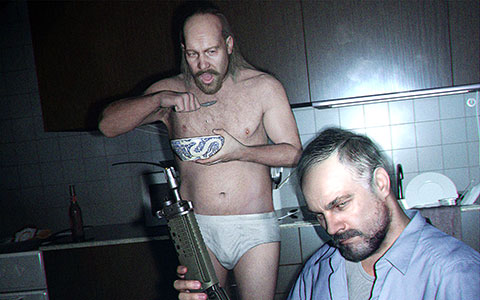
Is that. . . Is that a new Blade Runner gun on the left? Next to the M2019 PKD Detective Special?
YOU TELL ME
Showing posts with label Ridley Scott. Show all posts
07 October, 2016
16 October, 2015
Mark Watney of Mars
A Review of The Martian (2015)
by James Kislingbury
The past decade or so of Ridley Scott's
career has not been the greatest. Since the early 2000's successes of
Gladiator and Black Hawk Down, his output has been one long run of questionable films that range from the half-baked, the
butchered, the confusing, and the downright awful. During this period, his technical skills only seemed to remind us that he once seemed capable of making good films. And then we remembered that his last unqualified good film came out around ten years ago.
The Martian, thankfully, defies this trend. It's the best movie Ridley Scott has turned out in a decade. It's fun, it's light, and despite lacking the depth of his best works, it's an eminently watchable film. Considering the amount of calories I've wasted defending Kingdom of Heaven and Prometheus, this is exciting for me.
The Martian is about Dr. Mark Watney, hunk and space botanist, who is stranded on the red planet after a freak storm. From there, it's a series of duct-tape drama, self-surgery, and, back on Earth, an oddly gripping story that revolves around resource allocations (that and conversations about how people should just, like, try harder). It's more Robinson Crusoe than it is
Enemy Mine, more Apollo 13 than it is, uh, Robinson Crusoe on Mars.
It's tackles the science fiction genre
in a way that I don't think I've ever seen. Namely, it's a movie that
is about actual science. Films in this niche have always dabbled with this sort of thing. Interstellar jumps most immediately to mind and 2001: A Space Odyssey jumps most unfairly to mind (as though anything should ever be compared to a Kubrick movie, for good or for bad). Those films only use the science a starting point for the drama. With The Martian, the science is the drama. It is the end all, be all of the film. It's a film without a villain, where doing long division is more important than bravery.
For the most part it works. Seeing a guy, step-by-step figure out how not to die is pretty intriguing. You know, that's cool. The problem comes from the fact that there's no real emotion in the film. It's a long line of problems that need to be solved and smart people doing bloodless math in their heads about how it gets solved. I mentioned it in my podcast, but later on, I thought of United 93 and the thrills Paul Greengrass manages to eek out of bureaucratic procedure and couldn't help but realize that I've seen it done better than it was in The Martian.The Martian is a perfect title, because nobody in the film ever seems to act like a human being. People assemble into rooms, assess a problem, and then all go to their respective corners like no collection of human beings in charge of multi-billion dollar programs would ever do. It's a movie where Jessica Chastain is stoic. I don't know about you, but stoic is not why I show up to a Jessica Chastain picture.
The film seems more interested in maintaining momentum than it does in creating individual moments where characters can be confused or upset or indecisive. Human beings don't fit into alegebra, so the film moves right past them.
As lacking as the film is in emotion or any sort of attachment, it does have its moments here and there. You have Donald Glover taking the set of skills he honed in Community to be the most obvious quirky scientist this side of The Big Bang Theory (which, like JPL, is also in Pasadena). Then there's you have Sean Bean and Jeff Daniels dueling in a series of industrial offices over who can appear the most affably schlubby without tipping over into "I have a puppy in my van" territory. Most importantly, you have a montage set to David Bowie's "Starman," which is important if only because it is only the third most obvious David Bowie song about space and someone deserves credit for that coup. Then, after these moments, the story kind of slides back to its steady, unwavering tale about a dude trying to figure out how he can, oh boy, "science the shit" out of his space car. Beyond the drama and beyond its technical achievements, The Martian deserves viewing, because it speaks to the importance of space exploration. Between the various disasters that have plagued our space program and the various earthbound horrors we've witnessed over the past decade or so, we've lost our ability to stare at the stars and wonder what could be. We've forgotten what they mean. The Martian steadfastly ignores this sort of cynicism. Like its drama, there's no place for it. Space travel is an incredible achievement. It is something that represents the best of our race. In this film it isn't some asshole's talking point about how we should spend that money feeding people in America instead of sending people to space (as though we have to choose). Going to space is, in a very real way, the best we can do as a species. If this film can put us right on the importance of space exploration, to get us wondering about what could be, then The Martian will have done its job.
Imperfect as it may be, The Martian is one of the smartest blockbusters to come out since, well, Interstellar. It is a film that, despite its failings, manages to strike a balance between hard science fiction and populist entertainment. It's, you know, pretty cool for the most part. As many better films of this sub-genre as there are, there are few that are as well produced as this one and even fewer that are as technically accomplished. The Martian is a respectable, enjoyable film that is also about as overflowing with human feelings as the planet it depicts.
James Kislingbury is a writer, a podcaster, and an Explorion.
25 February, 2015
This is How it Ends
A Review of Prometheus: Omega
Part Sixteen of "James Versus Fire and Stone"
I was going to say that “Fire and
Stone has been a real shit show,” but then I realized that calling
it such terms doesn't do it justice. The real value of Fire and Stone
is that it's been a learning experience for me. This comes on the
heels of me realizing some things about my “career” (which is a
term that needs some bold quotation marks). Fire and Stone hasn't
pointed me towards this exactly, but one thing I've learned, or at
least one thing that has really codified a philosophy I've been
developing for some time. Basically, I realized that as bad as
something might be, it's not my job to fix it. And it's certainly not
my job to fix it for free. As flawed as Prometheus might be as a
comic and as just plain incompetent as Alien Versus Predator is, it's
not my job to sit there and think of ways that I could make this
better.
Because that's a sucker's game.
And that bums me out. I should be the
target of internet vitriol. I should be the one with snarky blog
posts aimed at me. I should be the one losing sleep to meet a
deadline on a book that nobody will remember in two years time. I'm
not saying that a “creator” is inherently better than a “critic”
(they aren't, just tell me that Roger Ebert hasn't contributed more
to art and civilization than Uwe Boll). I've just been struck by this
general sense that I need to do more. Whatever that means.
Maybe I should thank each and every
book in the Fire and Stone line-up. It wasn't the straw that broke
the camel's back, but it has pushed me. In different ways, each one
of these books has pushed me to be a better writer. Maybe.
Anyways, with all of that said, when I
found out that Fire and Stone was seventeen parts and not sixteen, I
know I groaned. I must have. There's no other sane response to
finding out that I'm going to get suckered out of another four bucks
on a self-imposed dare. All of that said, this last book came as
something of a surprise. Because, Blimey. Prometheus: Omega is
really, really good.
Omega is written by Kelly Sue
DeConnick, she of Pretty Deadly and Bitch Planet (which shares the
same pulpy/political DNA that made up the first three Alien movies).
That should have told me that this was going to be an excellent book.
Of course nobody told me this. It's nice to be pleasantly surprised,
though. As much as Pretty Deadly is most certainly not my thing, she
is a writer with a point of view and a set of skills that I like to
see put to work. There's also this tinge of liberal guilt in the back
of my head telling me that it's nice that women are writing more
comics and that these comics are good (I'm currently reading a trade
of the new Ms. Marvel run. It's so good, guys). There's no inherent
value to that, I suppose, but it's nice. And it certainly can't be
any worse than the men who worked on AvP.
Agustin Alessio deliver some solid work
as the book's artist. Like the artist behind Prometheus, Alessio
delivers a painterly quality that gives the work a level of class
that you don't see in a lot of other books. Often when you see this
style of work in a comic, it ends up being a series of good looking
pictures that, when put together form a bad comic book (the companion
to this phenomenon would be when a screenwriter or a novelist tries
their hand at making a comic). Fortunately, that isn't the case.
Alessio's work isn't perfect, though.
His work does lack some of the impact and the kinetics of Mooneyham
had on Predator (a very different book, but one with a steady hand
behind the art). Yet, conversely, therein lies its strength. His work
isn't fantastical. It isn't showy. It's grounded and it gives the
story the kind of weight that a horror (or adventure) story like this
should have. The world of Prometheus: Omega looks less like a comic
version of an alien planet than it does an alien planet. Tonally, it
shares the most similarities with Patric Reynolds's work, which
couldn't look more different stylistically.
I like it a lot is what I'm saying. I'm
sorry I lack the vocabulary for writing about art. I should work on
that.
MUTANT OF THE WEEK: Dare I say. . .
It's Elden.
That's right. Elden: My Most Hated of
Characters. Elden the Abomination. Elden the Plot Device That Just
Won't Die. Elden the Least. He's kind of great in this. As listless
and silly as he's been in the hands of other writers, DeConnick
actually manages to put him into the right place at the right time
and turn out a corker of a story.
As I say this, keep this in mind: There
is a mutant mountain full of alien juice that the team has to escape
from. Elden, for his achievements in this book, is cooler than a
living piece of the planet- Cooler than an actual xenomorph as
defined in the dictionary.
Then again, Elden's final scene is him
becoming a Giger tapestry. How can anything in the world compete with
that?
![]() |
| Nothing to do with the topic at hand. I'm just excited for this movie. |
After a long spell in the cold, it's a
relief that I can give Prometheus: Omega FIVE OUT OF FIVE
CHESTBURSTERS. It's nice to see something this well put together cap
it off the only miniseries event that I've ever partaken in. I'm glad
it's over, but I'm also glad for the few highlights cut inbetween the
crap. Omega is a rare beam of light.
As a stand alone comic it also works.
It's well written. It's funny. It's weird. It's good looking. Like
Predator, it's everything a comic book should be and, even better,
it's everything this
particular comic should be.
If you have any affection at all
towards Prometheus, Aliens, Predator, or any combination there of,
this is a comic you should pick up. Or you should just pick it up
because Kelly Sue DeConnick is a talented lady who deserves your
adoration and dollars. If Fire and Stone only provided her (and the
team on Aliens and on Predator) a forum for more people to see them,
then perhaps it was worth it.
Perhaps. . .
You can read all of "James Versus Fire and Stone" here! There! It's all there! Read it!
Alien Versus Predator #4 Predator #3
Aliens #4
Prometheus #4
Alien Versus Predator #3
Aliens #3
Predator #2
Prometheus #3
Alien Versus Predator #2
Aliens #2
Predator #1
Alien #1 and Prometheus #1
James Kislingbury is basically over it.
22 February, 2015
“BEHOLD! GLORY!”
Predator #4 Review
Part Fifteen of James Versus Fire and
Stone
I can't believe I've made it. I can't believe we made it. I can believe that I'm this late, though. That shouldn't come as a surprise to anyone. In reality, this whole thing. . . Well, I guess I'll get a little more meditative when I review Prometheus: Omaga. . . Whenever it is that I get around to that one.
Back when iFanboy* had a website complete with writing one of the running gags, or complaints, really, was that it was hard to write things about good books week in and week out. There was Brubaker's run on Captain America. There's books like The Walking Dead (which they read in different formats, but still). Even now they still kind of go on about how it's hard to say new things about books that are continually good (Batman under the tutelage of Scott Snyder and Greg Capulo comes to mind)
I always saw that as a lack of
creativity. Or will. Some kind of intellectual cowardice. Well, I'm here to
say that I'm an asshole. It's hard to say more good things about
Predator #4.It's just a solid book. It's fun. It's
funny. It looks good. It feels good in a way that I cannot quite
quantify. It's possible that it isn't the most intellectual stimulating book on the market, but I bet a lot of smarter books don't also have an alien big game hunter getting into a fist fight with a living god. If you like Predator, then go buy this book. Go read it at
your local library. Just do something, will you?
It ends in a stronger way that any of
the other books have. A solid portion of my good feelings towards the
ending is down to this being an otherwise excellent book. So, if the
ending is open-ended or incomplete in some way, oh well. The rest of
it was fun as hell. In the end we get the journey and the destination. Good for Predator.
Also, shouldn't it be enough that something doesn't make people feel bad about things? That's an art, right?
If you want to imagine what this book
is in my brain, it's Christopher Mooneyham and Joshua Williamson
doing donuts in the school parking lot while everyone else from Fire
and Stone looks on in frustration, trying to finish their assignments
(not sure if Sebela and Olivietti can see it from the special
education building down the way, but they can definitely hear those
sweet, sweet donuts getting pulled). That's what it is. Imagine two
bros pulling donuts in a parking lot forever. That's Predator: Fire
and Stone.
Fuck it: I give Predator #4 FIVE OUT OF
FIVE CHESTBURSTERS. I love it. It excites me. There's something about
taking a thing as silly as a Predator/Prometheus/Alien crossover and
taking it just serious enough to crank out a fun book. Go read it.
Contrary to my whining about the BOOK WHICH SHALL NOT BE NAMED,
this is the type of thing you should support. It's not high art, but
it doesn't need to be. It's a genre piece that works and, since we're
all friends here, I'm not afraid to say this: Sometimes that is as
good as you need to be.
You can read the previous installments of "James Versus Fire and Stone" below:
Alien Versus Predator #4
Predator #3
Aliens #4
Prometheus #4
Alien Versus Predator #3
Aliens #3
Predator #2
Prometheus #3
Alien Versus Predator #2
Aliens #2
Predator #1
Alien #1 and Prometheus #1
*Gee, I sure mention iFanboy a lot. Probably because it's one of the few sources of comic opinions that I've listened to over the past eight years. And it's not like I'm going to link my friend Joe's opinion or a back issue of Wizard or something, appealing as that might be to everyone. . .
You can read the previous installments of "James Versus Fire and Stone" below:
Alien Versus Predator #4
Predator #3
Aliens #4
Prometheus #4
Alien Versus Predator #3
Aliens #3
Predator #2
Prometheus #3
Alien Versus Predator #2
Aliens #2
Predator #1
Alien #1 and Prometheus #1
*Gee, I sure mention iFanboy a lot. Probably because it's one of the few sources of comic opinions that I've listened to over the past eight years. And it's not like I'm going to link my friend Joe's opinion or a back issue of Wizard or something, appealing as that might be to everyone. . .
James Kislingbury is a writer, a
podcaster, and a survivor. You can follow his show here. You can
donate to his endeavors here. Or you can just hire the poor bastard.
Have you seen how skinny he is? He can't be eating well.
16 November, 2014
"I'm tired of your bullshit"
A review of Alien #2
Part five of "James Versus Fire and Stone"
Here we are again. Another week,
another entry in Dark Horse's “blockbuster event” Fire and Stone.
This week: Aliens #2. This is the sixth installment in the series and
my fifth blog entry. By the time this comes out, we'll be a full two
months into this long march to insanity. Let's do it, to it, shall
we?
Half out of confusion and half out of
academic interest, I've been asking myself over and over again: What
makes an Alien story and Alien story?
I think the best way to boil down what
makes the Alien series unique (besides the titular creature) are the
themes that it visits and revisits. It's these ideas that Ridley
Scott and his creative team produced in the original film that were
then extrapolated on and expanded upon. At some point the
French got involved and really fucked up the line of reasoning, but,
hey, what are you going to do?
Each movie is fairly different from the last, yet there are a few disctinct features and themes of each movie (the cast outside of Ripley). There are also a few themes that reoccur a few times, but not in every movie (such as the Colonial Marines and Jones the cat, for example). A lot of other movies use the same tropes, but an Alien movie is different in that it uses the same tropes over and over again.
All of this in mind, I did the most academic thing I could think of: I made a list. Below are the things that define the Alien series (as I see it):
Working class heroes (The crew of the
Nostromo, the Colonial Marine grunts)
Androids (Ash, Bishop,
possibly another Bishop, Cole. This can also be extrapolated to the idea of something being human-like, but not in and of itself human like the Alien.)
Monster as Worst Nightmare (Being an unkillable Space Viet Con in Aliens and a demon from Hell/woman in Alien 3)
An Evil Corporation/Higher Authority
(“The Company,” Weyland-Yutani, the Army)
Strong Female Protagonist
(Ripley, Ripley, Ripley, Ripley, and even Elizabeth Shaw)
Industrial Space/Working Environment (The Nostromo, Hadley's Hope, the Leadwork)
Confined and Inescapable Spaces (Space Ships, Prisons, Etc.)
High Schlock (Haunted House + Gender Horror, Sci-Fi Military Metaphor, Apocalyptic Prison Drama, and. . . a French movie.)
The Alien Itself (and its ability to mutate and adapt. The queen, the facehugger, the hybrid, etc.)
(Let me know if I missed anything!)
In that regard, Aliens #1 and #2
features a scant handful of these themes. There's the Working Class
Heroes. The Company is also present, but it isn't
malevolent or greedy, it is just there. If anything, it's a zombie
comic book with some aliens thrown in. Which, you know, hey. That's a
perfectly fine idea. If you can't copy it, at least mke it
interesting. It's just that it isn't an Alien story. Not really.
As for Fire and Stone as a whole (and a
lot of other Alien comics), I can't tell if the writers and artists
are simply trying something new and failing or if they simply do not
get it. These books seem to exist in this middle ground, where I'm
wondering whether I should pat them on the head for doing their
darnedest or to roll this book up and hit them on the nose with it.
That's annoying. I like my emotions to be clear cut.
What I keep on thinking time and
time again: "This doesn't feel right."Besides my metatextual nitpickings, how is Aliens #2?
It's a solid horror comic. Patric Reynolds is doing a bang up job keeping the book as dark as it
should be. There's something about his work that seems grimy and
funky in the way that an Alien story is supposed to be.If anything fits my semi-fictional construct of what an Alien story is, his art is it.
I wonder if he's done a Hellboy book before. . . He has! And an issue
of Abe Sapein. Huh. Makes sense.
As for Roberson, he keeps the book
moving and on point. There's nothing terribly fancy about his work,
but that's just fine. The plot moves forward and as spare as the some
of the story might be, it moves along and it tells it all coherently.
Actually, now I'm going to look up
Chris Roberso, as well. . . Man. This guy is mad prolific. Good for him! Good
for everyone!
So, the story. What goes down?
After some fairly yeoman like exposition and an obvious revelation or two, the end sneaks up on us with a really interesting cliffhanger.
Keeping in lock step with every other issue #2 (including AvP, a comic I have yet to review), Aliens #2 ends with a mutation. This time, a xenomorph and a human are seemingly bonded together by the Engineers' black goo (or "accelerant" as this comic insists on calling it for whatever reason). It's fun to see the black goo increase the stakes and change the status quo. It's a simple addition to the formula and it is exactly the kind of change I do want to see coming out of a non-canon Alien franchise expansion (did that sound qualified enough?).

Plus, we get to see a new, weird mutant-alien and why wouldn't we want that?
After some fairly yeoman like exposition and an obvious revelation or two, the end sneaks up on us with a really interesting cliffhanger.
Keeping in lock step with every other issue #2 (including AvP, a comic I have yet to review), Aliens #2 ends with a mutation. This time, a xenomorph and a human are seemingly bonded together by the Engineers' black goo (or "accelerant" as this comic insists on calling it for whatever reason). It's fun to see the black goo increase the stakes and change the status quo. It's a simple addition to the formula and it is exactly the kind of change I do want to see coming out of a non-canon Alien franchise expansion (did that sound qualified enough?).

Plus, we get to see a new, weird mutant-alien and why wouldn't we want that?
Is Aliens proving to be an integral
extension of the Alien series? No. Look to Alien: Isolation if you want that. But, is it a good book that manages to
mix Dawn of the Dead with Land of the Lost and sprinkle a bit of Lost
here and there? Yes. Is it worth reading? It kind of is. I am
interested to see where Predator #2 goes, but so far Aliens is in a
technical lead as the best book in Fire and Stone.
This book gets Four out of Five
Chestbursters. I am kind of on the fence about some things and #3 is
going to be the book to determine whether this is an actual book of
quality or if it just appears to be. But, I am optimistic. Hesitantly optimistic. . . Or maybe that does make it an integral
part of the Alien franchise after all.
James Kislinbury is a writer and a podcaster. Right now he's begging for money to support the latter on Patreon.
You can read previous entries in "James
Versus Fire and Stone" below--
Predator #1
Predator #1
James Kislinbury is a writer and a podcaster. Right now he's begging for money to support the latter on Patreon.
03 November, 2014
"We Were So Wrong!"
A Review of Prometheus: Fire and Stone #2
Part Three of "James Versus Fire and Stone."
Prometheus #2's greatest sin might be
that it is rote to the point of not needing to exist. It is baseline
comic book making from beginning to end. Its one or two interesting moments are
counter-weighed by an equal number of equally powerful moments of
idiocy. It isn't bad, it's just not very good.
Prometheus #2 executes on the
cliffhanger issue #1 sets up. Meaning: Everyone gets turns into dog
meat by a horde of xenomorphs. So there's that. This is followed by a
chase scene involving lots of gunfire and then, finally, a
mutant-alien shark attack. And it doesn't work. It's just there. As action, though, it isn't compelling because none of the people being killed or fighting back matter. They're just cyphers for the aliens to chew through, one after the other.
![]() |
| I couldn't find any real art from #2, so here's this. |
It made me think of Alien 3 and one of the many reasons why it doesn't work. It's chock full of violence and carnage, but, as a story it fails to scare you in the same way that it does in Alien and Aliens (or even Predator). Why?
As many people get wiped out in succession in James Cameron's masterpiece (to which all of these stories owe a debt, so I think it is fair to bring it up), that movie does a very good job setting up who these people are in very short order. Drake is a jock. Apone is a born marine. That one butch pilot is a stone cold professional. That one black guy likes pussy. And the world these characters live in. We recognize them, we like them or we hate them, but we know who they are and when they die, we can see them die as people.
This comic does not accomplish that
feat of tricking the audience into thinking they know something.
Maybe it attempts to do so. Maybe it thinks that Prometheus, as a
film, is enough to carry this world along. That there is a certain amount of knowledge an audience is going to carry in with them. If that's the case, then
Paul Tobin has gravely miscalculated how to tell this story.
It isn't until about half of the way through the issue that any of the story actually bothers to get told. That's fine. Nothing wrong with that. I feel like most issues of Zero have a story that could fit on a bar napkin and that series is brilliant. This comic, if you haven't gathered is not brilliant.
The little plot we have is unpacked in a way that doesn't make sense and then completely lacks in any gravitas. So, it fails on both a functional and an emotional level. For example, our captain, you know What's-Her-Face, finally decides to come clean about the "true nature" of the mission. Her secret agenda being that she is out to discover what happened to Peter Weyland.
It's odd, because this is something that we already know. It doesn't read right at all. Is she supposed to appear to be a believer like Elizabeth Shaw? A fanatic like Ahab? A profiteer like the crew from Resurrection? Who knows! Who cares? All I can see is that her crew members are pissed off that they've been mislead. . . Even though danger was already inherent in the mission and there is no indication that they won't still be collecting big paychecks. She doesn't care about her mission, so neither do we.If anything, her "big reveal" is less a confession to her crew
than a half-hearted apology to the reader.
Secondly, there is an entire sub-plot involving Elden and some scientist guy, who discover a cave that a survivor had been living in on this hostile alien planet. And, credit to Tobin, the idea of Robin Crusoe in space is pretty neat (if lacking in a monkey this time). Where it falls apart is that this plot goes from "Hmmm, what's all this?" to "Let's shoot each other up with alien goop. Should work out, right?" in about eight seconds flat. It's ridiculous.
To borrow a quote from Roger Ebert, "A good movie should leave you searching for answers, not asking questions." If that is true, then Prometheus #2 isn't a good story. It is less about developing a mystery than it is about leaving certain facts half-told and hoping that's good enough.
It bares stating that Juan Ferreyra is a solid enough artist and he delivers in #2 just as he did in #1. He can draw talking heads that look suffictiently different very well. If any of his work is actually lacking, it is in his panel layouts. His action sequences both show too much and then fail to connect one panel to the next. For whatever reason they don't seem to work like they should. Maybe that's more the fault of the writer, but how fair is that? He's already getting blamed for enough here. . .
The main failing is Paul Tobin's story. It doesn't hold together. On a character level we fail to understand what is motivating these characters and why their actions matter.
And, again, that space ship still looks like shit.
I give this THREE CHESTBURSTERS out of
five. Not particularly great, but not particularly offensive. Plus,
it gets some bonus points for trying its hand at writing something
new for a movie that people talked nothing but shit about. A
thankless task, if there ever was one.
The next issue on the agenda will be
Predator: Fire and Stone #1. If you read one review in this entire
series, I think you should stick around and read that one. . . That and AvP #1, because I hated that thing.
You can also read my reviews for:
And, if I haven't said it before, I'll
say it this time: I am riding this fucking thing into the ground. There might even be a bonus after all the smoke clears. . .
James Kislingbury podcasts, writes,
draws, and has brow-beatingly bold beliefs about Alien 3. He also has a Patreon going for his podcast, so if you love rambling and movies, why not help us out?
12 October, 2014
Fire and Stone and Everything Nice
A review of Prometheus #1 and Aliens #1
Part One of James Versus Fire and Stone
Ever since my sister Amy bought me a Ripley action figure for my sixth birthday, I've had acid in my blood.
![]() |
| I'm not saying this triptych makes any sense, but I do want it tattooed across my back. |
2014 marks the 35th Anniversary of the film Alien and, as such this October has seen a
well planned flurry of secondary and tertiary market material: A newvideo game, a 35th anniversary blu-ray (which will mark
the 4th time I will have bought this movie and I still don't own it on VHS or laser disc), aninstallment in the BFI's Film Classics series, and a return of Dark Horse's
comic book series.
Also, there's a distinct chance that I
just wanted to feel pain.
![]() |
| Never mind the water mark. . . |
The first book I picked up up is
Aliens: Fire and Stone #1 by Chris Roberson and Patric Reynolds.
Aliens does quite a few thigns right, but what sticks out is something that has been driving me crazy when it comes to horror books (especially Alien books). It gets the art right. Patric Reynolds was the exact right choice for this project.
It's a kind of sketchy art that belongs on a horror book and, while
you can't hide behind lighting like you can in a movie, Reynolds' art
manages to evoke the kind of vague sketchiness that matches the subject matter and the tone of the writing.
As for Roberson, he wisely eschews colonial marines in favor of what built Alien in the first place (what William Gibson called its "kitchen sink funk"): Working Joes. Bread and butter, salt of the earth folks. People with jobs, people incapable of dealing with something like the Alien. That is to say, Robertson understands what makes Aliens tick and he understands what makes a horror book tick.
I give it four chestbursters out of
five. Not perfect, but I'm not going to begrudgingly pick up issue
#2. A promising start, yet, as with any licensed material, this thing might tip over at any given moment and list right into the fucking rocks. Let's hope it doesnt!
Then there's Prometheus: Fire and Stone
#1. Written by Paul Tobin and with art by Juan Ferreyra, Fire and
Stone #1 is, as I understand it, the first Prometheus story that
isn't the film.
My problems with it begins in the
opening fold of the book. To the left of the first page is a quick summary of the facts: Who Elizabeth Shaw is, what the Engineers are, and who Mr. Weyland is. Then, right at the end, as a little foot note, it adds one more fact: It says that it takes place after the
events of Aliens: Fire and Blood #1.
Hold up. After? How can it take
place? If I'm not mistaken, the entire premise of Prometheus is that
it is a prequel. It is fundamentally a story about origins. That's the reason it exists.
![]() |
| To be sure: This is the best page in the book. |
It's other main draw is that it is in
the Alien universe, but not exactly of the Alien universe. It is less a Phantom Menace than it is an Old Testament to Alien's New Testament
(except that it was written after the first movie and, as I
understand it, originally not connected to Alien at all, which, I
guess would make this Prometheus closer to the Book of Mormon than
anything else).
But, the premise of the Fire and Blood event (or
whatever Dark Horse is calling it) is that everything connected.
That's odd. The entire premise of this book is to make the entire
premise of the movie moot. With that said, you're faced with a story
about scientists that stumble into a bunch of aliens and, correct me
if I'm wrong, that isn't any different than an Aliens story.
Another thing: Considering the
amount of weird grotesqueries that inhabit Prometheus (the hammerpede, the deacon, that zombie, the Engineers, etc etc etc), why would you
go back to the well and show us the xenomorph, a monster we've seen a million times before? The comic does feature
a weird monkey monster and a hive of black goo infected ants (a silly
idea, but one that I can't fault them for, because it is literally
the exact same idea I wrote into an Alien screenplay I wrote about
seven or eight years back), so maybe it is holding back. Again: Let us hope.
Of course all of this would be fine if
it was a truly gripping story. It isn't. The Aliens comic is not
without its problems, but it accomplishes what it sets out to do: It
delivers a bunch of working class schmoes getting killed by aliens. Done
and done. I guess Prometheus #1 does offer up a mystery and no little
amount of foreboding doom, it's just, I need more than that,
especially when you're going to screw around with the core premise of
the book. When I see the premise getting futzed with, I tend not to
believe that this is a brave writer making some bold choices, but a
guy who doesn't get what he's writing. That's what this feels like.
![]() |
| It's not fair. They put Paul Pope on it, so I had to buy it. |
The other problem is the art. Unlike
Aliens: Fire and Blood #1, the art isn't great. Juan Ferreya does a
fine job. The problem is that, unlike Patric Reynolds, he doesn't fit
on this book. It's too glamorous, it's too realistic, it looks too
nice. I guess Prometheus is a cleaner universe than Alien's, but
that's like saying that Dr. Moreau has a nicer house than Dracula.
This story lacks the gothic horror that the universe requires.
Also, the font used on the comic's
cover kind of has that weird, lined gradation that Predator has.
That's weird.
Two out of five chestbursters. Could go
somewhere fun. So far I am unimpressed. Buying it next month will be
a slightly unpleasant experience. With all of that said, I do want to see what a Predator looks like when they get hit with some of that black goo. . .
What this will turn into, who knows? So
far, with only two issues (four as of today), the Fire and Stone
cross-over event is a real mixed bag. One solid book, another with a
lot of ground to gain. But I'll be buying them all and I'll keep you
update, because, man, I sure do love Aliens, Predator, and Prometheus
and if I was going to stop buying things based on quality I would
have started doing so a long time ago.
Labels:
Aliens,
AvP,
Comic Books,
Dark Horse Comics,
monster island,
Paul Pope,
predator,
prometheus,
Review,
Ridley Scott,
Sci Fi,
science ficiton
09 September, 2014
A Trailer, a Thought, and More Defensiveness About Movies I Love
This looks like it might be a winner, right?
After watching the trailer for Automata (which is way too close to the warmed up left overs that is the Penny Arcade crew's Automata), I wondered something: Are we quietly living in the best era of science fiction since the late 70's/early 80's? While that decade had Silent Running, Alien, and Star Wars and in the early 80's you have Blade Runner, Empire Strikes Back, Aliens, Terminator, and Outland.
Now, we have Looper, Moon, District 9, Inception, Primer, Her, Attack the Block, Snowpiercer, and the new Planet of the Apes series. . . I mean, these movies aren't perfect, but we're in pretty good shape here, right? They're either great pieces of cinema or they're interesting pieces of cinema.
And with that said, look at how good our big, dumb blockbusters are! Did anyone expect Guardians of the Galaxy to be that hardy of a picture? And while Edge of Tomorrow might be a lark, it's a smarter film than a lot of other sci-fi films that I do not care to name. Then there's Pacific Rim, which is a movie that I could go on about forever (and have).
And what did the 90's have? Total Recall (a great, great movie) followed by a bunch of Will Smith movies (you could argue for Terminator 2 (but that's more action than it is science fiction and that seems to be an outlier). Then you've got the 2000's which are stained with the legacy of the Prequels That Shall Not Be Named and, what? Avatar?
Oh yeah, Minority Report was awesome. Good call on that one, reader.
Maybe I just have a selective memory or a kind of blind confirmation bias. Who knows? Whatever the case is, we're lucky to be in an era where special effects have finally caught up with screen writing.
I don't know. Movie are cool. I guess that's what I'm getting at. We should be exicted about them. Which brings me to the next item on the agenda:
The script of Blade Runner 2 is complete.
There's been a lot of boring, Internet skepticism about this and as much as we all love a good skeptic now and again, it's important to remember you can shut the fuck up we have a goddamn Blade Runner sequel here. Thirty fucking years in the making do not take this away from me!
There's every reason in the world to trust Sir Ridley Scott on this one, too. I mean, he did make Blade Runner.
And Alien. And Gladiator. And Kingdom of Heaven. And Black Hawk Down. And Prometheus and fuck you, Prometheus is awesome. And sure, he's done quite a number of highly questionable films-- some of them as recent as the past year-- but, hey, when you're one of the greatest film makers of all time, you're entitled to a slump here and there. HE MADE BLADE RUNNER, YOU CURS.
In the meantime everybody go read Do Androids Dream of Electric Sheep as a warm up for Automata. And toss Neuromancer and Akira in there while you're at it, because, you know, they're great.
James Kislingbury is a writer, podcaster, and an enemy of mankind. You can follow him on twitter.
FOOTNOTES
*Notably I've left out Kathryn Bigelow, who would be perfect to take the mantle from Scott, except that she's already at work on Alien V, which is a fact that I am 100% is true.
After watching the trailer for Automata (which is way too close to the warmed up left overs that is the Penny Arcade crew's Automata), I wondered something: Are we quietly living in the best era of science fiction since the late 70's/early 80's? While that decade had Silent Running, Alien, and Star Wars and in the early 80's you have Blade Runner, Empire Strikes Back, Aliens, Terminator, and Outland.
Now, we have Looper, Moon, District 9, Inception, Primer, Her, Attack the Block, Snowpiercer, and the new Planet of the Apes series. . . I mean, these movies aren't perfect, but we're in pretty good shape here, right? They're either great pieces of cinema or they're interesting pieces of cinema.
And with that said, look at how good our big, dumb blockbusters are! Did anyone expect Guardians of the Galaxy to be that hardy of a picture? And while Edge of Tomorrow might be a lark, it's a smarter film than a lot of other sci-fi films that I do not care to name. Then there's Pacific Rim, which is a movie that I could go on about forever (and have).
And what did the 90's have? Total Recall (a great, great movie) followed by a bunch of Will Smith movies (you could argue for Terminator 2 (but that's more action than it is science fiction and that seems to be an outlier). Then you've got the 2000's which are stained with the legacy of the Prequels That Shall Not Be Named and, what? Avatar?
Oh yeah, Minority Report was awesome. Good call on that one, reader.
Maybe I just have a selective memory or a kind of blind confirmation bias. Who knows? Whatever the case is, we're lucky to be in an era where special effects have finally caught up with screen writing.
I don't know. Movie are cool. I guess that's what I'm getting at. We should be exicted about them. Which brings me to the next item on the agenda:
The script of Blade Runner 2 is complete.
There's been a lot of boring, Internet skepticism about this and as much as we all love a good skeptic now and again, it's important to remember you can shut the fuck up we have a goddamn Blade Runner sequel here. Thirty fucking years in the making do not take this away from me!
There's every reason in the world to trust Sir Ridley Scott on this one, too. I mean, he did make Blade Runner.
And Alien. And Gladiator. And Kingdom of Heaven. And Black Hawk Down. And Prometheus and fuck you, Prometheus is awesome. And sure, he's done quite a number of highly questionable films-- some of them as recent as the past year-- but, hey, when you're one of the greatest film makers of all time, you're entitled to a slump here and there. HE MADE BLADE RUNNER, YOU CURS.
In the meantime everybody go read Do Androids Dream of Electric Sheep as a warm up for Automata. And toss Neuromancer and Akira in there while you're at it, because, you know, they're great.
James Kislingbury is a writer, podcaster, and an enemy of mankind. You can follow him on twitter.
FOOTNOTES
*Notably I've left out Kathryn Bigelow, who would be perfect to take the mantle from Scott, except that she's already at work on Alien V, which is a fact that I am 100% is true.
25 November, 2013
Child of Gluck: A mediocre review of a mediocre movie
![]() |
| Remember this poster? Well, this is at least better than The Savages. |
Cormac McCarthy stories are almost guaranteed to bum you out in some way. From main characters being brutally murdered to people losing their innocence, his stories don't tend to comfort. In his universe hope is something to be extinguished. This is no less true of The Counselor, crime film that has more in common with a Greek tragedy than it does with film noir. Of course, that's the shame of it. It isn't trashy enough for noir and it isn't finely tuned enough for tragedy.
I went into this with no little anticipation. McCarthy is my favorite author and Ridley Scott is high in the running for my favorite director (despite his recent run of middle of the road features). Toss in an excellent cast on top of that and you have every reason to believe that this is going to be one of the best movies of the year. How could it not? As it turns out this particular Cormac McCarthy story bummed me out in a new and terrible way.
Sorry. I was just sighing there. Give me a moment. Alright. Let's get to it.
![]() |
| "Congrats! We get paid for this no matter what our Fresh Rating is!" |
As much as The Counselor is a reflection on Classical tragedies or maybe the Drug Wars or maybe even the human soul. Or maybe it's just a bunch of assholes hoping that if they talk long enough they'll get to the point. In Blood Meridian this works. In No Country For Old Men this works. And even in Blade Runner you get the sense that somebody, somewhere, either on screen or off has something of note to say.
The film makers don't seem to know what the film is about, so how is the audience supposed to know? In opaque thrillers like The Spy Who Came in From the Cold and Tinker Tailor Soldier Spy, we're given insight into a world that is completely unknowable to us, yet retains a dramatic spark because somebody in the play does. We're invited to discover what is happening along with the characters. In this case I don't even think the characters know what they had for breakfast. But they sure as hell want you to think that they know.
Maybe the problem isn't that the characters don't know what is going on. It's not their fault that they have no clue what is going on, it's the film makers. They want to make this work of high tragedy with all of the markings of trash pulp and, in the end, it doesn't end up satisfying either genre. Then again, looking at the talent, maybe they did know and they went ahead with it anyways. Now that's a scary thought. . .
All of these concerns aside, the problem real problem of the film is that The Counselor, if it is about anything, it is a movie about furniture.
With every new scene we are treated to a new set, impeccibly shot and designed and with every scene we're treated to another piece of the Herman-Miller collection. Or a French press. Or a computer. Or a cool bar. Or something that you're paying attention to instead of the story. And, oh hey, is that a motorcycle? Cool.
And that isn't a metaphor for the vacuousness of these people's lives. It isn't some sign of their misgotten gains. It isn't a plot point. It isn't mis en scene, for God's sake. It's the movie. It's a series of chairs and tables occasionally broken up by some fool whining endlessly about whatever new nonsense has kinked up their life. And then it goes on for two hours like that and then it ends and you realize that Cameron Diaz must have photos of somebody somewhere.
The movie's fixation with mid-century modern, while laudable is a sign of the film failing on just about every other level. Furniture shouldn't be something I am staring at. Characters should be something I am staring at. Unless I'm autistic and, in that case, that's just how my brain works. In this case I'm just bored. And a little bit angry.
Blade Runner is a movie that I can watch endlessly and, even having seen it probably twenty times, is a movie that still yields little details hiding in the background. It's the perfect example of a world that is fully realized, a world that feeds into the story as the story feeds into it. There isn't a hard line where the plot starts and the set begins, it is all a part of a piece and, like I said with Gravity, that is an incredible sight to see. When it works it is amazing. When it doesn't, it's Avatar.
Ridley Scott, at his best, can design these worlds and make them real in a way that George Lucas once knew how to do and Stanley Kubrick went insane attempting. Even in his less successful films (Kingdom of Heaven leaps to mind), he creates a world with real weight and texture.
![]() |
| A vision of a much better movie. |
This isn't even Ridley Scott at his worst. I don't know what this is. It is polished mush. Not a turd, it isn't terrible. Despite how hilarious a scathing review can be, it isn't bad. It's worse than that. It's a shining, grey mess that the man who directed Black Hawk Down and Alien and Thelma and Louise should not be capable of creating.
After doing my time with The Counselor, I feel as though I've picked this movie clean of any hidden detail. And the details I've found are unremarkable in all aspects except for how unremarkable they are.
I have the Mark Kermode go-to line about a movie of this nature. That "There's a good 90 minute exploitation movie in there" and as much as I think there's truth in that line, I don't think there is in this case. There is something fundamentally wrong with this film and it cannot be solved by trimming it down. It was perhaps rotten at birth and should have been drowned at the earliest possibility. A lot of heartache and dollars could have been saved that way. Instead we have a fully grown monstrosity to deal with and we have to wonder to ourselves "How could this have gone so bad?"
The Counselor doesn't sadden me because it's awful or because of a widespread series of failures. It saddens me that the collective talents of Cormac McCarthy and Sir Ridley Scott and many others made a work of art that merits the phrase "It's alright."
Who saw that coming?
SIDE NOTES:
This was made for 25 million dollars? Alright. I am slightly more okay with this movie now. Slightly. Guardedly. Shamefully.
After walking out of this, I was left wanting a new, good McCarthy movie that I almost want to see Child of God. You hear that? Jesus Lord. The Counselor has wanted me to seek comfort in the arms of a necrophiliac tone poem adapted by a guy who could barely read a cue card at an awards show.
I'm still going to buy the screenplay. I have a collection to keep up. At the very least, it's always nice to have a cautionary tale that is concrete.
Maybe someone out there will pull a reverse No Country For Old Men and take an average movie and adapt it into a good book. SD Perry, you still working? I think we got a job for you.
I hate Salon, but this review is a delight.
THE AD ZONE:
I just had a comic printed! It's 40 page comic that features a new, 22-page story, along with a ten pager that came out last year in the Freshman Fifteen. It's cheap. It's easy. It's fun and it keep me from dialing that assisted suicide guy that I found on Tor for one more month. It's not on Graphically yet (the old one is), but, in the mean time, think about it, won't you?
I also do a podcast with my friend Cruz (and, formerly, my friend Joe). It's called White Guys, Square Glasses and it's a lot of fun. I think so, anyways. If you like laughter and ribaldry and dirtbags sounding off about movies and stuff, maybe give it a listen? Or at least subscribe to it on iTunes and never listen to it. Either way, we win.
Labels:
Bad Fashion,
Books,
Cormac McCarthy,
Crime,
Disaster,
Drug Wars,
Film Noir,
neo-noir,
Ridley Scott,
The Counselor
04 August, 2013
"If your definition of a friend. . . "
". . . Is someone who tells you that a trailer for a Cormac McCarthy and Ridley Scott movie has been released, then you have no friends."
What the fuck, guys? Why were you holding this from me?
Labels:
Cormac McCarthy,
Crime,
Ridley Scott,
Trailer
29 August, 2012
/ I I I \
![]() |
| via Monster Brains. |
I figure this is as good as any place to post this little discovery about Alien here.
And, yes, my legendary award winning essay on Alien is still being cleaned up. . . by which I mean I found it and I found my sources, which is to say: It's gonna be a while.
Labels:
Alien,
Art,
Film,
Horror Movies,
Posters,
Ridley Scott,
Sci Fi
30 June, 2012
Max Payne: The Post-Modern Shootmetheus
Max Payne 3 is a mighty fine video game. It's been a long damn while since the last installment of this series has come out
This entry really isn't going to be about that. It's really just going to be about things that it reminds me of. I'm going to glaze over things I learned in my film classes and I won't nearly have an appropriate amount of references. If that sounds fun, then let's go! Let's do it!
Lost in a Payne Hole--
This game triggered something deep inside of me. It is something that I can't even put exact words to. I can only ramble. . . but rambling has taken me this far, so I figure I'll just figure out where it wants to take me. With a lot of things ans with this game in particular, it's practically subconscious and I can testify to this because it has made me pine for Michael Mann films, which are films that I have complained about again and again ad nauseam. It's also made me think of a lot of other nonsense.
If that's what you want to read about, then come along! Seriously! Last warning!
What it's made me think about, though, are mostly subjects that are just on the periphery of the game. Everything from the storyline to the tone to the setting to the game play reminds of me a heap of movies an TV shows (and those things in turn remind me of other TV shows and movies). Most specifically Kane and Lynch 2: Dog Days (at least in some ways, but I'll get to that in a moment.).
The Max Payne series has always been over the top and self-aware. It's a hard-boiled game series that knows it's in a hard-boiled game series. Not only did the creators know that its audience had their heads chockful of Sin City and Pulp Fiction (not hard-boiled, but you know what I mean), but Max did too. Referencing past works is in the DNA of Max Payne. It's why he moves in slow motion and holds two pistols at once and talks in overwrought metaphors.
While the third installment has been made by a new team and it has stripped away its old comic book noir sensibilities, it's now published by Rockstar, a company that has never felt shame over wearing its influences on its sleeves. If anything, in this case, they want you to remember the things that inspired it.
This game picks off years after the last installment in the series came out and, predictably, the years of murder, mayhem, and drug abuse has not done Max any favors. He's a wash-out and a self-hating addict with a very narrow set of professional skills. In short Payne is exactly the sort of character that I love best.
(Why couldn't they just make that game?)
The Case of Lynch V. Payne--
What Max Payne 3 is what Kane and Lynch 2: Dog Days should have been. Where Kane and Lynch 2 is a monochromatic, senseless game with poor controls and almost no plot to speak of, Max Payne 3 has great art design, an entertaining combat system, and a plot that is about as edifying, but much better written (CONTRADICTION) it has greater depths than "LET'S GET THE FUCK OUTTA HERE!"
Despite being a man of no little education, I like Kane and Lynch 2. I know I'm alone on this and I know that I shouldn't. It's a complete mess. From top to bottom it is an unworthy game. Its a shooter where shooting barely works. It takes place in an exotic location that you can't see. Calling the main characters two-dimensional would be an insult to cardboard and worst yet its last boss is literally a dog.
Let me repeat: THE LAST BOSS IS A SINGLE (ONE) DOG.
Payne's boss is a much more impressive encounter, even though both of them take place on an airport. If I had to put my finger on what differentiates these games is that Max Payne 3 is Jack Bauer and Kane and Lynch 2 is just Jack Bauer torturing people.
![]() |
| Don't like these guys? Tough shit. |
I cannot think of a game as unapologetic and brutal as that game. One of its trailers revolves around the titular characters running naked from police attack dogs. One of the men is attacked and his partner picks up a plastic fast food tray and starts hitting the dog. Top that off with the "Bowling for Shangai" video, I realized that this is a game that I want to play (plus the demo wasn't terrible. It had potential and some of the guns had the kind of kick that guns in a gritty game like this should have. Unfortunately the finished game is not the demo).
Where it goes a bit pear-shaped is that it's entire aesthetic seems to have been crafted to have been off-putting. From the washed-out You Tube-esque digital grain to the nihilistic storyline and its scumbag main characters seems to have been crafted to get people to not want to play it. Well, IO Interactive succeeded. They wanted to make a game that is as unpleasant and mean as the world the titular wallows in and they hit the bullseye. Good for them, I guess. But maybe they should've wrapped a better game around that whole concept.
Max on Fire--
But general harshness isn't the main thing Max Payne 3 (or the games before it, really) shares with Dog Days.Max Payne 3's non-gameplay sequences is complete with digital distortion and neon blow-outs and every other kind of 21st century film making technique. It's a technique they both use in various ways and to various effects. It's not a direct stylistic aping and it might be that if they both weren't crime-centric third-person shooters I wouldn't have ever thought of it, but here we are.
The one piece of art that's most similar to the third Max Payne is the movie Man on Fire, which not only lends a big, bloody chunk of its plot, but also its frenetic on-screen aesthetics. It's worth noting that Man on Fire is also the only Tony Scott movie where Tony Scott's recent manic style isn't completely terrible.
But it isn't just the odd crime game or Tony Scott movie that's been doing this sort of thing, I've also seen it appear most recently in the second episode of the second season-- 'scuse me, guv, the second series-- of Sherlock. The You Tube era's version of distortion has supplanted my generation's TV snow. I doubt that kids today even know what the hell snow is (And I know they do not appreciate the pleasure of scrambled pornography. We lucky few). In that case I think that was specifically a decision to be clever, but it's Sherlock-- That whole show is a showcase for clever.
In most of these cases, they aren't They aren't statements, they just look cool.And art is in a position where instead of making things look better and have higher fidelity, we're trying to find ways to make things look wonky. In fact, new technology seems to exist specifically to make things look less like regular ol' reality.
Without getting into stuff like indy lo-fi bands or vinyl collecting, I think the best example-- and really the most fun example-- is the newest Star Trek movie.
To Boldly Mess Things Up For a Lot of Money Like Nobody Has Before--
There probably isn't a single shot in Star Trek that doesn't have some kind of computer effect in it. Not including the green screen, even, what was shot on the set is not the movie that we saw and enjoyed. That movie wasn't made until it was built months later. It's funny, because the Star Trek is a movie that was never actually shot. (I guess in the same way that people say that the Gulf War wasn't ever actually fought).
Fifty years ago a lens flare was considering a flaw in filming. A lens flare is a result of the light of the Sun (or a similarly bright projection like a lamp or a key light) hitting the back of the film stock and projecting back into the camera. Film isn't supposed to work that way and traditionally that was a fuck up. It meant that you filmed a scene poorly, after all, nobody wanted to watch a scene with Humphrey Bogart with these optical spirits dancing around the camera. In still photography that also meant that you would pray to whatever saint was relevant that you had images on your test strip to cover you.
It wasn't until Lawrence of Arabia came around that lens flare actually became an artistic technique. That film had long and important sequences about the Sun and about the heat of it and these flaws in the filming because the means to show the audience just how terrible this Arabian sun was-- After all, we'd never seen a sun so bad before that it distorted a camera, had we?
And that was then. Lawrence of Arabia is considered one of the best films of all time and with reason, so it's funny to see the reboot of Star Trek take that lesson and apply it, not as a reference to Lawrence of Arabia, but because lens flare means the future. It's made a full circle. It isn't an error, it isn't even really an artistic choice, it's ubiquitous.
(I guess it's also worth considering that color opens up the film to a lot more techniques like that, where as in black and white, which is binary by definition, it is a far more glaring flaw.)
There are plenty of other problems that come up with digital filming, but every single piece of lens flare that appears in JJ Abrams' Star Trek has been artificially placed there. What you have then is a film that has spent millions of dollars to artificially mar a film that would have been a disaster only a generation or so ago. What was once a flaw has turned into a stylistic choice and now has just become standard operating procedure. I wonder what David Lean would think.
![]() |
| Hey, Larry? That's a fire hazard, buddy. |
And to bring it back to video games this sort of absurdity is only heightened. Digital distortion is now just an aesthetic choice as much as anything. For whatever reason war games have globbed onto this style, as well, because nothing says visceral like static and buzzing noises (and a vaguely disguised Terminator theme, apparently).
(Ghost Recon: Future Soldier also has supertext and words projected onto the world in the same way that Splinter Cell: Conviction, but, again, where Max Payne uses it to get across the concept of grit, Ghost Recon does it because pop-up words means the future. So: More static to think about.)
And the list of games that use the same techniques as Max Payne 3 and Kane and Lynch 2 to get their tone across goes on and on.
Mass Effect 2 naturally had a false film grain effect on it, which naturally kicks it back to the kind of 70's and 80's science fiction films that it's a product of (Aliens, Silent Running, Outland, Enemy Mine). I guess that's another slight break between Alien and Prometheus, which is that one is super sharp and the other is a low-budget genre flick from the 1970's.
Resident Evil 5 allowed you to put multiple film grain effect over the game once you beat it (Since it's a horror game, I don't know why that isn't simply the default. I know it's an HD game, but come on, film grain is cool!). Silent Hill uses the same technique, as well, which is a case where I'd appreciate them taking it out, because, fuck, man, I couldn't even finish Silent Hill 2 I was so upset by it. Tone it down, Silent Hill 2, I just want to play you!
In science fiction seeing film grain makes you think of the future and in horror it's there to instill a sense of something being off (or, again, maybe you just want to reference Evil Dead 2 or something). With fake film grain you can have it all!
(And that isn't anything new either. I remember that the final shootout in Taxi Driver was purposely given a grainy look in order to tone down the brutality. Apparently it worked. Again, you have a director purposely making his film look worse, but in this case instead of it being for fun aesthetic reasons, Scorsese did it to get his movie and R-rating. The same goes for Kill Bill Vol.1. In that case Tarantino made the big sword fight black and white in order to tone down the gore. In both cases, I guess it worked.)
Then, there are video games that now have lens flare a la Star Trek and Lawrence of Arabia or whatever else, but, again, like there being no film to have grain there isn't any lens to have a flare. There isn't even a sun or light. It's all made up!
Putting Dog Days Down--
Alright. Back to Kane and Lynch 2-- Because I have to get this out somewhere--
![]() |
| "Here's looking at you, shitwad." |
I mean in in that it allows room for actual good guys and maybe lets some people to not be tortured to death. It's not much, but there is something more to this game than Dog Day's main statement on the human spirit than "We're all cocksucking scumbags or Chinese. Or dead." It's depressing.
Max Payne 3 has a discernible story arc as well as an incredible design, and what is more is that is plays like a good video game. There is something that is simple and appealing about diving at people whilst holding two guns that I just can't explain. It's just awesome. It doesn't work as well as it does in the first or second Max Payne, admittedly, but it is a much different kind of game.Thematically Max Payne 3 also works far better as a Michael Mann homage than does Dog Day's (the first game, Dead Men, has a whole level that apes the club scene in Collateral).
The visceral appeal of Mann's movies are that they revolve around men being experts at a sort of obscure art. Whether that be a behavioral psychologist, a thief, a frontiersman, another kind of thief, a cab driver, cops posing as thieves, or cops fighting thieves, he makes movies about men being men in very specific ways. I love that. And where this game goes its own way is that Max isn't a professional, he's a fuck up who has been cursed with having professional skills. His skill set is more a curse than a boon and you couldn't say that of somebody like Ali.
None of Mann's character's are cursed (except for in The Keep, but since when has The Keep ever counted for anything?). They execute until they cannot execute any more. Payne is a character who has to execute because he isn't much good at anything else, especially being alive. I like that. I like a down and out character and I especially like that being rammed into the digitally perfect styling of Michael Mann. As much as this game is indebted to Mann (in addition to Man on Fire and Elite Squad and, of course, John Woo) it is also shirking these associations and going its own way. It is being honest with its influences without being a copycat.
I also appreciate that Max Payne 3 had the good taste not to force America through another parkour sequence through a favela (see: The Incredible Hulk, Fast Five, and Modern Warfare 2). At least video games have made some progress with this thing.
To mangle a Joseph Campbell quote, he was once asked why what he studied and talked about mattered and he replied that it didn't matter. He then said that a dog is happy, but it doesn't know about anything that we care about or any of the things we study. But, he added, "It's a dog's life."
Which Brings Us To The End--
So, what's the fucking point? I don't know: If you're going to do something weird, make sure you do it well. I don't see a sense in mucking it up any further than that. I already used the term "post-modern" and that's unforgivable enough without me becoming an even bigger jerk.
I guess, in general, though, I like being reminded of good things. It's more than just that pleasure of recognizing something, which is the kind of thing that Dane Cook thrived off of, I just like seeing and knowing that the thing I like also likes other good things. Knowing that the Coen Brothers love Raymond Chandler makes me like them more and it makes me understand them more as artists. I also like seeing where something as simple and as generally invisible as intentionally grainy footage goes. That's fun to me. If it wasn't I wouldn't have become a media studies major.
Now, okay, I guess that's what makes me the jerk in this scenario
If you've got any input, please let me know. I won't assume that anyone will make it this far down this article, but it is always nice to hear from other people. That sort of thing keeps me sane. My friend Andy said some interesting things about my Prometheus post, so maybe I'll present my rebuttal when it comes out on DVD. I wish I had gotten back to him on that. Anyways, good on ya, I'm off to watch Body of Lies.
Anyways, apropos of very little, here's the best bit of dialogue in the movie Thief--
A FEW RANDOM OBSERVATIONS:
* I think it's pure laziness on the part of the Max Payne 3 writers that there's a gang called the Comando Sombra and nobody connects the dots and calls them "cocksuckers." Get it together, guys.
* While Kane and Lynch 2 is almost uniformly regarded as garbage by both the public and the critical community, the new Hitman looks pretty hot even with stupid shit like videos about killing battle nuns.
* I'll back away from falling any further down the reference hole, but you all should watch Elite Force: The Enemy Within, Mandala Bala, and Senna as soon as humanly possible. They are great, great films about Brazil for completely different reasons.
* Thinking about t now, I realize that Kane and Lynch 2 has one advantage over Max Payne's third outing which is that you can pick up gas canisters and fire extinguishers and chuck them as bombs. That's the kind of weaponization that I'd like to see more of in video games.
*Oh, you can also take human shields in Dog Days. I like that. You can't turn them into bombs though as in Gears of War 3, though.Two steps forward, one step back. . .
* Life imitates art. . . But in Spanish, not Portuguese.
* Here's a link to something better about this game.
* Also: This image kind of perfectly sums up the tone of Kane and Lynch 2.
* I love how many costume changes Max goes through in this game. His hair changes with just about every level, as does his clothing and his various wounds. It's great. It'sa big macho game of dress-up the psychopath. What's more is once you beat the game you can dress him up as Max from the first two games as well as the model from the ending, which includes Max in full-blown tourist wear right down to the flip flops.
* Not to bring up Prometheus again . . .again (again), but while looking for Lawrence of Arabia images, I remembered that movie was featured in Ridley Scott's sci-fi film after stumbling upon this blog.
* I could have totally used the term "mis en scene" to describe the various styles, tones, and aesthetics of these movies because, but I didn't. Because I care about you the reader.
* Also my next entry will be shorter and more coherent then this one so, as you may have guessed, it will be about Chinese history.
Labels:
Action Movies,
Badass Dudes,
Brazil,
China,
Cinecult,
Crime,
Film Noir,
Hong Kong,
Post-Apocalypse,
Postmodernism,
Ridley Scott,
Video,
Videogames
Subscribe to:
Posts (Atom)