19 December, 2017
PUT IT IN MY VEINS
I guess this is one of them new surprises. The last I heard of Sicario 2, all they had was a subtitle and a vague idea that it was going to be about Benicio Del Toro's character. I didn't even know it was happening?
And now? Now? Give me that drug war stuff. Give it to me now!

Regressive Rural Wretches Renege on Righteous Retribution
A Review of Three Billboards outside of Ebbing, Missouri (2017)
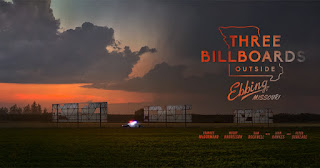
Three Billboards outside of Ebbing, Missouri is a shitty
movie. That isn’t to say that it’s bad. It’s just, well, shitty. It’s shitty to
everyone. Men, women, the disabled, white people, minorities (especially
minorities). The only people it doesn’t throw some an elbow
jab is Jewish people and I have a strange suspicion that’s because the scene is
deleted. It's an ugly film with an ugly heart that manages to float on top of the water, like the pond scum that it is, only because basically everything else in the movie is pretty much top notch.

The performances in the film, from top to bottom, are great.
There’s a lot of great turns from both its main characters and its bit players. Frances McDormand is perfect as a middle-aged and
middle-class mother that seems to have been ground out by life like a glacier
over a rockface. Sam Rockwell also does a pretty solid job doing his irritated
moron routine which, hey, is always a lot of fun. It makes me look at all of
these actors, and all of the talent behind the camera, and wonder why it isn’t
better? Why don’t I care about these assholes? Why the fuck should I?
Oh. I think I just answered my own question.
While it is far from the vaunted and hallowed failure of Ridley Scott et al's The
Counselor, Three Billboards fails to be more than the sum of its parts. It's a great cast and a respectable director with some fine films under his belt. It’s a
letdown of that talent. It’s talent only highlights the movie’s flaws. It’s a
maddening inconsistency and one that, more or less, sums up the real problems
with this movie.
The problem with Three Billboards—rather, one of the
problems, one of them being how it treats non-white people should be readhere—is that it is a movie about forgiveness with nobody worth forgiving. It’s
a movie that wants to wrap up the denoument in people forgiving each other
(never themselves, tough), except that in a very un-Catholic manner, it shoots
right past the general concepts of contrition or redemption. It lands so far
off of the mark that it actually completely forgets about mercy all together.
Even worse, it seems to argue that a lack of mercy is what might actually bring
people together in the end. Mostly, though, it argues that no matter what you
do and no matter how shitty you are, we should kind of let you slide if you’re
well meaning enough. Or something.
Not that every movie about revenge has to have a nice little
button about everyone coming together—we’re talking about the medium in which
Death Wish won’t stop being remade—it’s just
It just makes me wonder what the hell all that was about?
Clocking in at a little under two hours long (not that it
feels like it), Three Billboards, like its title is an overlong journey to
nowhere. While it does have some fun, retrograde humor and it revels in not
being politically correct, none of its spite seems to add up to anything. It’s
a mean movie that doesn’t have anger. It, like its main character, is listless
and misguided and leaves you wondering if this was the best use of everybody’s
time and energy.
My dad liked it, though. So that’s gotta be worth something.
James Kislingbury is a writer, a podcaster, and has never committed a felony. You can donate to his Patreon . You can buy the book he edited here (and on eBay). You can also follow him on Twitter. Also, if you well and truly give a shit hmu on my Paypal. Want to buy me a coffee? Get at my Ko-Fi. Have a happy holiday!
James Kislingbury is a writer, a podcaster, and has never committed a felony. You can donate to his Patreon . You can buy the book he edited here (and on eBay). You can also follow him on Twitter. Also, if you well and truly give a shit hmu on my Paypal. Want to buy me a coffee? Get at my Ko-Fi. Have a happy holiday!
08 December, 2017
I. . . Wait. What?
WHY DOES HER FACE LOOK LIKE THIS
WHAT DID YOU DO TO HER FACE
WHY DID YOU DO THAT TO HER FACE
03 December, 2017
Your Buddy Dahmer
A REVIEW OF MY FRIEND DAHMER (2017)
True crime is having a moment. Online there's Serial and Criminal and My Favorite Murder and White Wine, True Crime, then there's Mindhunter (directed and partially produced by a guy famous for serial killer movie). I talk to ex-girlfriends about murders. I can’t sit down at dinner with my folks without Forensic Files coming on (mind you, this is after Frasier, who is also having a moment). It's only natural that Jeffery Dahmer would finally get his turn in the spotlight.
True crime is having a moment. Online there's Serial and Criminal and My Favorite Murder and White Wine, True Crime, then there's Mindhunter (directed and partially produced by a guy famous for serial killer movie). I talk to ex-girlfriends about murders. I can’t sit down at dinner with my folks without Forensic Files coming on (mind you, this is after Frasier, who is also having a moment). It's only natural that Jeffery Dahmer would finally get his turn in the spotlight.
My Friend Dahmer is an adaptation of the graphic novel of the same name. As a film, it’s a compelling blend of a portrait of a young madman with
a regular horny teen comedy. And while those things sound anathema on paper, as
you watch My Friend Dahmer you realize that these two things are actually
closer fits than you might realize. That they might actually belong together
and that the strangeness doesn’t come from the juxtaposition, but rather from
the fact that nobody ever thought to pair these two things together in such a
straightforward, forthright manner. More than that, the true horror of My
Friend Dahmer isn’t how unusual a serial killer can be, but rather how
perfectly mundane this man can be.
My Friend Dahmer performs an incredibly balancing act. It
manages to make a sicko like Jeffery Dahmer into a sympathetic character
without isolating him from the monster that he will become. You can feel sorry
for the monster without feeling sorry for his monstrosities. It does not so
much ask you to feel a certain way as it makes you aware that there are things in this world that are unknowable. There is never going to be a truly satisfying answer for a man like Jeffery Dahmer. The triumph of My Friend Dahmer is that it turns the annecdotal-- a year in high school-- into a project that is much more meaningful.
My Friend Dahmer is clever in that it never seeks to be clever.
It simply is. Unlike the epic odes to ornate serial killers from David Fincher
or the Millennium Trilogy, My Friend Dahmer is as straight forward and as po’ faced
as can be. That’s too it’s credit. Marc Meyers and his cast and crew take what could very
well be a crass or a cliched piece of entertainment and they made something
unique and interesting that I cannot stop thinking about. It doesn’t hurt that
every performance from top to bottom is pitch perfect. It's this careful combination of light and dark that allow the movie to be a simple story about a screwed up kid in high school, but also a study of Man's darkest urges.
My Friend Dahmer is a movie that is about cruelty by casual
and active, both intentional and unintentional. In places, it's also really funny, and occasionally, it's even a little touching. It’s a movie that doesn’t judge
and doesn’t preach and doesn’t bother to tart up what is already an incredible
story. It simply stands there and shows life as it was. As it should not have
been. Looking at the world, looking at movies now, sometimes you don’t need to
explain everything. Sometimes the world enough is its own explanation.

James Kislingbury is a writer, a host, and a convicted criminal. You can listen to his news podcast. You can listen to his cult movie podcast. You can donate to both podcasts. But, seriously, don't try to blow up Margaret Thatcher, guys.

James Kislingbury is a writer, a host, and a convicted criminal. You can listen to his news podcast. You can listen to his cult movie podcast. You can donate to both podcasts. But, seriously, don't try to blow up Margaret Thatcher, guys.
02 November, 2017
Some Words About That New Jackie Chan Picture
A REVIEW ON THE FOREIGNER (2017)

 Plus, how bad can the IRA be? They tried to blow up Margaret
Thatcher. That's a noble endeavor. It’s arguably Alzheimer’s one saving grace.
Plus, how bad can the IRA be? They tried to blow up Margaret
Thatcher. That's a noble endeavor. It’s arguably Alzheimer’s one saving grace.
This year has been a real whirlwind when it comes to delivering on trailers. On the one hand, there were pleasant surprises like Logan
and It, as well as Blade Runner 2049, a movie that had no right being as excellent as it was considering the expectations behind it. On the other end of the spectrum, there were movies like Atomic Blonde and Alien: Covenant, both of which failed to deliver on my ever-so-finnicky expectations. Unfortunately The Foreigner falls into the latter half. It had a great trailer, a great director (Martin Campbell), and a solid cast. Despite that, the end result is a middling, dull in parts, and, most frustratingly, it does
not deliver on the magic of its premise.

I mean, how do you make a movie about Old
Man Jackie Chan beating the fuck out of the Irish Republican Army? In what world does that fail to be the best movie ever made? Hell, if they handed the script off to another director and called for a do-over, I'd pay to see it all over again.
The Foreigner is most interesting when it hints at the world
of politics and the world of terrorism and law enforcement being a constant struggle
of compromises. It presents the murky world of British governance and old Irish grudges as being two worlds, intertwined. With the IRA it presents a world where difficult ideals are easily undercut by radical purists and where even the finest of beliefs can be undone by expediency. On the other hand, you have the "Brits," who only care about results. And then you have Jackie Chan, who can build bombs. Which is nice. I kind of wish they made the movie about him.
That, ultimately, politics is a business of relationships,
and without an underlying trust and affection, it does not matter what your end goals are.
Nor do your tactics. In the world of The Foreigner, character is destiny. In
all of this, Jackie Chan’s mourning father is the only man of pure purpose and
of pure drive and, as such, he’s the only one who seems to walk out of the
movie unscathed (of course, not literally, mind you). Of course, that’s the
movie’s problem. That Jackie Chan beating up dumb paddies with a step ladder
isn’t the main draw of the film. It's Irish internecine politics. The fact that I, James Kislingbury, do not care about a movie where in the complexities of modern Irish radical nationalism is on display is a problem.
And, frankly, it beggars belief to take the IRA seriously in
any way, shape, or form in the year of our Lord 2017. Maybe it plays better in
the UK and in Ireland, where these stories hit much closer to home. Maybe they
even play better in China or in Asia where the IRA is just a series of letters. But who knows?
The IRA always felt like a safe stand-in for more deadly international
terror groups (and more controversial ones). Don't want to piss off the Palestinians or the Saudis? Throw the IRA in there. The Red Army Faction doesn't exist any more? Throw in the IRA. De Gaulle is out of office? Throw in the IRA. Get Sean Bean on the phone or some poor dead toe-rag from Game of Thrones and call it a casting session. I mean, whose feelings are we going to hurt? Plus, everybody knows who they are. Easy-peasy, lemon squeezy.
 Plus, how bad can the IRA be? They tried to blow up Margaret
Thatcher. That's a noble endeavor. It’s arguably Alzheimer’s one saving grace.
Plus, how bad can the IRA be? They tried to blow up Margaret
Thatcher. That's a noble endeavor. It’s arguably Alzheimer’s one saving grace.
Ultimately, The Foreigner seems to be caught between several
different movies, each of which succeeds where this one fails. You have the staid, idealist Boy Scoutery of Patriot Games and its
IRA villains. You have Campbell’s own Casino Royale, which is a perfect film on
every level. Lastly, you have Old Jackie’s chef character reflected in Clint Eastwood’s
Best Picture winner, Unforgiven. Then, lastly, there’s Edge of Darkness, a
movie so close to Martin Campbell’s heart, that he made it twice, once as a
mini-series in England and another as a feature in America (staring Ray
Winstone and slightly pre-freak-out Mel Gibson). But the problem isn’t
necessarily that this movie isn’t as good as those. The problem is that each of
those movies is great because they succeeded in being unique and being good in
a unique way.
The Foreigner isn’t bad enough to be depressing. If it looks
like anything, it looks like itself. Its broken, grey shape is best reflected
in its titular character, brilliantly played by Jackie Chan, as a broken down,
hobbled old man who had one good thing hidden inside of him. The one difference
is that Jackie Chan and his character actually came through.
James Kislingbury is a writer, a host, and, unfortunately, a protestant. You can listen to his news podcast. You can listen to his cult movie podcast. You can donate to both podcasts. But, seriously, don't try to blow up Margaret Thatcher, guys.
30 October, 2017
03 October, 2017
On Tom Petty
This one hurts. Tom Petty is one of my favorite musicians of
all time. He's right up there with Nick Cave and David Bowie and Johnny Cash and a whole bunch of other people I don't even want to think about right now. Hearing that he’s gone, that there won’t be any new songs or
concerts hurts. That’s it. Done. More than any other artist, it hurts, because
Tom Petty was a part of my life in a way that nobody else ever was. More than
anyone ever will be.
But, I’ll start with a lighter note: The first time I ever
consciously heard Tom Petty was on The Simpsons. You know the episode. Homer’s
waiting for his background check to clear so he can pick up his gun. Whatever
it was about that song, it stuck with me. Eighth grade, I didn’t
There was something about this Tom Petty guy.
The first concert I ever went to was Tom Petty and the
Heartbreakers. I went with my friend and my older sister and it was amazing.
And not amazing because, oh boy, a concert! Because I hate people and I hate
concerts, but it was amazing, because holy shit, Tom Petty and the Heartbreakers
could play.
The real reason I love Tom Petty is that he probably saved
my life.
It could be that I’m overstating that, but Tom Petty and the
Heartbreakers is anchored to one of the worst times in my life. Looking back on
it, I don’t think I was ever in any serious danger of going off of the deep
end. I don’t think I would have killed myself or gotten into drugs or made any
rash decisions and I don’t think I would have lost control of my life in any
serious or irreversible way. But back then I didn’t know that. It was a bad
time.
Tom Petty made that time manageable. It made sense of things
and it managed to make them into four-minute stories about love and loss and
Los Angeles and a lot of other things that I didn't quite get at the time. But Tom did. The Heartbreakers did. It made them real in a way that nobody else had taught me up to
that point. I could deal with that. I could see it. Tom Petty knew what I was going through in a way that I don't know that anyone else did. And I don't mean that I related to his music. I mean that he understood what I was going through. I mean that literally. I don't know how or why or by what means, but I know it's true.
I got over it. I figured things out. I forgave some people.
I forgave myself. I realized what I had done wrong and what I could do better.
And day by day, I got over it. And I realized that it wasn’t so bad and I got
back on my two feet and I moved forward.
Looking back on that time, I can’t imagine it without Tom
Petty. Not “How could I have done it without him?” No. It could never have
happened without him. It’s like looking back on a memory and wondering what it
would be like without oxygen. Maybe Tom Petty didn’t save my life, I don't know. What I do know is that the person that I am now, the guy that got through all of that bullshit and came out the other side does not exist, cannot exist without Tom Petty.
There's a lot of stuff I can exist without. Tom Petty is not one of them.
An even lighter aside: I’ve only ever done two drugs. Weed and
salvia. Weed is fine. Salvia is not. Salvia sucks. It’s like weed, but with a
stronger kick up front and a longer headache out back. It’s bad. There’s a
longer story here, but I’ll cut to the relevant point: Riding out a bad salvia
high, I decided to go to bed early, walking from a friend’s apartment through
rain that may or may not have been imagined and crashed on my bed. Instead of
letting the bad vibes get me, I did the only thing I could think of doing: Listened to Tom Petty.
It’s what I’m going to do right now.
It’s what I was planning on doing anyways.
It’s what I’m still going to be doing in the future.
There’s a quote from RZA that I think of every once and
a while, half as a joke, half as a way to get into a joke, and it goes like this “How can hip-hop be dead if Wu
Tang is forever?”
How can Tom Petty be dead if his music is forever?
14 September, 2017
Gimme Them Movies
Just give 'em to me now. I don't care if Ridley Scott has been burning me one movie after another for the past ten years, I want them, I want them now.
08 June, 2017
This too is The Aesthetic
I JUST WANT TO FEEL NICE THINGS AGAIN HELP ME OUT GENTLE JAPANESE CARTOONS!
02 May, 2017
KONG, VIET KONG
KONG, VIET KONG
Or "I Lost a Lot of Friends in That Ape Movie"


Skull Island is mostly about a giant ape wrecking shit, but it also isn't a coincidence that it is centered around one of the great clusterfucks in American history-- one that we still haven't learned the right lessons from. I mean, look around you. Look at the news. You think we've learned a goddamn thing about dropping bombs on places that we don't understand in the past sixty years?
 It also indicates that we’re officially at the point where
we can just throw giant apes and space people at this tragedy and nobody is
going to cry foul. Kong goes a step further in that it isn’t Vietnam War
imagery, it is literally the Vietnam War (or, you know, a film version of it.
Let’s not split hairs here, Borges). More than that, as rich as the art design
of Rogue One (another film that took cues from 'Nam), it doesn't quite work. There is a dissonance there. Kong: Skull Island succeeds where Rogue One misfires, because Vietnam War imagery and symbolism is succinct, meaningful, and perfectly
applied to the story that it is trying to tell.
It also indicates that we’re officially at the point where
we can just throw giant apes and space people at this tragedy and nobody is
going to cry foul. Kong goes a step further in that it isn’t Vietnam War
imagery, it is literally the Vietnam War (or, you know, a film version of it.
Let’s not split hairs here, Borges). More than that, as rich as the art design
of Rogue One (another film that took cues from 'Nam), it doesn't quite work. There is a dissonance there. Kong: Skull Island succeeds where Rogue One misfires, because Vietnam War imagery and symbolism is succinct, meaningful, and perfectly
applied to the story that it is trying to tell.
Or "I Lost a Lot of Friends in That Ape Movie"

I’ve been thinking about Vietnam lately.
Not that it’s ever far from my mind, but I’ve really been
thinking about it recently. I put my iPod on shuffle and Johnny Cash’s “Drive On” came on and all of the sudden, a well-spring of memories popped back up for
me. I remembered Platoon. I remembered that Ken Burns has a documentary coming out
this year. I remembered the first two years of college where everything seemed to somehow point back to the 1960's (even though most of our heroes from that era seemed hell-bent on escaping their current time frame). And I remembered Kong: Skull Island. And I remembered that
Kong is an opportunity to talk about war, art, and movies. In short, Johnny
Cash reminded me of something that was never far beneath the surface.

It’s been a long while since a Vietnam War movie has been in
the theaters. The last movie I can even remember mentioning Nam by name was No Country
For Old Men and that was only in passing and ten years ago (and even then I might be confusing that with the book). We’re overdue for a
Vietnam War movie. We’re also overdue to talk about the damn thing. I’m glad
Skull Island came along. It’s a reason for me to talk about Nam and it’s also a
reason for Nam to surface in the culture, again.
Jordan Vogt-Robers wears his movie nerd credentials on his sleeves. Mark Kermode mentions it in his review of the film. Hell, Vogt-Roberts says as much in this interview (which I highly recommend that everybody read, because, man, that boy is a nerd). Even a cursory view of the trailer and its Huey choppers choppers silhoutted by the sun summon up memories of Apocalypse Now (or at least its poster). Beyond film allusions (beyond it just being a reboot of a remake of a remake), the film directly quotes from the Vietnam War. Brie Larson's character is an amalgamation of Catherine Leroy and Dickey Chapelle. If Vogt-Roberts is willing to bring Pokemon into the text of his film, then I believe he is also willing to put the work into discussions about the actual war he's making a movie about.
The director chose Nam for a reason. He had something to say. Yes, Skull
Island is a monster movie, but even the loweliest genre film can say something
about our society at large (example: Godzilla, Monsters, every single really
bad and really good zombie movie). It matters because it speaks to our wider
culture, our wider society.
Giant
Monster Movies have always existed to speak to something larger and more important that the existential threat of giant monsters. The original Godzilla spoke to the trauma of nuclear war and the two most recent Godzilla's spoke to environmental disasters and government inaction (or both).
 It also indicates that we’re officially at the point where
we can just throw giant apes and space people at this tragedy and nobody is
going to cry foul. Kong goes a step further in that it isn’t Vietnam War
imagery, it is literally the Vietnam War (or, you know, a film version of it.
Let’s not split hairs here, Borges). More than that, as rich as the art design
of Rogue One (another film that took cues from 'Nam), it doesn't quite work. There is a dissonance there. Kong: Skull Island succeeds where Rogue One misfires, because Vietnam War imagery and symbolism is succinct, meaningful, and perfectly
applied to the story that it is trying to tell.
It also indicates that we’re officially at the point where
we can just throw giant apes and space people at this tragedy and nobody is
going to cry foul. Kong goes a step further in that it isn’t Vietnam War
imagery, it is literally the Vietnam War (or, you know, a film version of it.
Let’s not split hairs here, Borges). More than that, as rich as the art design
of Rogue One (another film that took cues from 'Nam), it doesn't quite work. There is a dissonance there. Kong: Skull Island succeeds where Rogue One misfires, because Vietnam War imagery and symbolism is succinct, meaningful, and perfectly
applied to the story that it is trying to tell.
It’s not only a morally grey war (with a morally grey conclusion),
it means everything. Kong does a good job reminding us of the fact that Vietnam
War comes with a lot of cultural baggage above and beyond the actual war
itself. It literally blares the subtext out of loudspeakers at the audience.* It blares "THIS IS A FILM ABOUT FILMS ABOUT VIETNAM. ALSO IT IS ABOUT VIETNAM. KIND OF A HEADFUCK, ISN'T IT? BUT YOU'RE JUST LISTENING TO BLACK SABBATH, SO FUCK IT."
Vietnam isn’t Vietnam. It’s The Beatles. It’s Bob Dylan. It’s
Richard Nixon. It’s Hunter S. Thompson. It’s MLK. It’s RFK. It’s Indian’s
Rights and Women’s Rights and Jane Fonda posing on an AA gun. It’s John McCain
being captured (and coming back and running for president). It’s Donald Trump dodging the draft. It’s The Wonder Years.
It’s Jimmy Carter forgiving our draft dodgers. It's the Things They Carried. It's the things they carried. It’s my alcoholic uncle that
didn’t see 60 because of what he saw over there. It's forgetting and remembering and rediscovering these things. And it's a metaphor. And it's in our bones whether we know it or not.
Vietnam is a choice and it’s a choice that is reflected in the substance Kong: Skull Island. In that film, as in Vietnam, there are very few actual good
guys. There are bad guys with problems, problems that might be good guys, a bad
guy that becomes a good guy (off screen), and people that have bad things
happen to them. There are also natives that, thankfully, aren’t bizarre
caricatures. Like Vietnam, there are no winners, only survivors.
It’s why seeing Vietnam War imagery in Rogue One struck me as being so dissonant.
Star Wars has always been a tale of black and white morality, with big, clear
lessons to be learned. Good Versus Evil. A fantasy. Vietnam is about nobody being the good
guy. Nobody being the winner. It’s a signifier that is at odds with the
foundations of Star Wars.
Kong has no such baggage. It’s a property that exists in a
genre that was specifically created to serve as a metaphor. It would be more
uncharacteristic to be about how awesome giant monsters are than it would be
for it to be about Vietnam. Metaphors and metatext and all of that jazz are
what these movies were meant to be. They’re the pill wrapped in a piece of
cheese. The message is hidden in the medium, but also the medium is the
message.
I saw a Marx quote from one of my good commie friends on twitter. Marx says:
And by the same token the whole principle of socialism is concerned only with one side, namely the reality of the true existence of man. We also have a concern with the other wise, i.e. with man's theoretical existence, and make his religion and science, etc, into the object of our criticism.
What Marx is saying is that when you look at society, when
you try to work on what it is and how it works, it isn’t enough to just change
the economy or the politics. It’s important to talk about the underlying
factors. In this case, art. More specifically: Monster movies. All of these things are there. It's the movies that help us remember. They're our myths. They're what sparks old memories inside of our heads and helps us remember. Sometimes a giant ape is what it takes for us to talk about something that we haven't ever bothered putting into words.
* With the added bonus of allowing some really good diabetic music to entertain us. Because, I don’t care if it’s cliché at this point, hearing CCR blast out of a Huey gunship is always going to get my heart pumping, and, as Bruce Dern said to me recently, “I’d call that rock n’ roll”).
James Kislingbury is a writer and a podcaster. He does a movie show called "A Quality Interruption." He does a "news" show called "World's a Mess." Both require funding, which you can help out with. He also has a series of stupid tumblrs, which are all linked on the right hand side of this page. So that's fun.
07 April, 2017
SOMEBODY THINK OF THE CHILDREN
SOMEBODY THINK OF THE CHILDREN
 Domu: A Child’s Dream was always one of those books that I
was curious about. Lurking in the back pages of issues of Dark Horse Comics, I
was always struck by the abject creepiness of the thing. It was Japanese. It
was somehow related to Akira (a name I knew, but, at that point, not a film
that I had seen). And it involved
Domu: A Child’s Dream was always one of those books that I
was curious about. Lurking in the back pages of issues of Dark Horse Comics, I
was always struck by the abject creepiness of the thing. It was Japanese. It
was somehow related to Akira (a name I knew, but, at that point, not a film
that I had seen). And it involved
Luckily, after one of my podcasting partners went blind, I managed to fall into a spare copy of Domu. Among other things. It was well worth the wait. I mean, definitely not worth Alex going blind, but here we are. What are you going to do?
Otomo, for lack of a better phrasing, is doing some next level shit. We're thirty years past this comic book coming out and it still looks like something out of a different sub-set of space and time. It’s like hearing violin music your entire life and then
suddenly hearing what an orchestra sounds like. Otomo feels like he’s working
from a different tool set than the rest of humanity. It’s amazing that a human
being—a living human being, no less—can use a pen and pencil to pull off the
things that’s he’s pulling off.
Or, How I Finally Got My Hands on a Copy of Domu: A Child's Dream
 Domu: A Child’s Dream was always one of those books that I
was curious about. Lurking in the back pages of issues of Dark Horse Comics, I
was always struck by the abject creepiness of the thing. It was Japanese. It
was somehow related to Akira (a name I knew, but, at that point, not a film
that I had seen). And it involved
Domu: A Child’s Dream was always one of those books that I
was curious about. Lurking in the back pages of issues of Dark Horse Comics, I
was always struck by the abject creepiness of the thing. It was Japanese. It
was somehow related to Akira (a name I knew, but, at that point, not a film
that I had seen). And it involved Luckily, after one of my podcasting partners went blind, I managed to fall into a spare copy of Domu. Among other things. It was well worth the wait. I mean, definitely not worth Alex going blind, but here we are. What are you going to do?
Written and drawn by Katsuhiro Otomo, Domu tells the story of a series of strange accidents and
suicides at a modern public housing complex in Japan. It bounces around various residents of the housing complex, ranging from a newly arrived little girl to a local latchkey kid and on to the local detectives trying to make sense of this case (and to figure out whether it's really even a case at all). Eventually culminates in a sequence of urban destruction that only Otomo can pull off. Unlike Akira, one of the great epics of the medium, one of Domu's strength lies in its brevity. It's short, bloody, and brutish. And it's a damn good comic.
 |
| Me opening my Twitter feed. |
Usually when people describe comics as being "cinematic" it's because they secretly don't respect the medium*.
Personally, I find it kind of irritating. It’s reductive of
the work itself. It’s a compliment that states that the work isn’t complete
until it is something else (and something completely different). In the case of
Domu, I’m not sure if that’s an insult (especially when you consider that Otomo
has worked in film for the past thirty years).
These aren’t discreet drawings. They are a continuity. There
is a flow from one image to the next without any visible or conscious break. It's a flow that moves beyond the mere aesthetics of Domu. There is a pacing of the panels, and a willingness to intercut between various plot threads that lets gives the impression of movement-- more than that, that the thing has energy. It has a pacing and a heartbeat that, again, I don't know that I've ever seen accomplished on this level. Part of me wonders if there is just something special about Otomo that I love or if Otomo is just working on that high of a level. Either is equally possible.
It
accomplishes what film is supposed to do, which is transport you from your
world into another world using the illusion of movement. With pure
draftsmanship and design, Otomo has managed to do this with six panels to a
page instead of twenty-four frames per second. In all of the important ways,
Domu out cinemas cinema.**
OTHER THOUGHTS:
- Otomo is the best at drawing. He's just. . . Why the fuck does anybody else even bother?
- Man, I haven't seen this many kids killed in a thing since Logan. Not that I'm complaining!
- There is a sparseness to setting up the premise of the story that is almost invisible in how incidental it is. There is no wasted space in this comic. Both artists and writers could learn something from this dude. I know I can. So, again: It's cinematic. It's packing a lot into a little and he makes it look so easy.
- I kind of want to hunt down a bunch of single issues from the original run on Dark Horse. I kind of want to huff those sweet, old comic book pages. I know that makes me a sick person.
- Man. this comic is so goddamn good.

Unfortunately, it looks like Domu is back out of print. The
rights moved from Dark Horse to another company and, now, like a lot of obscure
works, it’s been relegated to the second-hand (and marked up) market. But it’s
so good, damnit. It’s so damn good.
Domu is a compact, succinctly beautiful book that deserves
to sit next to Akira as one of the great (Japanese) comic books of all time. It’s
got beautiful art. It’s got a great story, with wonderful characters. It’s has
horrific ultra-violence. It’s everything you want in a comic book. I mean, you know, if you like good comics.
*And, as it turns out, Domu is being adapted into film. Along with Jordan Peele being in discussion to direct a long-awaited live-action Akira, Otomo has been having a nice little year).
*Though. I'm no hardliner. "Camera angles" makes a lot more sense than "panel angles." Camera, at least, gives off the sense of three-dimensionality. A panel, though? That's a flat picture. Let's not lose our minds in our search for purity.
James Kislingbury is a writer, a podcaster, a newscaster, a
doodler, and a crank. If you are so inclined, you can support his endeavors at
his Patreon. Or at the very least, rate, like, and subscribe to what you can. It's either this or re-dedicating myself to my eBay account.
10 March, 2017
Subscribe to:
Posts (Atom)