Showing posts with label DC Comics. Show all posts

03 April, 2019

Let's All Talk About the Big Movie Thing Part 3,568,432!


That looks like it might be pretty okay? It might even be good?

I have some hopes for this movie-- tepid hopes, tempered by the stark reality that DC seems terminally incapable of making a film that is even mildly worth a damn. I love Joaquin Phoenix and Todd Haynes Soldonz Phillips is actually an inspired choice considering that almost all of his movies are about demi-criminal dirtbags looking for a laugh-- except this time he's not trying to fool us into thinking they're actually funny.

I was going to go on to say something more about the flak that this movie has been catching online and what a big, obvious target it is, but then I remember that I was 19 once and I'm a fucking media studies major. I get it. It's an almost stastical certainty that this movie is going to suck shit and it's a good opportunity for two-thousand people to simultaneously make the comment "Why would I want to watch this when I could watch Taxi Driver/Punch Drunk Love/The King of Comedy?" (as though Scorsese and Anderson don't wear their influences on their sleeves-- also, if you're going to make the that comparison, at least have the decency to bring up You Were Never Really Here, a criminally underrated Taxi Driver-inflected film staring Phoenix from 2018-- so, come on, get it together, snobs.)

And here I am bitching about people bitching, which is kind of what I was hoping to avoid. But I've have a beer in me and I'm not a very good writer, so here we are. Fuck it.

Life is too fucking short. I hope this movie is good. Not because it would be good to see DC get a win or for there to be another "smart" blockbuster movie or to see somebody do a cover-song version of Scorcese, but because a good movie, of any variety, of any caliber is a cool thing. It's good, and it is much more interesting to dissect a good movie than a bad one.

So, while we're all popping off, throwing our scalding takes out into the ether, here's my question: What if they actually get away with it?

01 September, 2014

It's All Over


Things Not Worth Knowing
A review of Unknown Soldier (1997).

I was trying to eat a cheeseburger the other day when my dad, watching the TV, started complaining that Al Jazeera wasn't "Pro-American."

To him, the BBC is offensive enough, but Al Jazeera is a news company that is most definitely in the hands of Islamo-fascists (or "Islamo-Nazis," depending on the mood he is in and the beer he is on). The rest of the burger was eaten in an uncomfortable, one-sided silence as I wondered if he knew where Qatar was.

Nevermind that we were actually watching NHK.

But, as I began to think about, I realized that he had hit on something. Watching a piece of media that you think hates you can really put you off. But it really puts you off when the story isn't any good. By staring into Unknown Soldier, I finally understood my dad's madness. To engage with something and the overriding thought that you have is "I think this book hates me" is a bit distracting.

The story begins with a fine hook: Agent Clyde, an All-American, Boy Scout-type finds a list of mysterious names on his computer. The names all have one thing in common: A covert agent code named "Unknown Soldier," a man who does not, and should not exist. It's at that point that his whole world turns into a carnival of violence that only becomes more bloody and terrible as he gets closer to this legendary secret agent.

It's a story full of tropes, characters, and ideas that Ennis revisits time and time again-- especially in the exceptional Fury: My War Gone By. The difference is that with decades of experience under his belt, My War Gone By, is a story that manages to move quickly through conflicts and through time without ever sacrificing its themes. It's a story that doesn't get lost in its size. With Unknown Soldier, as soon as the premise is laid out, the story takes a nose dive. The last issue closer resembles wreckage than an actual, working story.


The problem is that the book never gets properly started. Clyde is a boring character. Which is fine. Superman is a "boring" character. James Bond is a "boring" character. The problem is that Clyde is a boring character that exists in a boring world. You neither like him nor do you want to follow him into interesting scenarios. It's pointless on both counts.

It is further frustrating (and a bit of a consolation) in that Ennis has written about the same subjects Unknown Soldier concerns it with, but he's done it better. Again, My War Gone By, stars a straight-laced true believer in the American way (and so does Graham Greene's The Quiet American. His CIA agent Pyle is basically the prototype for that archetype). In those cases, the "boring" character works because they're either in a world that is interesting or they exist as a counter-point to warfare's more cynical characters. This book has neither of those things.

When Clyde is confronts the actual Unknown Soldier he's less a character than an emotion with two legs.. He doesn't argue for some kind of sanity. He sits there and takes it and then rants for an entire issue, I guess, the story ends. And it's all wrapped up in this half-baked idea that he fights for America because it's "always right," whatever the hell that means. It's odd, because Ennis has written scenes where a scumbag argues with an idealist before. He has also written tightly plotted and compelling stories, but I guess nobody is perfect.

It makes me pine for better espionage books like Greg Rucka's Queen and Country or better thrillers like Who is Jake Ellis? and Velvet. Hell, it even makes me pine for lesser Ennis war books like the prurient Fury MAX or the nihilistic 303. Or even Dancer.

(But, hey, at least it isn't The Programme.)

Then there is Kilian Plunkett's art. Man. I hate to hammer on this book, any more than I already am, but Plunkett's art in this book is some of the murkiest, low quality work that I've seen in a book in a long while (at least since The Programme).

But the shame of it is that I mean, is that the actual scans and the printing quality is atrocious. The actual line work from Plunkett seems to be fine and so are his layouts, but it's completely compromised by the piss poor workmanship of whoever slapped this book together (or, possibly, whoever assembled it back in 1997). If DC was capable of shame they should find some time to be embarrassed about shabbiness of this book. If a comic is going to suck, at least let it suck as it was intended to.

Again, it's a point of both exasperation and consolation that there are much better espionage books than this poor mini-series. In fact, a better contemporary Unknown Soldier story is the run Joshua Dysart and his crack time of artists created back in 2008*.

The 2008 Vertigo run of Unknown Soldier is a book that, like the 1997 mini-series, has a sense of outrage. It's brutal, it's violent, yet, the difference with Dysart's story is that he doesn't get lost in the anger and the spectacle. Instead of it being driven solely by some poorly thought out emotion, it delivers a story full of action and intrigue. It's also one of a rare few books that I would call "important" without meaning it as an insult. It's a book that has something to say.


And if I could speak as a fan for the moment, my distaste for this book partially comes from the fact that Garth Ennis, of all people, has misread the character of the Unknown Soldier. He's turned him into the cynical, fist of American exceptionalism. It's a concept that doesn't develop into anything.

I might just be a drunk, barely employed loser, but I know the Unknown Soldier and this isn't him. Reading this book is like seeing Sgt. Rock burn a Vietnamese hooch or, I don't know, Superman snap a guy's neck. If you're going to break from tradition, it isn't enough that it's edgy, there has to be a reason. There has to be some kind of a heart. Unknown Soldier has none. Beyond the anger, beyond the pointless violence, it is this lack of meaning that makes Unknown Soldier so offensively ugly.


Or maybe he didn't misread it. Maybe it was all on purpose. And maybe I don't care.

What are we left with? Read a better book, first of all. If you want to read a spy story or a war story, go read  Ennis' War Stories or Battlefields first. Then read Fury: My War Gone By. Then read Punisher Max. Then, if you have time, read Fury: Peacemaker. Or maybe even Adventures in the Rifle Brigade or even. . . anyways. . .

The other thing that we're left with is that as much as it seems that Unknown Soldier was written by an angry poli-sci major with an axe to grind, that is not the real reason you should hate this book. There are plenty of stories where I disagree with the politics, but I enjoy them anyways. A good story should transcend our petty political biases. It should give you something to think about or maybe teach you something. This book doesn't do any of that.

Saying that the Unknown Soldier is anti-American isn't strictly true. It just feels like it is. The reality is much more mundane and depressing. This isn't a book that has a point of view, anti or pro or otherwise. The reason that I hate this book is because it commits the most unforgivable sin of all: It's boring.


James Kislingbury is a writer, podcaster, and a war comics snob. You can follow him on twitter.

FOOTNOTES:
*Here's an interesting piece on the Unknown Soldier and Dysart's run with the character.

03 July, 2013

Social D was Right

I was wrong about The New Frontier. I was wrong and I'm sorry about that. So very, very sorry.


My main problems were that the beginning of the story struck me as dirivative of Watchmen which I think is a fair assumption considering how much of the landscape of comics is dirivative of Moore and Gibbons' work. (Also Cooke wrote and drew a Before Watchmen story and wrote another so, in hindsight, I am not all that far off base. But let's not waste any more calories than we already have). Where it becomes a stupid opinion is that it's much, much more than that, which is something most Watchmen rip-offs do not manage.

There's also a few more nebulous problems like the lack of Batman (and the Trinity in general), the appropriateness of the Centre as a villain (and it's inexplicable and hateful British spelling), and the fact that it's both too sprawling and too small.

Yet, now I feel the flaws less acutely and those few niggling doubts are overcome by the quality of the art and the quality of the storytelling. They're just mars on the piece, they aren't the piece itself. Darwyn Cooke might not be the literary heavy weight that Alan Moore is (which I mention because, rightly or wrongly, he weighs heavily in my outlook on comic books. . . mostly wrongly the more time goes on) or as prolific as a Jason Aaron or as clever as Jonathan Hickman, but he delivers something that none of these men can, which is that he can draw the stories that he writes.

He delivers something that is inherently part of the whole. There is no invisioning, there's no collaboration or compromises, there's just the finished work. Not every comic written and drawn by the same guy have that cohesion, though. Darwyn Cooke is just the guy who can fuse those things together, through style, though design, and through story. As a guy who piddles about with pens and pencils sometimes and has a back catalog full of genre bullshit that is inspiring. It means that someone can do it and do it well.

I think a lot of my esteem for Cooke comes from the work he did after The New Frontier (ie: the work I read after I read The New Frontier). Books like The Spirit and his odd story in Jonah Hex (a Canadian western? Okay. I guess that's not too weird) and especially his work on the Parker graphic novels have opened my eyes to the talented writer and artist that he always was. It wasn't that he got better it was that I was just too full of shit to see what was in front of me. The guy who forged that epic run on The Spirit is the same guy who spun out this wonderful not-quite Elseworlds tale.

Cooke loves good old fashioned fun and The New Frontier is chock full of that feeling-- that feeling that some things were better back then and if they weren't, at least they were simpler, more pure, more black and white. It's nostalgia done well. It doesn't shy away from the ugliness of the past, either. That's just another layer that he uses.

Another thing I find myself saying a lot and writing a lot is that this feels like storytelling judo. Cooke isn't screwing with things or skewering them or anything, instead he's it's using the momentum of nostalgia and the weight of the past to move into something else, bigger, and more impactful. And, again: It's great to see that someone can actually manage that.

I'm know I'm not breaking any news, I just wanted to make a correction. At least to increase the power of my other opinions, I'll say it again: I was wrong about The New Frontier.

That cartoon is still unlistenable, though. You'll bury me with that opinion.

And here's a Social Distortion song--


SIDE NOTE: The New Frontier was also a Las Vegas hotel. Like most of Las Vegas, it is thankfully long gone. What remains, though, are a few precious shards of history. I was going through an auction catalouge on my road trip with my dad and I found, coincidentally, some New Frontier chips for sale. They were estimated to sell for at least a thousand dollars. We are all obviously in the wrong racket.

17 September, 2012

And Overdue Comic Book Thing

for the past month or so I've had almost a dozen books sitting in my peripheral vision every time I jump on the computer. It's long overdue that I actually address the reason they are there: I want to talk about them. I want to write about them. I'd like you to listen to me.

There will be no pictures.

Here are the comic books I've read in the past three months or so are as follows (in more or less chronological order)--

League of Extraordinary Gentlemen: 2009--
This to me felt like a step back in the right direction of the League series (which I will never abreviate as LXG, thank you very much), which seemed to want to meander into minor points about metatext or imagination or whatever and not really deal with the nut meat of what made the first two volumes so grand, which was folks you know (and some folks you don't) all getting together and having an adventure.

Of course my main problem with this is that it revolves around Orlando, a character which I never liked. She/he always felt like an interloper into a story which was about everyone else but her/him. Orlando brings a lot of interesting things to the table, especially when you think of her as this sort of Bond-like cudgel that exists more to get things done and to bring out the interesting things of people around her. I don't know. I guess I just liked the Victorian adventure aspects of Alan Moore's story than did I enjoy the counter-cultural pansexuality bits. One seemed far more in keeping with the work than the other, but that's just me.

So, it's better than 1910, but I'm going to side with 1969 being the best of the bunch if only because it involves a prolonged reference to Performance and for once I think I understood something that no one else did. It also has Harry Potter pissing lightning, so, I don't know, if that doesn't sell you then I don't know what else to say.

Dinopopolus--
This is the most fun and energetic book this side of King City (see several paragraphs from now for my King City review). If I had to describe this book, it is somewhere between She and Adventure Time, which is to say that it relentlessly loves treasure hunting in equal measure to it being English (which to me is basically only calling cookies "biscuits." Weird.). It reminds me of the kind of wonder you used to get by looking at a Legend of Zelda instruction manual. It comes from a place of pure energy and wonder and it's a nice bit of fantasy to counteract the books that I usually read. It is also gorgeous. This dude can draw dinos is what I am saying.

War Stories Vol. 1--
It's not much of a category, but as far as war comic writers go Garth Ennis is the best there is (who else is there? Greg Rucka? Jason Palmiotti, maybe? Jason Aaron? He likes 'Nam, right?). This collection came out a long time ago and its spiritual continuation exists in the Dynamite Comics series Battlefields. I would say that these are a classic group of comic book war stories, but then again it is Garth Ennis, of course it is. My favorite story is "The Reivers", which is about the SAS' involvment with the LRDG during WWII. I won't spoil it, but it has everything a Garth Ennis war story needs: The SAS, metaphysics, hats, and things getting bollocked (bollocksed?) up. In short: A masterpiece.

Baltimore: The Curse Bells--
This whole arc, as beautiful and fun as it could have been fell flat. I don't know what it is. Perhaps it is the fact that this little story wants to be, on one end, a fun little one-off in the classic comic-book sense and on the other end it wants to be a much more involved continuing story. I think. I guess the main problem is that the adventure doesn't quite work as it stands. You've got Madam Blavatsky and the Theosophy movement on the one hand and on the other hand you have the Grand Wizard Hitler and somewhere between that chasm my efforts to care got lost. I think it might have hit its head on something. The point is we haven't seen it since. We assume it dead, but maybe crab monsters might bring it back. Only patience and prayer will see this dark time out.

Parker: The Score--
It's Darwyn Cooke doing his Darwyn Cooke thing. So, yeah, it's pretty stellar, thanks for asking.

BUY IT.

Also, just a thought, but if I said this "Darwyn Cooke is the world's best cover artist that just happened to work in comic books", would you get mad at me?

Guerillas Vol. 2--
If I didn't talk to you about the first volume of this book, I appoligize. For those who don't know what this is, Guerillas is a book about a platoon of AWOL chimps during the Vietnam War and the Nazi scientist who is tasked to catch them. It really is everything I want in a comic book and all wrapped in a wonderfully illustrated package. I really, truly hope that this book makes it to its conclusion, because it deserves it. Comic books about ape soldiers in Vietnam is the exact purpose comic books were created.

Sweet Tooth Vol. 1--
Sweet Tooth, in my mind, is one of the great sleeper books that Vertigo has put out in the past five years. It's a sweet book that manages to take place in an Apocalypse somewhere between The Stand and Huckleberry Finn. As rough as the art may be, the book has a lot of heart. As brutal as this world is and as frequent as the violence may be, it is a book that is generally sweet on the people in it. . .even if terrible things keep on happening to them. It's a less sadistic book than is The Walking Dead and it also has a much more arresting mythology.

So, with that I haven't re-read it, but the fifth volume is coming out soon, so believe me when I say that I've got some homework to do. . . And so do you for that matter.

Fatale Vol. 1--
I can't say that I get this book. It's the same team that made one of my favorite books, Criminal, and yet it doesn't have the same punch, which is odd. As high as the body counts may be and as gruesome as the takes might become it seems to have less impact that Criminal had during its best moments. As the scope widened, the impact lessened. I guess there's something to be learned in all of this.

There are a lot of flashbacks and parallels and unreliable narrators and so forth bouncing around between the covers and yet none of that seems to come to a head in the way that it should. I mean, if you're going to use a frame device-- a horror device going back to Frankenstein-- wouldn't you do something else with it besides use it because it's a horror device dating back to Frankenstein?

It's a better book than The Curse Bells because it didn't leave me quite as flat. I wish it was a much better book than it actually is. . . Oh well, at least the cover is awesome. Oh well. At least we still got Incognito. . . OH SHIT THERE'S A HARDCOVER COLLECTION!?

The Sixth Gun Vol. 2 and Vol. 3--
As we speak I am about to dig into the third volume of this lovely little book. . . Alright. I dug through it. This book is great. While it doesn't have the highs or the hard-end of the first arc, it still has the energy, the artistry, and the overall sense of adventure that it had. It also has manny more mummies and mudman action in the second and third arc than does the first one, so there is that to consider. Mudmen. Mummies. Ghost slaves. A Vincet Price look-alike. . So, yeah, Why aren't you buying this? It's great. The fact that it has lasted this long is nothing short of a miracle. I mean, it's a Western book in the paranormal stylings of a comic book you would use as rolling paper in 1977 and it's going to hit at least 30 issues. That is incredible.

(PS: BUY IT.)

King City-- 
King City is like the cousin of Dinopopolous that got it high after that one family reunion. It's a bit of a trouble-maker and a bit rough around the edges, but there is a clear and important genetic link. It is a madcap and energetic work that deals out sex and references to Sega in equal measure. It is the kind of comic that I am sure we're going to get a lot more of (Scott Pilgrim jumps to mind for many reasons). In terms of storytelling it isn't a perfect book, but I'd like to think that it is the perfect example of what an indie comic book should be.

It is an uncompromised piece of work that indulges itself and goes off in tangents in ways that a mainstream and "commercial" book will not or cannot go. It's a rough, book, too, but that is part of the charm. You can see the evolution in the art and you can see the problem of not having an editor hitting you with a measuring stick every three days reminding you of the fundamentals. King City is too much fun for any of those prickly problems to matter. Even though I realized that half of the crazy ideas in this book are puns what remains is an insane book that has to be read to be believed.

I mean, the book revolves around a twenty-something cat master (that is a man who has a specially trained cat that can become anything through special injections) fighting some kind of evil hell-master and his machinist friend and his ex-GF that is dating a drug addict veteran of the zombie war. THIS IS A BOOK THAT EXISTS AND IT IS MAGICAL.

Also: It was really good weed. King City is not going to push that stank schwag on you, my gentle homies.

Single issues that I have read (in brief)--

The Goon #40 and #41--
I love The Goon. Even with Watchmen and Preacher and League and Sandman, Eric Powell's junkyard magnum opus is what got me back into comics. It's a story with all of the heart and beauty of the soft-focused 1940's with all of the grim horror that you knew was going on just behind the scenes. The Goon is a comic book written by a Jimmy Stewart movie that after a showing went home and beat its wife. While The Goon hasn't quite been what it was (at least in my hazy memory), it is still a great looking book with a fine sense of humor and more than enough knives finding their way into people's ocular sockets to keep me satisfied for another forty-one issues.


The Massive #1--
As a rule Brian Wood's insistance on bringing his reactionary liberal politics into things irks me to no end, this book seems like the Brian Wood other people are always talking about (ie: The one that can write very good comic books).

Personally I thought DMZ was a fine premise and a fun book that devolved into a raving mess, Demo I found to be indie nonsense, and Northlanders was a pretty good, if spotty book*. That is not to say that his work didn't have something in them. I mean, he is clearly not an imbecile, it's just that I got the sense that he wanted to talk more about an issue than he wanted to tell a story. The Massive is interesting because the issue really is the plot. Maybe he's found a way of tricking the Republican part of my reptilian brain. Who knows? All I know is that The Massive is a good book from what I have read.

This is the Brian Wood that made me believe in DMZ and I'm sure it is the Brian Wood that many others see. It is only one issue and maybe it'll go tits up by issue 16 like DMZ, but maybe he can take his bleeding heart off of his sleeve for a moment and get down to making some more awesome comic books (that are also about things of a political nature).

Oh, no, wait, his Conan book is pretty fun so far.

Prophet #27 and #28-- 
I honestly have no idea what the hell this book is about any more and after reading King City I get the impression that this is at least partially the style of Mr. Graham. This sense of confusion and transitory curtain pulls is more Graham's style than it is a disfuction. That is encouraging, but I would really like more from this book. The first arc was great and so were the odd little epic side-stories that we have got since then. That doesn't mean that it couldn't use more of a story (which, to be fair, seems to be what this current arc is about). Even if it doesn't all coalesce, though, what you have in this book is one of the raddest pieces of science fiction I've ever seen in comic books. Good for everyone.

Graveyard of Empires #4--
I have no idea what went wrong with this book. For a zombie book I enjoyed it mightily because it had some well constructed characters, some amazing art and lay-outs, and a real attempt at warming over the zombie genre. This issue has none of that. It is clearly an issue put together over too long of a period of time and was constructed out of a need to finish

It is too cluttered, too unclear, and nonsensical to the point of it resembling a clip show of a graphic novel. I liked this book. I liked its covers and I liked its premise. It's a shame that it so badly undoes all of that with this (presumably) final installment.

Fuck this book makes me angry. It also makes me sad as all get out. This is why I am afraid to write or to draw. I'm sure it's the same for you people. If these people, who do not seem to be fools, can put all of this effort into a work and have it get mangled so poorly what can we do? Can you not see your own future being borne out so poorly? Christ. My comic is even about Afghanistan. Jesus. Is this the world it's going to live in?

Fucking shit.

Just go read Prophet instead, would you? It is apparently under threat of being cancelled. The first trade is out now and available for only ten bucks! What a steal!

SIDE NOTE: Since actually finishing this entry I've read a whole new heap of books. This is a rough game, this graphic novel business.

SIDE SIDE NOTE: I used a British English affectation in this article! Try to figure out which one it is! I'll be waiting anxiously!

*Oh, wait, shit. The Couriers was a vulgar dogshit sack, as well-- not the contents of the bag, I mean. I actually do mean the bag itself was vulgar for its purpose. The Couriers read like someone cast a magic spell on a high schoolers margin doodles during his Econ class. What is worse is that I was recommened that book by someone. . . I'm going to say Wizard. Fuck you, Wizard.

12 June, 2012

De-Programme

I can safely say that The Programme Vol. 1 is one of the legitimately worst comics I've read in a long time. It's a mess from start to finish and while the first issue does set-up an intriguing premise it not only fumbles that idea (being that the Nazis developed superhumans, but instead of deploying them in the war, they fell into the hands of the US and the USSR, developing a secret side-game in the Cold War. In a modern generic Middle Eastern country at war, those weapons have been awakened into a world they cannot understand), it obliterate it in a fever of poor art, poor design, and the most facile political points this side of a high schooler's peechee folder.

It's a poor, poor book and I want to make fun of it. Join me, won't you?

(See this cool cover? It's the last good thing you'll see in the book.)
I recently posted that I liked Prometheus because, despite its flaws, there are some really cool things going on. The Programme is the inverse of that where I hate something even more because of how badly it screw up its potentially cool ideas. I'll try to come up with a smart corollary rule for that.

(And besides a successful version of this story already exists, it's called The Winter Men and it was amazing.)

The dialogue and the general themes of the book have all of the relevance of a Human Shield in the months before the Iraq War. There's nothing wrong with a book being political and there's certainly nothing wrong with the kind of angry liberal politics inside of this book (I'm more of a Mort Zuckerman-man myself, but that's just me). What is a problem is when the politics of a work have all of the energy and poignancy of a bumper sticker on an ugly car.

V for Vendetta managed to be a strident attack against the policies of Margaret Thatcher and a statement on the feelings of the time, but it also managed to be a parable about political power in general and, most importantly, be a well-told story. That's an intensely liberal-minded story. It works and people from all over the political spectrum enjoy it because it is much more than a rebuke of a political philosophy that no one can recall in detail.

This book ended its much too long 12 issue run in 2008, the year Barack Obama was elected as President of the United States. Could you think of anything less relevant than the angry hysteria of the Iraq War protest movement in 2008 (and, also, wasn't Obama going to fix that whole mess)? The Programme seems to be written as a reply to an argument long since paved over in light of the forward movement of reality.

The politics are a kind of whiny, rambling dissidence that was annoying during the Bush years, but now has all of the heft a homeless man arguing with a dumpster. Vague anger and political buzzwords isn't a theme. When a forth of a page is taken up by the panel "THE PRESIDENT OF THE UNITED STATES IS A DANGEROUS PSYCHOPATH" (is there any other kind of psychopath?) apropos of nothing you can't help but conclude that not only is this book without subtlety, it's a book that values making a statement over creating a story.

Plus, we know the US president is a dangerous psychopath, he just fired off a nuclear warhead. Psychopathy is implicit in the act of firing off a nuclear warhead. We don't need to be told that. . . unless of course you were making an important political point! In which case we should all stop and ruminate on the important things you have to say, oh mighty swami!

The plotting is even worse. It reveals things with such little weight or care that it all feels incidental. Flashbacks come and go with no real context and while they do fill in the background of some of the characters they don't seem to actually be relevant to anything that is happening in the present. It'd be like if Dr. Manhattan's flashbacks were all about him attending physics classes in college. Too be fair, though, the flashbacks are the least agonizing thing about the book because at least stories begin and are concluded in them.

It's one of the only books I can think of that has managed to move both too quickly and still manage to drag everything out. Every opportunity for explanation or intrigue is wasted or tossed away in favor of vague references to imperialism or the worker's republic or whatever else. And they aren't concepts or thoughts, they're just words that people say. They're saying them enough times so they must mean something!

The biggest waste of an opportunity is present in the presumed protagonist, Max. Our boy is a superhuman made by the Nazis and programmed by the US government as a protector of truth, justice, and all of that other fun stuff that has no place in a comic this lifeless. As a protagonist he would make the main character in The Stranger blush with his ineffectualness. Bartleby the scrivener would tell him to get his shit together. Besides super strength and speed, his main power seems to be to make me want to throw a clock radio at him.

When he's told that he was a baby made by the Nazis and brainwashed by the military industrial complex by the CIA he takes it with all of the excitement of being given a pastrami sandwich instead of a Reuben. He doesn't seem to want any documentation on his heritage as a Nazi superman and just takes the spooks that show up at his word.

Then he proceeds to do nothing for the entire comic. He escapes from a CIA holding facility, but instead of going on the run like a normal plot would make him, he ends up running. . . right back to the bar where we found him in the first place where he proceeds to do. . . even more nothing. His personal problems are then explained away in one line of dialogue and he goes back to having a non-debate with himself for three issues. Because, again, if people like anything in their stories it is for comflict to present itself, however stupidly, then be instantly swept away with a declarative sentence.

Eventually another superhuman named Senator Joe, who is woken up and convinced that the US government is overrun by commies and pinkos, is sent to retrieve the reluctant superhuman.

But, of course, that character is wasted as well. He goes from being a super-powered Red-baiter to a being a guy who just wears a hat (Max, importantly, does not wear a hat). His change of heart happens off panel and is explained away in the next scene he appears in. So what you have is a super-powered right-wing nut job and a psycho-out-of-time changed into a guy who just kind of hassles Max ineffectually for half of an isse. Good. Great. That's the kind of crack story-telling people come to comics for!

At some point Max has a crisis of character, which is that he's a weapon of mass destruction that hates destroying things. At no point does anyone state the obvious which would be "Then don't fucking blow up anyone, you jackass" or "Good, because blowing up things for fun would make you a fucking asshole and everybody hates assholes." No, the scene is about. .  . I don't even know. There's nothing I can tell you factually that would be more interesting than whatever you imagine the scene is actually about.

Here's the writing prompt: Timothy Lehery and Superman are in a bar. They are talking about brainwashing. Go.

Alright, good work everybody.

Anyways, the scene drags on and, again, nobody states the other incredibly obvious point about how his mind has been messed with, which would be "It's called a conscience, you dingus. You're welcome for not being a soulless monster." Milligan doesn't seem to understand the difference between a revelation and a premise.

Then again having any motivation at all in our heroes puts the villains into sharp relief since they have all of the depth of a henchman in a Die Hard fanfic. They're Soviets! And they're evil! And they're attacking a faceless composite of Middle Eastern nations! And these Soviet guys are. . . doing bad stuff! Why? Because they are going to destroy American imperialism! Why? Because they're good Soviets and good Soviets murder Americans! Apparently!

There's no motivation, there's no plot, there's just a vague set-up that never really goes anywhere. They're plot is cardboard thin. They keep on referencing Joseph Stalin, but thinking on that mass murderer I can't help but feel he was a far more rational actor than these group of weirdos. If you made them Nazis or Christian fundamentalists or Martians or irrate mathematicians literally nothing would change in their motivations or actions.

Strangely the first Soviet super villain introduced seems to be intensely concerned with killing American soldiers, but doesn't even seem to be aware of the concept of there being people living in the country they're invading. Milligan doesn't seem to be either. He seems to want to bristle at the hubris of the American empire invading a country, but doesn't seem to be interested at all in the people they are presumably conquering and killing. He also seems perfectly fine in lumping the entire Middle East together into one big ball and calling it "Talibanistan." Real progressive work you're doing there, buddy.

Questions are all I have for this book. Angry questions. Is this an important moment? Is this a side character? Why is this happening? Who the hell is that? Do I give a shit? Questions like this pop into my mind at such frequency that I have to wonder whether Mr. Milligan ever asked "What the hell am I doing here?" It would have been a more constructive question to ask instead of what exactly we're doing in Iraq. At the very least there'd be an answer and my pain would end.


Then there's the art.It's a hideous neon-soaked nightmare that is so garish and blown-out that it would make Andy Warhol vomit in rage.There is really nothing redeemable about it. At its best it's merely competent. It is on a page, it is of people, and the word balloons correspond to those.

The coloring is an obnoxious mess. It reminds me of how Jae Lee's artwork is handled, which is it is very flat with maybe a few textures thrown in, but overall the colorist (Richard Isanove, especially) let's Lee's sparse line work and heavy shadows do the heavy lifting. Jae Lee (and Richard Isanove who seems to work with Lee most often) are talented artists though and CP Smith and Johnny Rench don't seem to know what a comic book is or even how to draw.

The color palette is a clear stylistic choice, which is fine. Had it worked it would have been a bold and striking style for the comic. Unfortunately the coloring seems to be barely competent, more reminiscent of something out of the late 90's when people started figuring out this art on computers business. The texture work is quite transparently just a texture out of Photoshop and the actual artwork itself is so reliant on tracing photos that its hard to tell when the shitty coloring stops and where the crappy drawings begin.

Most egregiously there are some pages that are digitized and chopped up to the point of actually being pixelated. I'm reading a comic book made in 2008 and I am looking at textures that seem to have fallen out of Kid Pix. It makes me ask another question which is whether somebody intended for it to look this lackluster or if this was a plan all along?

It's all made worst with a sickeningly dull layout. Every page seems to consists entirely of "Digitally traced people covered in too much shadow making weird faces at each other.While those silly faces aren't crammed with too many word balloons or caption boxes, the story's glacial pace makes me think that even the meager potential of these panels is being wasted on a poorly paced story.

The book is filled cover to cover with pictures of people standing with the odd addition of somebody maybe flying. The backgrounds are few and far between and what we do get, like the people in the comic, are clearly just photos of ugly places made uglier with Photoshop filters. Brian Lee O'Malley made it work. This CP Smith is no Brian Lee O'Malley.

You look at the artwork of Tony Harris and you realize that tracing and heavy photo referencing can be done and done to great effect. I'm fairly certain even Darick Robertson used photo references for characters in Transmetropolitan and that book looks amazing. So, in both the case of the flat, digital coloring and the tracing there are excellent examples of that work.

(To be fair, though, this Wolverine cover by CP Smith is pretty killer. I also seem to vaguely remember the issue being competently drawn.)

Fuck this book. If I wanted to read a half-assed and hideous version of Watchmen I'd vomit into my Absolute edition and shut it. This is a book without redeeming qualities. I let you know this because not only is it great fun to inflict retribution on this book, but it also presents a pause for us to reflect upon how great some of the comic books in our lives are. While not every superhero book is All-Star Superman or Powers at least there are also very few books like The Programme.

(Alright. That's enough of that. I promise to write about something good in the future)

10 June, 2012

Let's Mutate Comic Books!

As much as it's nice to commercialize comic books (as, let's face the facts, they normally aren't),there is something obnoxious about some studio exec looking down a list and saying "Let's go adapt that" or, more and more likely as time goes on "Let's reboot that."

If you heard that Battleship was being turned into a movie ten years ago would you have done anything but laugh? At least it flopped, proving that while America is stupid enough to keep watching Pirates movies, at least they aren't going to fall for a movie adapted from a boring board game.

There's a line and I don't know who said it (so sorry, dude), which is that movies are no longer allowed to be good, they have to be awesome. Adapting comic books has a lot to do with this idea because most comic books are awesome. They're basically budget free blockbusters. They're stories where you can burn down Europe, go to space, have the devil fight an alien, and enlist a cast of thousands without any larger of a budget than a kitchen sink film. In a way they're basically free screenplay idea and, while I don't want to get into the pitfalls of that whole end of movies, it's something to consider. I don't want to be accused of just hyping comic books to be turned into movies because, as artifacts on their own, they do not have to be anything else than good stories. Comic books are great as comic books. They are not always good as films.

But, who the hell wants to fantasize about things that should not be? Let's leave that to the religious fanatics, shall we?

So, what should be made before we get our unwanted Defenders movie, here is what I would like to see if I have to see it--

100 Bullets


It's hard to think of a crime book that's as byzantine or involved as 100 Bullets and while cramming it all down into a two hour (or God-forbid three hour) film would almost certainly be a disaster there is something to be said about seeing the b-movie schlock premise of the book, which is that a man in a suit named Graves shows up with a gun with one-hundred untracable bullets and tells you that you to go wild, turned into an adventure on the big screen. The world is full of great characters and dialogue as well and while film is full of noir crime stories it would be fun to see old man Graves encouraging a righteous killing spree or two.

It's a smart enough B-movie premise to get people in the doors and with the right actors and behind-the-camera talent it could be a pretty successful film (then again, you could say that about most movies, couldn't you?). Just throw Bruce Willis at it. He's great at this sort of thing. He doesn't even need to try any more, either.

Ideal Directors: David Fincher, Nicholas Wending Refn, Michael Mann.

Elevator Pitch: It's the ultimate crime caper mixed with the ulimate vengeance tale. It's smart, it's funny, it's got sharp dialogue, and, better yet, none of that matters because all of the bad people die in terrible ways. It's everything a crime movie should be and what's that? Oh, yeah, sequels. Franchise.

(Apparently David Goyer might have beat me to the punch on this one. Or not, you know how these things work.) 

The Damned


The Damned is one of the most refreshing books I've read in a long time.What sounds like a terrible idea in the abstract (in an alternate or after-life version of the 1920's the cities crime syndicates are all run by demons and curses are as deadly and as real as tommy gun bullets), but the idea comes to life because of the sharp dialogue and twisting plotting of Cullen Bunn and the sharp and expressive artwork of Brian Hurtt. It's everything a hard-boiled comic book should be with that little bit extra that should keep it from blending in with the rest of the uninspired genre dreck that plagues our shelves (though comic book noir, I feel, doesn't really fit on that list, does it?).

It's a wonderful comic book. It's funny, it's gory, it's creepy, and it's an original idea that executes as well as you could ever hope.

There's also a second volume of The Damned, but my shop is always sold out of it. I guess I could have them order it in for me. . . Hmmm.


Ideal Directors: Guillermo Del Toro, Rupert Wyatt, Tim Burton.

Elevator Pitch: Monster meet mobsters.

Desolation Jones


Desolation Jones is what happens when you film a remake of The Long Goodbye if the cast of characters consisted entirely of citizens of the Island of Misfit Superspies. . . which is literally what the book is. In Warren Ellis and JH Williams III's arc we're introduced to insomniac ex-spy Jones (the sole survivor of the mad science project) who is exiled to Los Angeles, which acts as an Elba Island for unusual spooks such as himself. From there Jones is hired by a retired (and probably insane) army officer to recover his private stash of porn staring Adolf Hitler. From there it gets weird.

It was a great book when I read it the first time and it was great when I read it again recently. Besides the wonderful art and layouts of Williams, Ellis has managed to create a world of spies and intrigue that doesn't feel at all rehashed or cornball. The world has a ton of potential and, unfortunately, this one trade is all we're ever going to have.The second arc was never completed, so, if there is any chance at a continuation it'd be on film. While most of the titles here I would rather see instead of Avengers 3 or Superman: King of All Monsters, in this case I'd like to see it simply to keep this weird little fucker of a story alive.

Read it if you can, because apparently no one else did (Hey, I detect another theme in this article!)

Ideal Directors: Joe Carnahan, Steven Soderburgh, Ken Loach.

Elevator Pitch: It's the Maltese Falcon if it cut open and wore the skin of In Like Flynn. It's the kind of movie Red grew up watching and decided to become a spy because of. Also: Stolen Hitler porn. Let's pull this trigger, shall we?

Hellblazer


As much as I loath relaunches and the very idea of a reboot Hellblazer is a book that deserves proper treatment in the eyes of the public.Whether you know it or not Hellblazer is one of the longest running books on the market which is incredible when you consider that it's about a Cockney wizard in modern times. He's one of the great icons of comic book history and considering that even Swamp Thing got a movie it does feel a bit odd that old Johnny Boy has been left out in the cold (then again so has most of DC's TV and film projects).

Of course Hellblazer was already adapted in what amounts to a not very good movie.What movie was that? Constantine, which, while not terrible didn't set the world on fire.

First of all they can't even pronounce the character's name right (even though how "Constantine" is supposed to be pronounced is stupid. . . ).

Secondly making John Constantine an American is incredibly bizarre. It isn't as though Americans won't watch a piece of media if it has English accents. Stupid people think that. Studio executives think that. As a result we're expected to believe that, but it simply isn't true. Guy Ritchie made his career selling accented shlock to the American people and Harry Potter is the highest grossing franchise of all time. People are ready for white folk with accents. To remove that is absurd at best and immensely and impenetrably retarded at worst.

He's Cockney. He speaks in that language and he's a part of that world. As bad as mid 2000's Guy Richie is he would have been much more at home than the guy they got. Toss in Eddie Marsan and Ray Winstone and you might have yourself an actual picture. Or at least the color of one. Making Constantine American is like making Sherlock Holmes into an American. Or Colonel Blimp for that matter. It might not be a terrible idea, though the odds are: It is probably a terrible idea. The reboot would need John Constantine to be American. Like he is fuckin' supposed to be.

Lastly Neil Gaiman was right: The movie would have been better if he had a tan trench coat. Nobody knows why, it just would have been better.

And, let me play the Internet's Advocate briefly and air out the idea that Benedict Cumberbatch play the titular detective. Hey, it worked before!

Ideal Directors: Matthew Vaughn, David Yates, Alejandro Jodorowsky.

Elevator Pitch: If Humphrey Bogart went to Hell and had an accent, he'd be the Hellblazer. Now give him all your money, would you? There's no better property in the DC canon to reboot than this bad boy.

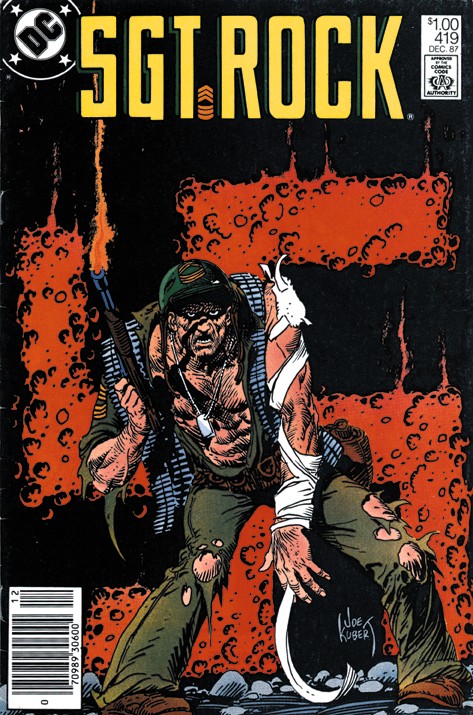
Sgt. Rock

For whatever reason DC relaunched this book during its "New 52" and decided that there was a market for garbage.

It also added superhero elements to the book, which isn't inherently a terrible idea (Punisher used to and still does fight superhumans and that seems to work just fine), but my thought is: If you're going to relaunch a character and have him fight supervillains why would you choose Sgt. Rock? A character famous for fighting in WWII exclusively? And don't we have Stormwatch for that? Also the book was called Men of War. I mean, did they even try?

After the failure of Men of War (just hire Garth Ennis, will you? Or Greg Rucka? Or Chuck Dixon? What's wrong with you idiots?) they started up GI Combat, which is the most comic booky of comic book ideas: soldiers fighting dinosaurs. Only Darwyn Cooke has ever made a worth a damn story about dinosaurs fighting GIs and that only lasted about a dozen pages. It's a terrible idea. There's nothing wrong with straight WWII stories. There's never been anything wrong with that. If you have to change the premise of something good either you have a brilliant concept or you're an idiot who doesn't know a good thing when he sees it. You can only round the wheel so much and that's Sgt. Rock if there ever was an idea.

It's simple, clean, Nazi killing fun. While that's not a great pitch to anyone outside of myself-- fuck you, this is my blog, damnit!

Ideal Directors: John Woo. No other names. Just John Woo.

Elevator Pitch: Quentin Tarantino proved that people still love a good WWII yarn and there's a million different ways to tell them. In short: Sgt. Rock kills Nazis. Let's let him. Also, fuck all of the DC 52 military relaunches. The fuck are they doing over there?

The Winter Men


The Winter Men is one of my favorite comic books of all time. Every aspect (but its tragic release schedule, which I'll get to in a bit here) is nailed perfectly by the writing and by the art.

The Winter Men takes place in a world where super heroes and super science once ran rampant, but has since fallen to the wayside, forgotten and abandoned like so many once mighty creations of the Soviet world. The main story isn't so much about those great colossi as they exist to set up the background of the world. They were then, the corruption and intrigue of post-Soviet Russia is now. From the accents to the background artwork The Winter Men feels like an incredibly well thought out and fleshed out world that we're only getting to see a sliver of one panel at a time.

Then there's John Paul Leon's artwork-- which I realize would not make it to the big screen-- which works excellently with the writing. He gives it just enough detail to flesh out this world and to feed back into teh realism of it and yet he can also draw robotic supermen and atomic children without it feeling silly. It's not so much of a strange book, it's a unique one. It's exactly the kind of weird jewel that I follow comic books for.

Maybe, at least it'll get people to buy more of these books. And if the creators get a nice piece of the pie, well, that'd be dandy. Overall, though-- and this is the fan in me speaking-- is that a movie could conceivably deliver a final and finished ending to a story that truly deserves it.

Ideal Directors: Duncan Jones, Martin Campbell,Werner Herzog.

Elevator Pitch: Fuck you, this book is a wonder. Give me the money I need to make glory. Fuck all the bodies who will not wish this so!

Honorable Mentions:
Bone
The One Trick Rip-Off
Onwards Towards Our Glorious Deaths
The Other Side
Queen and Country
Scalped
The Sixth Gun

Alright. That's enough of that. I'm going to go watch Prometheus now and then wonder later unironically why nobody seems to do anything original any more.

16 February, 2012

I'm Afraid of American Vampires


If you like comic books of a pleasing nature then you should already be buying American Vampire. I mean, if you're not, what are you, some sort of an idiot? It's got everything: Compelling characters, gross amounts of elaborate gore, cowboys, Stephen King, a loving rendition of recent American history, and wonderful art. Just because I liberated my first hardback from Borders when they were closing doesn't mean you

With all of that said, I just bought the third trade paperback. My local comic book store didn't have the second one in stock and not only did I not feel like waiting to buy them in order, the third volume is about Nazi vampires and Japanese vampire bio-organic weapons.

It's a great book, all told. There is a certain amount of spit in my eye, though, and I keep coming back to it. It is plaguing me.

I've found two glaring historical inaccuracies in the book. Naturally, they were about booze and guns.

INACCURATE FACT NUMBER ONE--
The mai tai is mentioned in the first arc. The mai tai was not invented officially (or named the "mai tai") until the 1950's when tiki themed bars were as common as people with jobs and crippling diet pill addiction.

INACCURATE FACT NUMBER TWO--
2) One fellow is clearly using a Colt Python. While one of the coolest and most iconic handguns ever to exist, the Colt Python was not minted until, again, the mid-1950's, when handguns were as common as people with jobs and airplane pilots' mistresses.

Also, the book is about vampires and everybody knows the last vampires were killed by the Vatican's secret army in the mid 17th-century and those who were no vanquished fled to Outer Thule to bide their time and dream of the day when man would fear them once again.

Maybe the aesthetic he was going for was one slightly ahead of the times. Lord knows that's a common thing to do, especially in books that are as steeped in science fiction and fantasy as a book about the legacy of fucking vampires in the goddamn United States. Metal Gear Solid 3 had its hover chairs, so why not let American V-pire (as we all call it down at the comic mine) have its anachronistic booze and Dirty Harry guns?

Oh, also a helicopter appears in the book to save the day, but I'll let that one go, because what kind of a nerd gives a good goddamn about the history of helicopters?

And, now to consecrate my love of this book, of blood suckers, and of David Bowie references apropos of nothing, here is the opening of The Hunger-- which is perhaps the bluest movie of the time.